

AI in ESG reporting now handles the grunt work: pulling data from PDFs, supplier questionnaires, and IoT feeds, flagging anomalies before they reach a disclosure, and drafting narrative sections in minutes rather than weeks. The catch is that none of that output is audit-ready until a human validates it and every claim traces back to a source document. Reporting teams that succeed treat AI as an accelerant for a specific, narrow pilot, not a wholesale replacement for judgment.
TL;DR:
- AI improves data ingestion, validation, and narrative drafting in ESG reporting, but outputs require human validation to ensure accuracy and source traceability.
- Robust data foundations, including centralized data systems and provenance tracking, are essential for reliable AI-driven ESG reports.
- Governance controls like human sign-offs, traceability, bias checks, and standards mapping are critical for audit-ready AI outputs.
- AI model weaknesses such as error amplification, regional data gaps, and loss of nuance need ongoing manual review and validation.
- Successful AI adoption relies on phased implementation, team training aligned with standards, and accreditation to build trust and compliance.
Table of Contents
- What Can AI in ESG Reporting Actually Do Today?
- Why Data Foundations Determine Whether AI Outputs Are Reliable
- How Do You Keep AI Outputs Audit-Ready?
- Where AI in ESG Reporting Breaks Down
- What Does a Practical AI Adoption Roadmap Look Like?
- Building Team Capability for AI-Assisted Reporting
- Speed Without Governance Is Just a Faster Way to Be Wrong
- Turn AI Readiness Into a Recognized Credential
- Sources
What Can AI in ESG Reporting Actually Do Today?
The Thomson Reuters State of Corporate ESG Report found that a substantial majority of respondents expect AI to have a high or transformational impact on their work within five years. That optimism is grounded in a handful of tasks where machine learning for ESG metrics already outperforms manual work.
The clearest wins cluster around four areas:
- Data ingestion. AI reads PDFs, spreadsheets, supplier questionnaires, and even satellite or IoT sensor feeds, converting unstructured inputs into structured fields without a data-entry team retyping everything.
- Validation and anomaly detection. Instead of a controller manually reconciling every emissions figure against last year's number, models flag outliers and inconsistent units automatically, cutting the reconciliation workload.
- Narrative drafting. Generative AI for ESG produces first-draft language for materiality statements, climate risk sections, and CDP or ESRS-aligned narratives, which a human then edits and verifies against evidence.
- Predictive analytics. Machine learning models rank suppliers or facilities by climate or compliance risk, helping teams decide where to spend limited assurance hours.
The most useful entry point for most teams is supplier data collection. GenAI-enabled tools can compress supply-chain data gathering that once took many months into a fraction of that time, especially when paired with a structured supply-chain mapping approach. Start there. It is contained, measurable, and directly tied to a pain point every reporting team already feels every reporting cycle.
Why Data Foundations Determine Whether AI Outputs Are Reliable
AI performs only as well as the data feeding it. A model drafting a Scope 3 narrative from fragmented spreadsheets, mismatched units, and undated supplier files will produce a confident, well-written, and wrong answer. Academic work on AI adoption in reporting practice points to integrated information systems as the real bottleneck, more so than the sophistication of the model itself.
Before any AI tool touches your disclosures, complete these steps:
- Centralize your data. Build a sustainability data layer or data lake with canonical identifiers so a "facility," a "supplier," or a "site" means the same thing across every source system.
- Map structured and unstructured inputs. Normalize units (tonnes vs. kilograms), timestamps, and reporting boundaries before anything reaches a model.
- Capture provenance. Every data point needs metadata tracking its original document, extraction date, and method, so an AI-generated claim can be traced backward.
- Choose an integration pattern. ETL pipelines, APIs, or cloud data warehouses each solve different problems; Google Cloud's sustainability AI playbook recommends starting with a data lake and a narrow pilot rather than a full platform migration.
- Set access controls. Define who can edit source data versus who can only query it, since audit trails break the moment edit permissions are unclear.
The common blocker isn't the AI. It's fragmented legacy systems and missing identifiers that prevent a model from knowing that "Plant 14" and "Manufacturing Site Ohio" are the same place.
Pro Tip: Run a one-week data inventory before you evaluate any AI vendor. Teams that skip this step usually discover, mid-pilot, that half their supplier data has no consistent ID, which stalls the project by months.
How Do You Keep AI Outputs Audit-Ready?
Governance is where most AI-in-ESG projects succeed or quietly fail. Auditors and assurance providers don't grade AI on how impressive its output sounds. They grade it on whether every assertion can be traced to a source, verified, and reproduced.
Four controls matter most:
- Human-in-the-loop sign-off. Assign a named reviewer for every AI-drafted section, with clear authority to reject or revise before anything goes into a disclosure.
- Traceability. Link every AI-generated claim back to its source document, and log the model version and prompt template used to produce it. Practitioners increasingly treat this as non-negotiable for auditability, since a black-box output with no paper trail is functionally unusable in assurance.
- Validation and reproducibility testing. Run bias checks and confirm the same prompt produces consistent results across similar inputs.
- Standards mapping. Tie every AI-assisted disclosure element to its corresponding requirement under CSRD, GRI, or ISSB/IFRS S1–S2, and retain the evidence trail.
With 77% of practitioners expecting AI to reshape their work within five years, the Thomson Reuters research suggests governance frameworks need to mature just as fast as the tools themselves. Document AI use directly in your disclosures and maintain a change log. Auditors will ask.
Where AI in ESG Reporting Breaks Down
AI amplifies whatever you feed it, including mistakes. A single faulty supplier record, multiplied across a model trained to generalize, can quietly distort emissions estimates across an entire portfolio. The World Economic Forum warns that AI can amplify errors unless paired with rigorous human judgment and validation at every stage.
Three failure modes recur most often:
- Error amplification. Generative models hallucinate plausible-sounding figures or citations when source data is thin, and a confident tone can mask a fabricated number.
- Bias and regional data gaps. Systematic reviews of AI-enhanced ESG models consistently flag interpretability problems and uneven data coverage, particularly for regions with less digitized supply chains.
- Lost nuance. Over-automating narrative sections can flatten the stakeholder dialogue and contextual judgment that make an ESG report credible rather than mechanical.
Mitigation isn't complicated, but it requires discipline: sample AI outputs for manual review, build validation rules that catch outliers before they reach a draft, run bias tests across different supplier regions, and document every override a human reviewer makes. AI should never be the final decision maker on a materiality judgment, a controversial disclosure, or any claim with legal exposure. Those decisions stay with people who can be held accountable.
What Does a Practical AI Adoption Roadmap Look Like?
Teams that scale AI in ESG reporting successfully move through four stages, and skipping one usually means redoing work later.
- Prepare. Complete the data foundation work: centralize data, assign ownership, define your standards mapping.
- Pilot. Choose one narrow use case, such as supplier questionnaire drafting or CDP response generation, and set measurable KPIs: hours saved, error rate reduction, percentage of fields completed without manual rework.
- Operationalize. Formalize the human-in-the-loop workflow, document prompt templates and model versions, and integrate the tool into the standard reporting calendar.
- Scale. Extend the validated workflow to additional disclosure sections or business units, using the pilot's metrics as your benchmark.
A maturity-style diagnostic, checking data quality, model transparency, and governance strength, helps teams prioritize where to invest first rather than buying an enterprise platform before the data foundation can support it.
Pro Tip: Narrow the first pilot to a single disclosure or a single supplier cohort. Google Cloud's experience with sustainability AI deployments shows that scope discipline, not model sophistication, is what makes early results reproducible enough to trust.
Quick wins matter for buy-in. A successful supplier-mapping pilot that saves forty hours in one quarter does more to win over a skeptical CFO than any theoretical efficiency argument.
Building Team Capability for AI-Assisted Reporting
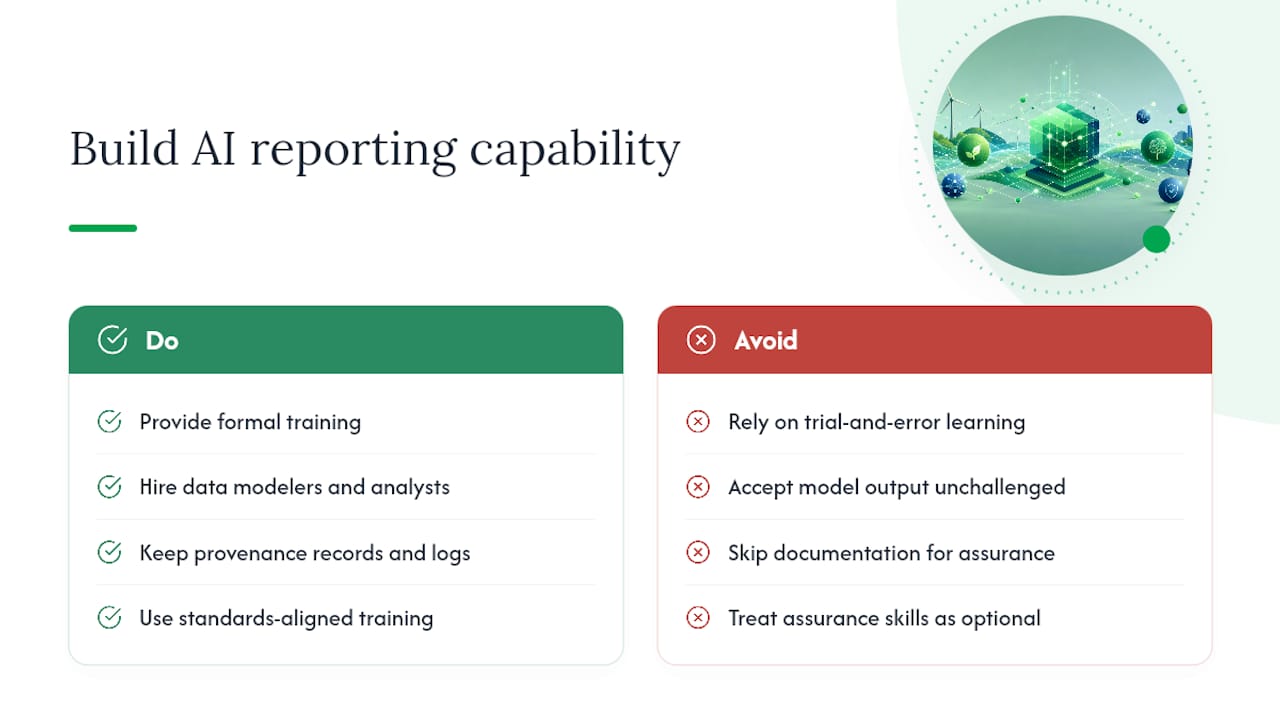
The skills gap, not the technology gap, is what slows most AI adoption. Reporting teams need data modelers who can build canonical data structures, sustainability analysts who understand what a plausible emissions figure looks like, and AI-literate auditors who can question a model's output rather than accept it at face value.
Formal training closes that gap faster than on-the-job trial and error. Assurance readiness depends on documentation discipline: provenance records, control descriptions, and sample testing logs that a third-party assurance provider can review without needing to interrogate the model itself. Building the specific skill set assurance work now demands is becoming a baseline expectation rather than a differentiator. Standards-aligned training gives reporting leads a shared vocabulary with auditors, regulators, and professionals applying these methods across significant ESG assets under management globally.
Speed Without Governance Is Just a Faster Way to Be Wrong
The instinct to chase full automation is understandable and misguided. Every pilot that has gone sideways in ESG reporting shares the same root cause: a team skipped the boring governance work to get to the impressive demo faster. The lesson isn't that AI is unreliable. It's that AI reliability is a governance outcome, not a model feature.
Invest in documentation and people before you invest in scale. A well-trained analyst who can catch a hallucinated emissions figure is worth more than a marginally faster model. Teams that treat training as a cost center rather than the foundation of assurance readiness tend to relearn this lesson the hard way, usually during their first external audit.
If you're building this capability on your team, hands-on, standards-aligned training is the fastest way to get there without learning through a failed assurance cycle.
— Ransford
Turn AI Readiness Into a Recognized Credential
Reading about audit-ready AI governance is one step. Proving your team can execute it is another, and that's where accredited training closes the gap the fastest. An institute offering standards-aligned certification programs addresses the maturity checklist this article just walked through, including data foundations, traceability, human-in-the-loop validation, and standards mapping to CSRD, GRI, and ISSB/IFRS S1–S2.
Rather than piecing together governance practices from scattered vendor blog posts, a focused course maps each stage of AI adoption directly to assurance-ready competence, the kind auditors and regulators already recognize. Explore the accredited certification pathways built for sustainability leads, risk officers, and assurance practitioners, or visit Esgtraininginstitute to find the program that matches where your team sits on the maturity curve today.
Sources
- Thomson Reuters — State of Corporate ESG Report 2024
- How GenAI is transforming ESG reporting and compliance — Thomson Reuters (blog)
- World Economic Forum — Harnessing AI for sustainability reporting: a path forward
- AI-driven sustainable finance: computational tools, ESG metrics, and global implementation — Future Business Journal (Springer)