
A compliant biodiversity report documents material impacts, dependencies, targets, and actions against recognized standards, primarily the GRI Topic Standard and ESRS E4, while satisfying any national duties tied to the Kunming-Montreal Global Biodiversity Framework. Your first move is not data collection. It's a scoped materiality assessment.
The minimum report needs six components: a non-technical summary, a baseline assessment, an impact and dependency analysis, a mitigation plan (often called an Environmental Monitoring and Management Plan, or EMMP), measurable targets, and a monitoring and assurance section.
- Non-technical summary for non-specialist readers and boards
- Baseline studies covering habitat and target species
- Impact assessment tied to material sites and activities
- Mitigation measures and an EMMP
- Targets with measurable indicators
- Monitoring and assurance statement
Pro Tip: Don't try to measure everything at once. A materiality-led scope, built using the LEAP approach, gets you to a defensible first report faster than an exhaustive site-by-site survey ever will.
State which standards you followed and whether the report carries third-party assurance. Those two disclosures are what auditors and investors check first.
Key Takeaways
A compliant biodiversity report combines standards-aligned disclosure, materiality-led scoping through LEAP, and credible data collection matched to assurance expectations.
| Point | Details |
|---|---|
| Start with materiality | Run a LEAP assessment before committing budget to surveys or data collection. |
| Follow layered standards | Pair ESRS E4 for EU disclosure, GRI for general reporting, and TNFD for financial risk framing. |
| Match data method to site risk | Use desk screening broadly and primary surveys or eDNA only at material sites. |
| Plan for assurance early | Document methods, geolocation, and chain-of-custody before auditors ask for them. |
| Build internal capability | Esgtraininginstitute's accreditation programs train teams to scope, disclose, and defend biodiversity reports. |
Table of Contents
- Who Must Publish a Biodiversity Report and What Scope to Set
- Which Standards and Frameworks Should You Follow?
- What Should a Biodiversity Report Include? Recommended Structure
- What Metrics and Data Collection Methods Actually Work?
- What Level of Assurance Do Biodiversity Reports Need?
- How Do You Prioritize What to Report On?
- A One-Page Checklist for Your Biodiversity Report Brief
- Build the In-House Capability to Deliver This Reporting Yourself
- Frequently Asked Questions
- Sources
Who Must Publish a Biodiversity Report and What Scope to Set
Applicability depends on your organization type. Public bodies often face statutory biodiversity duties requiring documented actions, as outlined in government reporting guidance for entities with legal conservation obligations. Companies in scope of the EU's Corporate Sustainability Reporting Directive face mandatory disclosure under ESRS E4. Development projects near sensitive habitats typically trigger project-level Biodiversity Impact Assessment requirements regardless of company size.
Scoping decisions to record before you start:
- Geographic boundaries and site-level geolocation for every material location
- Upstream and downstream value-chain inclusion (or explicit exclusion, with reasoning)
- Time frame and baseline year against which future progress gets measured
- Legal or regulatory triggers that put you in scope in the first place
Auditors and stakeholders need to reproduce your coverage decisions, not just trust them.
Pro Tip: Write a short "scope statement" (who, what, where, when) into the report itself, paired with a simple site map or geolocation table. It's the single fastest way to preempt an auditor's first question.
Which Standards and Frameworks Should You Follow?
Mandatory and voluntary frameworks serve different purposes, and conflating them is the most common early mistake. ESRS E4 is mandatory for companies in scope of the CSRD and defines disclosure requirements across strategy, actions and resources, targets, and impact metrics. The GRI Topic Standard for Biodiversity is widely used but voluntary outside jurisdictions that reference it directly. The Taskforce on Nature-related Financial Disclosures (TNFD) guidance targets nature-related financial risk rather than general sustainability reporting.
- ESRS E4: mandatory for CSRD-scoped entities; ties disclosure to double materiality
- GRI Topic Standard for Biodiversity: voluntary but broadly recognized for sustainability reporting
- TNFD: focused on nature-related financial dependencies and risks
- CBD/GBF guidance: frames national and public-body obligations tied to conservation targets
Double materiality, the framework underpinning CSRD and ESRS, requires you to assess both how biodiversity loss affects your organization financially and how your operations affect biodiversity. That dual lens changes which metrics you prioritize. Pair LEAP for materiality scoping, ESRS E4 for EU disclosures, GRI for general sustainability reporting, and TNFD when nature risk intersects with financial planning. Map every report section to the specific disclosure requirement it satisfies.
What Should a Biodiversity Report Include? Recommended Structure
A defensible report structure borrows directly from established Biodiversity Impact Assessment practice, which sets out a standard sequence of non-technical summary, baseline findings, impact assessment, and mitigation planning.
| Section | Content and minimum evidence |
|---|---|
| Non-technical summary | Plain-language overview of scope, findings, and commitments |
| Organizational context and scope | Legal triggers, boundaries, baseline year, scope statement |
| Baseline studies | Habitat baseline and target species baseline, survey methods and timing |
| Impact and dependency assessment | Material impacts and dependencies mapped to sites and activities |
| Mitigation and EMMP | Avoidance, minimization, restoration measures with responsible owners |
| Targets and KPIs | Measurable indicators tied to baseline and timeline |
| Monitoring and audit | Schedule, methods, and assurance level |
| Governance and resources | Roles, budget, and oversight structure |
| Stakeholder engagement | Consultation record, internal and external input |
| Appendices | Raw survey data, site maps, indicator definitions |
Each section should reference the specific disclosure item it satisfies. For instance, your targets section maps to ESRS E4-4, and your impact metrics map to E4-5.
- Attach site maps and survey protocols as annexes, not narrative text
- Provide raw survey data through a secure, access-controlled channel rather than the public report
- Redact precise coordinates for sensitive or protected species where disclosure risk exists
What Metrics and Data Collection Methods Actually Work?
Ecosystem extent and condition, species-state indicators, and pressure drivers like land-use change or invasive species form the core metric categories most standards expect, and they map directly onto ESRS E4-5 and GRI biodiversity indicators. Choosing units matters: hectares of habitat affected, species counts, or population trend percentages each tell a different story, and mixing them without documentation confuses reviewers.
Recent advances in Earth observation and AI-assisted classification make scalable biodiversity measurement genuinely feasible for organizations without unlimited budgets. Field surveys and environmental DNA (eDNA) sampling give you high-confidence, site-specific data but at higher cost and slower turnaround. Bioacoustic monitoring works well for ongoing tracking once a baseline is set. Satellite-based Earth observation and AI classification scale cheaply across many sites but sacrifice species-level precision.
- Field surveys: high accuracy, high cost, best for material sites
- eDNA sampling: strong species detection, requires lab turnaround time
- Bioacoustics: good for continuous monitoring after baseline establishment
- Satellite EO and AI classification: scalable and low-cost, weaker on species-level detail
Pro Tip: Use desk-based screening to identify your highest-risk sites, then spend your primary-survey budget only there. Trying to run field surveys everywhere burns resources you'll need for years two and three.
What Level of Assurance Do Biodiversity Reports Need?
Assurance typically progresses from internal review to limited assurance to reasonable assurance, and regulators increasingly expect the higher tiers as biodiversity reporting shifts from voluntary to mandatory. Auditors reviewing your report will look for documented sampling protocols, geolocated raw data, clearly stated baseline definitions, and chain-of-custody records for eDNA or field samples, following the same adaptive management principles that underpin credible impact assessment.
- Internal review: baseline check before external submission
- Limited assurance: external reviewer confirms plausibility, not full verification
- Reasonable assurance: full external verification, increasingly expected for material disclosures
Present uncertainty honestly. Confidence intervals, explicit data-quality scores, and conservative assumptions where data gaps exist read as more credible than false precision, a point reinforced by OECD research on biodiversity-related financial risk, which cautions against relying solely on desk-based estimates for material sites.
Pro Tip: Include a short assurance roadmap in the report itself: name the current data gaps and the planned steps to close them. Reviewers trust a stated plan far more than a report that pretends the gaps don't exist.
How Do You Prioritize What to Report On?
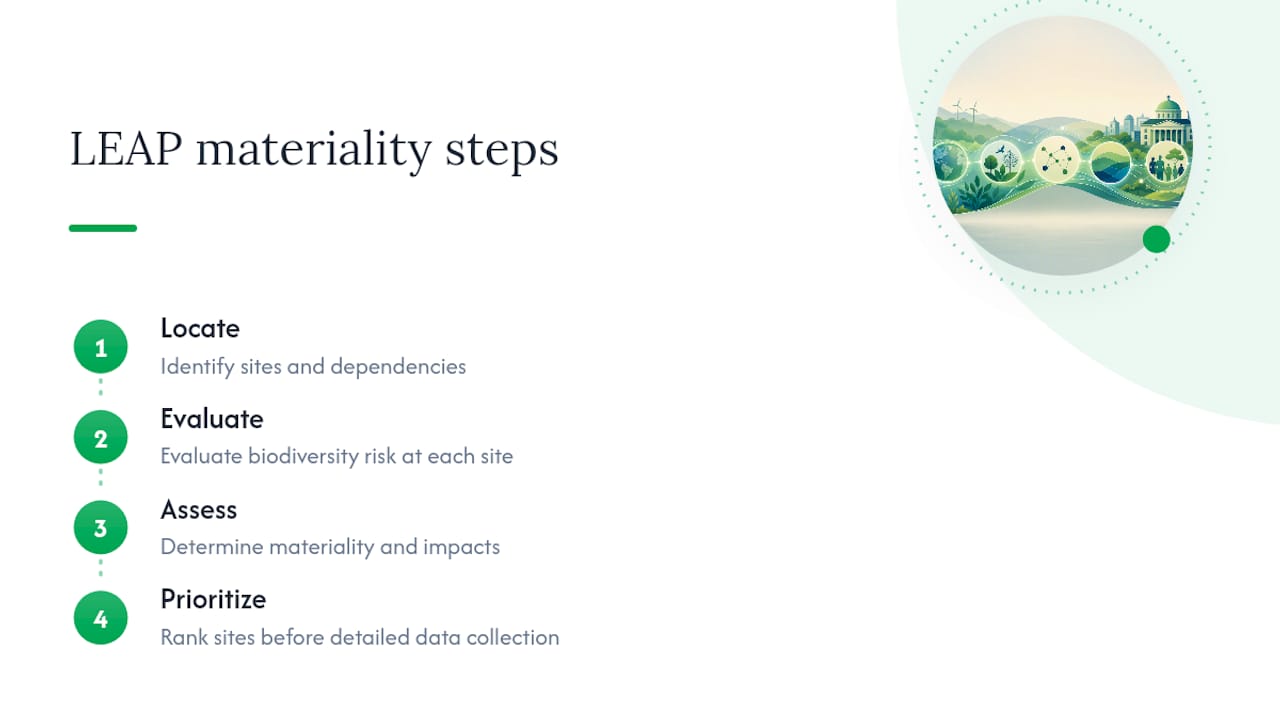
The LEAP approach, Locate, Evaluate, Assess, Prioritize, gives you a repeatable sequence for deciding where biodiversity risk actually concentrates before you commit survey budget. Locate your sites and dependencies, evaluate the ecosystem condition and pressures at each, assess the materiality of impacts and dependencies, then prioritize which sites warrant primary data collection versus desk-based estimation.
Combining impact materiality with financial materiality, the double-materiality lens central to ESRS, surfaces the sites and dependencies that matter most for both regulatory and investor audiences at once.
- Document who was consulted during materiality scoring, and when
- Record the evidence basis for each materiality decision, not just the conclusion
- Revisit materiality annually as operations, sites, or regulations change
Number of material sites or hectares assessed is a simple, credible indicator to state upfront. A report that says "42 sites screened, 9 assessed as material, covering 1,200 hectares" tells a reviewer more in one line than three paragraphs of narrative.
Pro Tip: Present the materiality outcome as a short table in the report body, not buried in an appendix. Reviewers scan for it first.
How Long Does It Take to Produce a First Compliant Report?
Budget five phases: scoping and materiality, baseline data collection (several months, longer if eDNA lab turnaround or seasonal survey windows apply), analysis and target-setting, draft report and assurance, and publication with ongoing monitoring.
- Sustainability lead owns scoping, materiality, and overall timeline
- Operations and procurement own site access and supplier data requests
- Legal reviews jurisdictional triggers and disclosure obligations
- External consultants or labs typically own field surveys and eDNA analysis
Seasonal survey timing is the most common bottleneck. Some species groups can only be surveyed in specific months, so lock in survey contracts before you finalize your reporting calendar. In the first 30 to 90 days: confirm applicability, appoint an owner, and commission the materiality assessment.
A One-Page Checklist for Your Biodiversity Report Brief
- Confirm applicability and jurisdictional triggers
- Set scope: sites, value chain, baseline year
- Run LEAP materiality assessment
- Commission baseline surveys for material sites
- Select metrics and document methods
- Draft mitigation measures and EMMP
- Set measurable targets and KPIs
- Arrange assurance level and auditor briefing
- Publish and schedule monitoring reviews
For a request-for-proposal to external consultants or labs, specify: scope and site list, required deliverables (baseline report, raw data, indicator definitions), data format, and chain-of-custody requirements for samples.
- Request raw survey data, not just summary findings
- Require documented methods and sampling protocols from every supplier
- Ask for chain-of-custody records on any eDNA or physical samples
Phased Reporting Beats Waiting for Perfect Data
Public bodies that wait for complete datasets before publishing anything usually publish nothing. A phased, materiality-led report, one that states clearly what you know, documents the gaps, and commits to a monitoring-linked improvement plan, builds more credibility with auditors and stakeholders than a delayed attempt at comprehensive coverage.
Build the In-House Capability to Deliver This Reporting Yourself
Getting a first biodiversity report right rarely comes down to knowing the standards exist. It comes down to having a team that can run a LEAP assessment correctly, choose defensible metrics, and brief an assurance provider without losing months to rework. Esgtraininginstitute trains sustainability leads, risk officers, and assurance practitioners specifically on the frameworks covered here, including materiality methodology, ESRS E4 disclosure mapping, and audit-ready documentation.

Rather than outsourcing every stage to external consultants, a trained internal team can own scoping, materiality, and governance directly, then bring in specialists only for field surveys or lab work where outside expertise genuinely earns its cost. That combination tends to produce faster timelines and stronger assurance outcomes than a fully outsourced approach. If your team is preparing its first mandatory disclosure, start with an accreditation program built around current regulatory expectations, and use it to brief your delivery team before the next reporting cycle begins.
Frequently Asked Questions
What is the difference between biodiversity reporting and an environmental impact assessment? Biodiversity reporting is an ongoing disclosure obligation covering impacts, dependencies, and targets over time. An environmental impact assessment is typically a one-time, project-specific evaluation conducted before development begins, though its findings often feed into ongoing reporting.
Is ESRS E4 mandatory for all organizations? No. ESRS E4 applies to companies in scope of the EU's Corporate Sustainability Reporting Directive. Organizations outside that scope may still choose to follow it voluntarily or align with GRI's Topic Standard for Biodiversity instead.
How often should a biodiversity report be updated? Most frameworks expect annual reporting cycles, with materiality assessments revisited whenever operations, sites, or regulatory requirements change materially.
What is the LEAP approach in biodiversity reporting? LEAP stands for Locate, Evaluate, Assess, Prioritize. It's a materiality methodology that helps organizations identify which sites and dependencies carry the most biodiversity risk before committing resources to detailed data collection.
Do small public bodies need third-party assurance for biodiversity reports? Assurance requirements vary by jurisdiction and organization type. Many public bodies start with internal review and move toward limited or reasonable assurance as reporting obligations and stakeholder expectations increase.
Sources
Consult ESRS E4 for mandatory EU metric and target disclosure requirements. Reference CBD guidance for EIA sequencing and stakeholder participation. Use BIA guidelines for project-level structure and survey methods.
- Accelerating biodiversity and ecosystem reporting — Natural Capital Project / Stanford
- Biodiversity and Ecosystem Services in Impact Assessment — IAIA (BEST PRACTICE, Feb 2025)