

The right approach is a hybrid one: apply activity-based or supplier-specific methods to your most material emissions categories, and use spend-based or average-data methods where better data isn't yet available. This isn't a compromise. It's the model the GHG Protocol's Scope 3 Calculation Guidance itself recommends, and it's how most mature reporting programs actually operate.
Four approaches dominate corporate practice:
- Activity-based/supplier-specific: uses real operational data (kWh, liters, kilometers) and supplier-provided emission data. Most accurate, most resource-intensive.
- Spend-based (EEIO): converts dollars spent into estimated emissions using economic input-output models. Fast, but coarse.
- Average-data/physical-unit: applies industry-average emission factors to known physical quantities. A middle ground.
- Hybrid: combines the above, prioritizing precision where it matters most.
Which one you lead with depends on data maturity, the materiality of the category, and whether the number needs to survive an audit.
Key Takeaways
A hybrid carbon accounting approach, activity-based data for material categories and spend- or average-based estimates elsewhere, produces the most defensible inventory for the least wasted effort.
| Point | Details |
|---|---|
| Start with materiality | Rank emissions categories before choosing a method so effort goes to the biggest contributors first. |
| Match method to data maturity | Use spend-based estimates as a starting baseline, then convert priority categories to activity-based data. |
| Follow the GHG Protocol hierarchy | Supplier-specific, hybrid, average-data, and spend-based methods rank in that order for accuracy. |
| Document every methodology choice | Record assumptions and emission factors per category to survive audits and explain year-over-year changes. |
| Close skill gaps with training | Esgtraininginstitute's accreditation programs build the Scope 3 and data-quality skills teams need for credible disclosure. |
Table of Contents
- Carbon Accounting Methods and the Three GHG Scopes
- How Each Carbon Accounting Method Works in Practice
- Why the GHG Protocol Sets the Standard for Method Selection
- Comparing Accuracy, Effort, and Audit Readiness Across Methods
- A Decision Checklist for Choosing the Right Method
- Where to Source Reliable Emissions Data
- A Phased Roadmap From Baseline to Supplier-Specific Data
- What Practitioners Get Wrong About Carbon Accounting Methods
- Build Carbon Accounting Capability With Standards-Aligned Training
- Sources
Carbon Accounting Methods and the Three GHG Scopes
Carbon accounting is the practice of measuring, tracking, and reporting greenhouse gas emissions in a standardized unit, carbon dioxide equivalent (CO2e), so that different gases with different warming potentials can be compared on a single scale. It's the discipline that turns diesel receipts and electricity bills into a number regulators, investors, and auditors can trust.
The GHG Protocol Corporate Standard organizes emissions into three scopes:
- Scope 1: direct emissions from sources you own or control, like fuel burned in a company vehicle fleet.
- Scope 2: indirect emissions from purchased electricity, steam, heating, or cooling.
- Scope 3: all other indirect emissions across your value chain, from purchased goods to employee commuting to the use of sold products.
Before you calculate anything, you need to fix your organizational boundary, either the control approach (you report what you operate) or the equity share approach (you report proportional to ownership), along with a base year against which future progress gets measured. Skip this step and every method comparison downstream becomes meaningless, because you'll be comparing inventories with different edges.
How Each Carbon Accounting Method Works in Practice
Once your boundaries are set, the real decision is which calculation method to apply to each emissions category. Here's how the four leading approaches actually function.
-
Activity-based and supplier-specific methods multiply a measured activity (fuel liters, kilowatt-hours, kilometers driven, tonnes of material) by an emission factor specific to that activity or, ideally, data supplied directly by the vendor. Supplier-specific data, actual emissions figures a vendor calculates and shares, sits at the top of the accuracy hierarchy because it reflects real operating conditions rather than an industry average. The trade-off is effort: getting a supplier to hand over verified emissions data for a specific shipment or product line often takes months of relationship-building and template standardization.
-
Spend-based methods use Environmentally Extended Input-Output (EEIO) models, which estimate emissions per dollar spent within an economic sector. Spend $50,000 on "professional services" and the model assigns a kg CO2e figure based on the average carbon intensity of that entire sector. This is the fastest way to produce a first inventory, especially for categories like purchased services or capital goods where activity data is scarce. The accuracy limitation is real: two companies spending identical amounts in the same category can have wildly different actual emissions, and EEIO models can't tell them apart.
-
Average-data and physical-unit methods sit between the two. Instead of dollars, you use a known physical quantity, tonnes of steel purchased, number of hotel nights booked, and apply an industry-average factor. This works well when you know quantities but not suppliers, and it produces a more defensible number than spend-based estimates because it isn't distorted by price inflation or currency shifts.
-
Hybrid methods are not really a fourth calculation technique so much as a portfolio strategy. You rank categories by materiality, then apply supplier-specific or activity-based methods to the handful that drive most of your footprint, while leaving smaller categories on spend-based or average-data estimates. Over time, you convert more categories as supplier engagement matures. Net0's analysis of carbon accounting methodologies describes this progression as the typical maturity path organizations follow, moving from a spend-based baseline to a hybrid model and eventually to supplier-specific data for the categories that matter most.
| Method | Data input | Typical accuracy | Effort required |
|---|---|---|---|
| Activity-based/supplier-specific | Meter readings, supplier emissions data | High | High |
| Average-data/physical-unit | Purchased quantities, industry factors | Moderate | Moderate |
| Spend-based (EEIO) | Procurement/spend records | Low to moderate | Low |
| Hybrid | Mix of the above by category | Variable, optimized by materiality | Moderate |
Pro Tip: Don't try to convert every category to activity-based data at once. Start with the two or three categories that likely represent over half your Scope 3 footprint, usually purchased goods and services or capital goods for manufacturers, and put your supplier engagement budget there first.
Why the GHG Protocol Sets the Standard for Method Selection
The Corporate Standard established five core accounting principles that still govern how credible inventories get built:
- Relevance: the inventory reflects the emissions that matter to your business and stakeholders.
- Completeness: all relevant sources within the boundary are accounted for.
- Consistency: methods are applied the same way over time to allow meaningful comparison.
- Transparency: assumptions and methods are disclosed, not buried.
- Accuracy: the numbers are as precise as practicable, with uncertainty minimized.
The Scope 3 Calculation Guidance builds on these principles with a specificity ranking, supplier-specific first, then hybrid, then average-data, then spend-based, and explicitly recommends combining methods rather than picking one for the whole inventory. That ranking is now the reference point auditors and assurance providers check against when they evaluate whether a disclosed number holds up.
Regulatory pressure is accelerating this. The United Kingdom has moved to enshrine mandatory climate disclosures into law for its largest companies, and similar mandatory regimes are expanding globally. That shift means the informal, spreadsheet-driven carbon accounting many companies ran a few years ago won't survive an assurance review going forward.
Comparing Accuracy, Effort, and Audit Readiness Across Methods
Picking a method isn't just a technical question, it's a resourcing question. The table below lines up the four approaches against the criteria that actually drive a sustainability lead's decision.
A manufacturer with concentrated, high-volume suppliers can often justify the effort of supplier-specific data for purchased materials. A services firm with many small vendors often benefits more from average-data or spend-based estimates across less material categories, focusing supplier engagement on the largest contracts.
- Manufacturing and industrial firms: prioritize activity-based data for direct inputs and energy.
- Services and finance firms: spend-based or average-data baselines often suffice outside travel and technology procurement.
- Any organization facing mandatory assurance: expect to justify method choice per category, not just report a final number.
A Decision Checklist for Choosing the Right Method
Method selection shouldn't happen category by category through guesswork. Work through this sequence instead:
- Build the full inventory scope first. List every Scope 1, 2, and 3 category relevant to your operations before deciding how to measure any of them.
- Rank categories by materiality. Estimate roughly which categories likely drive the largest share of emissions, even with rough spend-based numbers at this stage.
- Assess data availability and supplier readiness. Can your top suppliers provide activity data or emissions figures today, or would that take a multi-quarter engagement effort?
- Weigh regulatory and assurance requirements. If a category will face third-party assurance, factor in that spend-based estimates alone rarely survive scrutiny for material categories.
- Select and document a method per category. Not one method for the whole inventory, one deliberate choice per category, with the reasoning written down.
Pro Tip: Keep a living methodology document that records which method you used for each category and why. When your emissions numbers shift year over year, this document is what lets you explain whether the change is real or just a methodology update, a distinction auditors will ask about directly.
Materiality-first sequencing keeps your team from spending months chasing supplier data for a category that represents 2% of your footprint while a 40% category still runs on rough estimates.

Where to Source Reliable Emissions Data
Data quality follows a hierarchy: supplier-specific primary data ranks above average industry data, which ranks above spend-based estimates. Knowing where to find defensible numbers at each tier matters as much as knowing the hierarchy exists.
- Primary data comes from supplier sustainability reports, utility meter readings, and fuel invoices. Insist on it for your top two or three material categories, since it's the only tier that reflects your actual supply chain rather than an industry proxy.
- Secondary emission factors come from published databases: government sources like DEFRA in the UK and the EPA in the United States, sector-specific tools published alongside GHG Protocol guidance, and EEIO databases like EXIOBASE for spend-based conversions. Match the factor's geography and sector as closely as possible to your actual activity, a global average factor applied to a region with a cleaner grid will overstate your emissions.
- Sampling and extrapolation can fill gaps for large, homogenous categories, but watch for double counting when suppliers report emissions that overlap with data you're already capturing elsewhere, and check units carefully; mixing metric tonnes with short tons is a common, embarrassing error.
The EY analysis of sustainability reporting developments notes that as disclosure becomes mandatory, the accuracy and traceability of underlying data is being held to the same standard as financial reporting controls, which is a meaningfully higher bar than most sustainability teams were built for.
A Phased Roadmap From Baseline to Supplier-Specific Data
Building a credible, auditable inventory is a multi-year project, not a single reporting cycle. A workable roadmap looks like this:
- Phase 1 (months 1 to 3): Rapid baseline. Use spend-based and average-data methods across all categories to establish a first full inventory and identify materiality.
- Phase 2 (months 3 to 9): Supplier engagement. Target the top material categories identified in Phase 1 and begin collecting supplier-specific activity data or emissions figures.
- Phase 3 (months 9 to 18): System building. Integrate activity data into internal systems so priority categories move permanently onto activity-based or supplier-specific calculations.
- Phase 4 (months 18 to 24): Controls and assurance. Lock in a base year, document methods per category, and prepare the inventory for third-party assurance.
Pro Tip: Treat Phase 2 supplier engagement as a relationship investment, not a data request. Suppliers respond better to a standardized, low-effort template than to a bespoke questionnaire, and that consistency also makes your own year-over-year comparisons cleaner.
What Practitioners Get Wrong About Carbon Accounting Methods
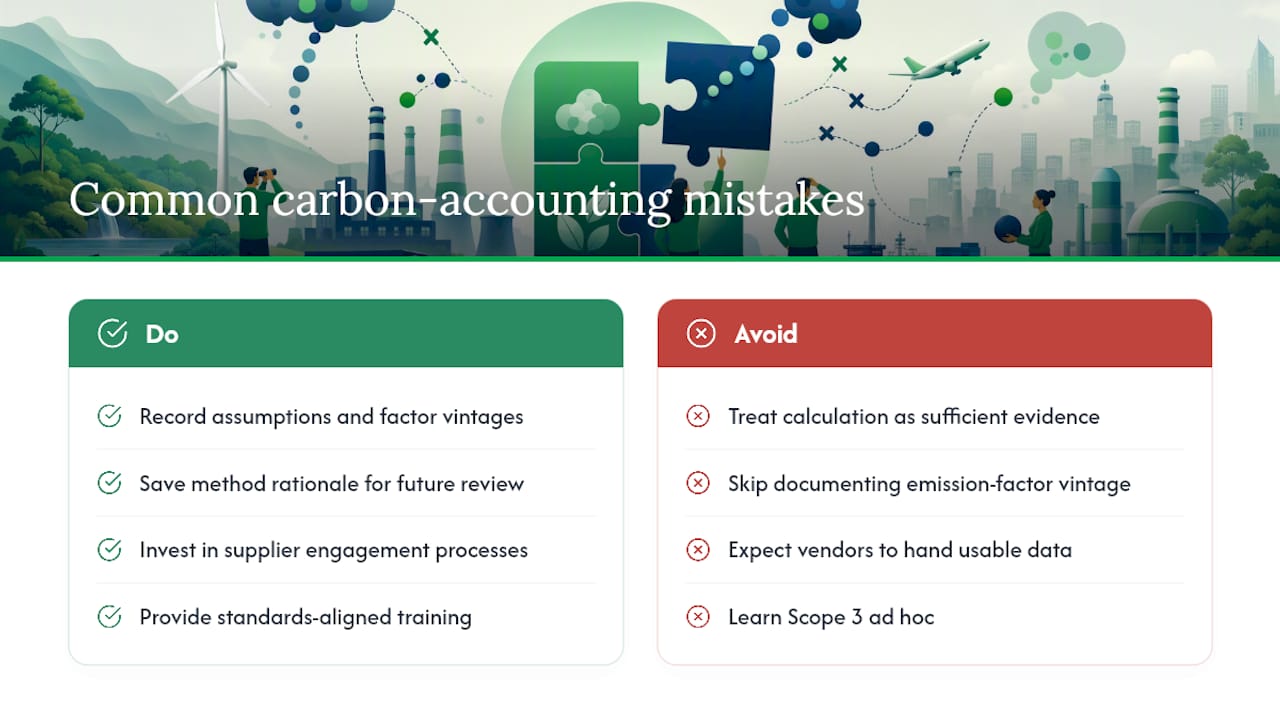
The recurring failure I see in carbon accounting work isn't a bad calculation. It's poor documentation. Teams pick a reasonable method, get a defensible number, and then can't explain a year later why the figure changed, because nobody recorded the assumptions or the emission factor vintage used the first time around.
Supplier engagement is the second underestimated skill. Getting a vendor to hand over usable activity data takes negotiation, template design, and patience most sustainability generalists were never trained for. That gap is exactly what standards-aligned training addresses: understanding the GHG Protocol's Scope 3 guidance well enough to defend a methodology choice in front of an assurance provider is a different skill than knowing the framework exists. Teams building out Scope 3 measurement programs generally move faster when at least one member has gone through structured, standards-based training rather than learning the data-quality hierarchy through trial and error on a live disclosure deadline.
— Ransford
Build Carbon Accounting Capability With Standards-Aligned Training
Choosing the right method per category is only half the challenge. Applying it consistently, documenting it defensibly, and defending it to an auditor requires skills most teams build on the job, often under deadline pressure. Esgtraininginstitute's accreditation programs are built around exactly this gap: structured, standards-aligned training in carbon accounting, GHG Protocol methodology, and assurance readiness, designed for sustainability leads, finance professionals, and risk officers who need their emissions data to hold up under scrutiny, not just look reasonable on a slide. Courses map directly to the data-quality hierarchy and Scope 3 calculation logic covered here, so teams walk away able to justify method choices rather than guess at them. If your organization is moving from a spend-based baseline toward supplier-specific measurement, review the certification pathways and enroll your reporting team before your next disclosure cycle.