

A carbon credit is a tradable unit representing one verified tonne of carbon dioxide equivalent (tCO2e) that has been avoided, reduced, or removed. A carbon offset is what happens when that credit gets used, or "retired," to compensate for emissions elsewhere. One is an asset; the other is an action. Confusing the two leads to weak claims, and picking low-quality credits is where most of the real damage happens.
TL;DR:
- High-quality credits must meet the Core Carbon Principles, including additionality, permanence, and robust monitoring, to ensure genuine climate benefits; many existing credits fall short on these standards.
- Avoidance credits prevent future emissions but are less permanent and more susceptible to leakage and reversals than removal credits, which physically extract carbon and last longer.
- Verra and Gold Standard publicly publish retirement records; verifying these before claiming offsets helps prevent double counting and ensures credibility.
- Compliance markets operate under strict legal rules with penalties for shortfalls, while voluntary markets rely on standards and are increasingly influenced by international rules like Article 6 of the Paris Agreement.
- Buyers should prioritize reducing emissions first, use removals for unavoidable residuals, and scrutinize vintage, standard, and permanence safeguards before purchasing credits.
Table of Contents
- Carbon Credits vs Offsets: The Core Definitions
- Creation vs Retirement: Where the Confusion Starts
- How Carbon Markets Actually Work
- What Actually Makes a Credit High Quality
- When Should You Actually Buy a Credit or Offset?
- The Honest Criticisms Nobody Should Skip
- A Six-Step Checklist Before You Buy
- Why Carbon Accounting Skills Reduce Your Risk
- Do Credits and Offsets Deliver the Same Environmental Impact?
- The Legal and Regulatory Rules Shaping Both Markets
- What This Means for Corporate Sustainability Claims
- Where Carbon Markets Are Headed Next
- A Pragmatic Note on Getting This Right
- Build the Skills to Buy and Report Credits Correctly
- Sources
- FAQ
Carbon Credits vs Offsets: The Core Definitions
A carbon credit gets issued by a registry after a project developer proves a specific climate outcome, such as a wind farm displacing coal power or a forest conservation effort preventing deforestation. Each credit corresponds to 1 tCO2e, verified against a methodology and tracked with a unique serial number. Multiple authoritative explainers, including the Grantham Research Institute at LSE, describe credits and offsets as commonly interchanged terms that carry a real technical difference.
A carbon offset is the act of retiring that credit against your own emissions. You don't offset by buying a credit; you offset by taking it out of circulation permanently, so nobody else can claim the same benefit.
A few concrete examples make this click:
- A solar plant in India generates credits for the clean electricity it adds to the grid, each one sellable on the voluntary market.
- A reforestation project in Kenya issues credits as trees mature and sequester carbon over years.
- A company retires 500 of those credits in its registry account to offset last year's flight emissions.
Creation vs Retirement: Where the Confusion Starts
The mechanics separate cleanly once you see them side by side.
- Credits are created and issued. A verifier confirms the project's climate outcome, and a registry issues a batch of credits into an account.
- Credits can be traded, bought, and sold multiple times before anyone uses them, similar to how a stock changes hands before someone eventually cashes it out.
- Offsetting is retirement, a one-way action. Once a credit is retired against a claim, it's marked permanently used in the registry and can never be resold or claimed again.
- Accounting depends entirely on that retirement record. If two parties both claim the same tonne, that's double counting, and it's the single fastest way to invalidate a sustainability claim.
The GHG Protocol's guidance on land sector and removals is direct on this point: credits used as offsets must be exclusively claimed by the buyer, with accounting adjustments applied so the same tonne doesn't get counted twice across different balance sheets or national inventories.
How Carbon Markets Actually Work
Carbon markets split into two distinct systems with different rules, prices, and buyers.
- Compliance markets are government-mandated. The EU Emissions Trading System (ETS) and the airline industry's CORSIA program force regulated entities to hold enough allowances or credits to cover their emissions, with legal penalties for shortfalls.
- The voluntary carbon market (VCM) runs on companies and individuals choosing to buy credits, usually to back climate claims or net-zero pledges, with no legal mandate forcing the purchase.
- Project developers, standards bodies, and registries form the supply chain: a developer builds the project, a standard (like Verra or Gold Standard) sets the methodology, and a registry tracks issuance and retirement.
- Article 6 of the Paris Agreement now lets countries trade mitigation outcomes internationally, which requires "corresponding adjustments" so a credit exported by one country isn't also counted toward that country's own climate target.
Scale matters here. Global carbon-pricing revenue from taxes and emissions trading systems reached roughly $104 billion in 2023, a number that reflects compliance markets far more than voluntary ones. That gap explains why compliance credits often trade at a different price than voluntary credits for a similar underlying activity.
What Actually Makes a Credit High Quality
Not every credit deserves your trust, and the industry has spent the last several years building better ways to tell the good ones from the weak ones.
The Integrity Council for the Voluntary Carbon Market (ICVCM) publishes the Core Carbon Principles (CCPs), a set of ten criteria covering additionality, permanence, robust monitoring, and conservative baselines. A credit that earns CCP-eligibility has cleared an independent bar that most credits on the market still haven't met.
Four terms decide whether a credit is trustworthy:
- Additionality asks whether the project would have happened anyway without carbon finance. If yes, the credit represents nothing real.
- Permanence asks how long the carbon stays out of the atmosphere. A forest that burns down five years later reverses the benefit.
- Leakage asks whether protecting one forest just pushed the logging to the next one over.
- Monitoring and verification confirm the claimed outcome actually happened, using field data rather than projections.
Practitioner guidance from ICVCM notes that credit quality varies enormously across project types, which is exactly why additionality and permanence checks matter more than the headline price.
Pro Tip: Check the registry retirement record yourself before trusting a company's sustainability claim. Verra and Gold Standard both publish public retirement logs. If the serial number isn't listed as retired, the claim is unverifiable.
When Should You Actually Buy a Credit or Offset?
Sequencing matters more than most guidance admits.
- Cut emissions first. The Oxford Principles for Net Zero Aligned Carbon Offsetting recommend prioritizing direct reductions before buying anything, and shifting steadily toward removals-based credits as a strategy matures.
- Use removals for what you can't cut. Removal credits (reforestation, direct air capture) pull carbon out of the atmosphere, which better matches the permanence of your own residual emissions than an avoidance credit does.
- Use avoidance credits with more caution. They prevent future emissions rather than removing existing carbon, which is valuable but a weaker match for neutralization claims.
- Check standard, vintage, and registry retirement before any purchase. An old vintage (issuance year) from a weak standard is a red flag even at a low price.
The Honest Criticisms Nobody Should Skip
Offsetting has real, well-documented weaknesses, and pretending otherwise undermines your own credibility.
- Greenwashing risk is significant. Companies have used cheap, low-quality credits to claim "carbon neutral" status while barely touching their actual emissions.
- Overcrediting happens. Some methodologies overestimate the climate benefit of a project, issuing more credits than the real-world outcome supports.
- Reversal risk is real for nature-based projects. A wildfire or illegal logging operation can undo years of stored carbon almost overnight.
- Revenue doesn't always reach local communities. The World Bank's carbon offset guidelines specifically call for transparent benefit-sharing, precisely because that hasn't always been standard practice.
A Six-Step Checklist Before You Buy
Buying credibly doesn't require an advanced degree, but it does require discipline.
- Confirm the project standard (Verra, Gold Standard, or another CCP-aligned program) and its verification body.
- Check the registry directly and confirm the retirement record shows your name or organization.
- Prefer removal credits when the goal is neutralizing your own residual emissions.
- Review the vintage year; older credits sometimes reflect outdated baselines.
- Ask about permanence safeguards, such as buffer pools or insurance against reversal.
- Look for documented co-benefits and benefit-sharing with the communities hosting the project.
| Step | What to check | Why it matters |
|---|---|---|
| Standard & verification | ICVCM CCP-eligible program | Confirms independent quality assessment |
| Registry retirement | Public log shows retirement | Prevents double counting |
| Credit type | Removal vs. avoidance | Matches permanence of your emissions |
| Vintage | Issuance year | Reflects current, not outdated, baselines |
| Permanence safeguard | Buffer pool or insurance | Protects against reversal |
| Benefit-sharing | Community proceeds disclosed | Confirms real local impact |
Why Carbon Accounting Skills Reduce Your Risk
Buying credits without accounting literacy is how organizations end up double-claiming a tonne they never controlled.
- Corresponding adjustments under Article 6 and GHG Protocol rules require someone on your team who understands exactly which claims are allowed.
- Assurance skills catch weak verification before a purchase, not after an auditor flags it publicly.
- Procurement teams that understand additionality and permanence negotiate better contracts and avoid low-quality supply.
Courses in carbon accounting and assurance cover the measurement and verification skills that separate a credible claim from an embarrassing correction.
Do Credits and Offsets Deliver the Same Environmental Impact?
They don't, and the gap comes down to what kind of tonne you're actually buying. A removal credit, generated by direct air capture or a mature reforestation project, physically pulls carbon out of the atmosphere. An avoidance credit, generated by a renewable energy project or efficient cook stove program, prevents a future emission from happening at all rather than reversing an existing one.
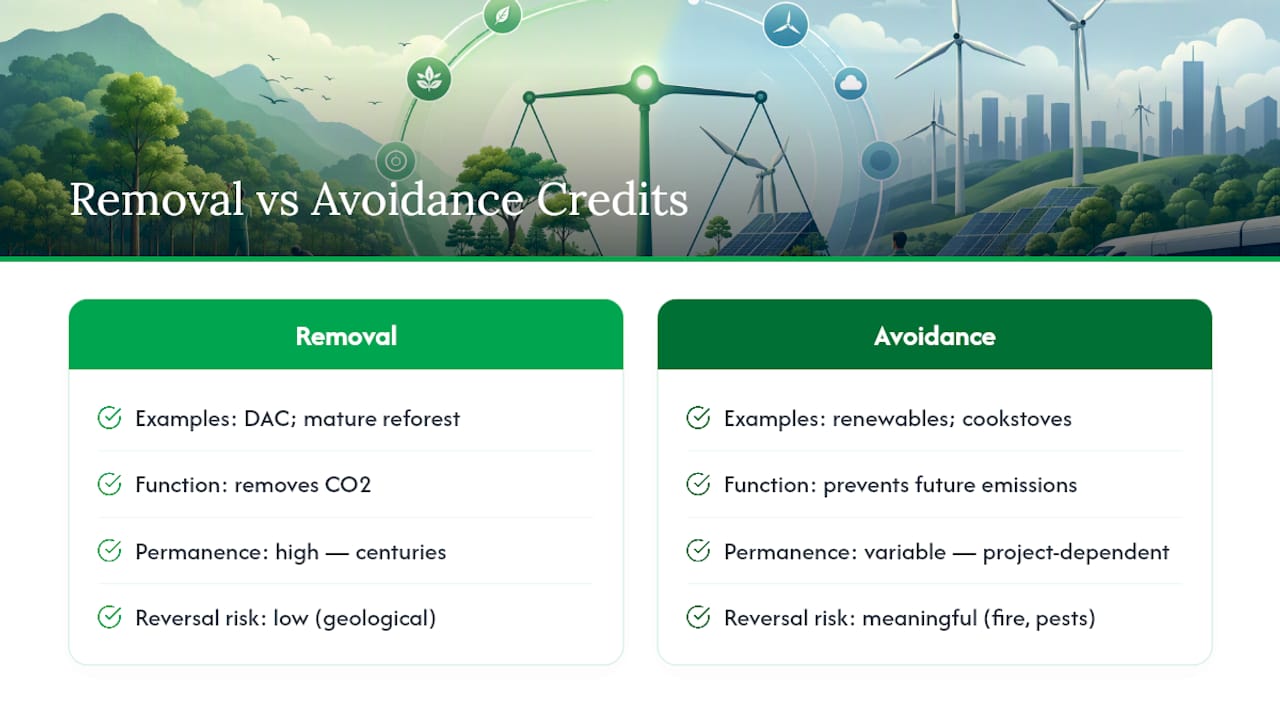
Both count as 1 tCO2e in the registry, but their real-world climate function differs. Avoidance credits help slow the rate of new emissions entering the atmosphere, which matters most when a sector still has no viable low-carbon alternative. Removal credits address the carbon that's already up there, which becomes increasingly important as science-based targets push organizations toward net-zero commitments that require balancing unavoidable residual emissions.
Permanence widens the gap further. A tonne removed and stored in geological formations through direct air capture can last for centuries. A tonne stored in a forest carries meaningful reversal risk from fire, disease, or land-use change decades later. Two credits with identical face value on paper can carry very different real-world durability.
This is why sophisticated buyers increasingly split their portfolios: avoidance credits for near-term, lower-cost climate contributions, and removals for the smaller, more expensive slice of emissions they're claiming to permanently neutralize. Treating every credit as environmentally interchangeable is the mistake that lets weak projects hide next to strong ones in the same shopping cart.
The Legal and Regulatory Rules Shaping Both Markets
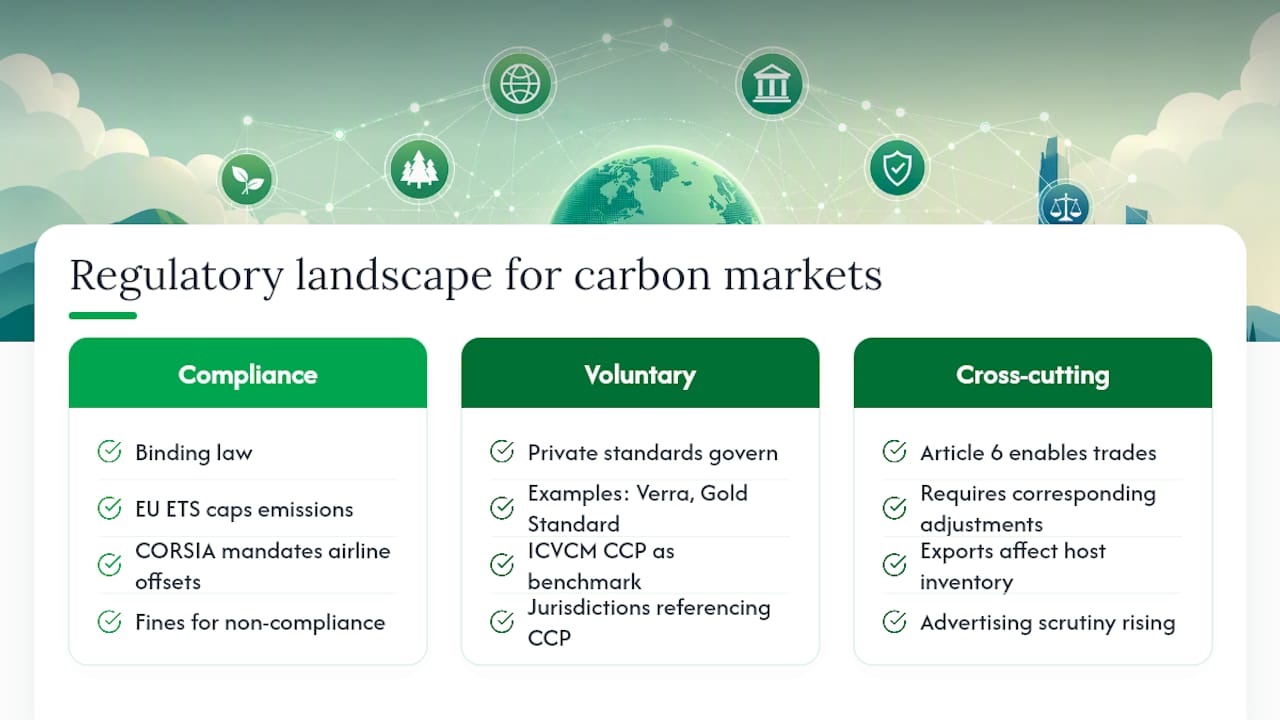
Compliance markets operate under binding law. The EU ETS caps emissions for covered industries and fines companies that fail to surrender enough allowances. CORSIA obligates airlines flying international routes to offset growth in emissions above a baseline, under rules set by the International Civil Aviation Organization.
The voluntary market has historically operated with far less legal structure, governed mainly by private standards like Verra and Gold Standard rather than statute. That's shifting. The ICVCM's Core Carbon Principles function as a quasi-regulatory benchmark even though ICVCM itself isn't a government body, and several jurisdictions are now referencing CCP-eligibility directly in their own disclosure or procurement rules.
Article 6 of the Paris Agreement adds an international layer. It permits countries to trade mitigation outcomes toward their own climate targets, but only with corresponding adjustments that prevent both the buying and selling country from counting the same tonne. That single rule reshaped how jurisdictional and large-scale credit programs get structured, because a credit exported for voluntary use abroad now has direct implications for the host country's own national inventory.
Advertising and consumer protection law is the newest front. Regulators in multiple jurisdictions have begun scrutinizing "carbon neutral" and "net zero" claims tied to offset purchases, treating vague or unsupported claims as potentially deceptive marketing rather than a harmless sustainability flourish. Any organization making a public claim tied to credits should expect that claim to face the same scrutiny as a financial statement.
What This Means for Corporate Sustainability Claims
A carbon-neutral claim is only as strong as the credits behind it, and reporting frameworks are catching up to that reality. Under GHG Protocol guidance, a company can't just buy credits and call it a day. It has to demonstrate the credit is exclusively claimed, properly retired, and not double counted against another entity's inventory or a government's national target.
This changes how sustainability reports get written. A claim like "we offset 10,000 tonnes this year" now invites scrutiny over which standard issued the credits, what vintage they carry, and whether the registry retirement record actually confirms the claim. Assurance practitioners reviewing these reports under frameworks like ISAE 3000 look specifically for that documentation trail, not just the headline number.
The reporting landscape itself is shifting too. As frameworks move from voluntary disclosure toward mandatory standards like ISSB's IFRS S1 and S2, climate claims tied to offsetting face the same rigor as financial disclosures. A company that overstates the quality or permanence of its credits risks more than reputational damage; it risks a restated report.
The practical implication is straightforward: separate your reduction claims from your offsetting claims in every report. Show gross emissions, show reductions achieved through operational change, and show offsets used for the residual separately. Blending the three into one flattering number is exactly the pattern that regulators and assurance providers are now trained to flag.
Where Carbon Markets Are Headed Next
The voluntary and compliance markets are converging faster than most buyers expect. Jurisdictional and policy-level crediting under Article 6 is expanding beyond single projects toward whole sectors and regions, which changes how credits get counted and traded across borders. That shift means a credit's legitimacy increasingly depends on how well its host country's national accounting lines up with international rules, not just the quality of the individual project.
ICVCM's Core Carbon Principles are becoming the shorthand buyers reach for first. CCP-eligibility is turning into the default signal of quality, similar to how a credit rating simplifies a bond purchase, and that convergence should make it easier for individuals and smaller organizations to shop with confidence over the next few years.
Removals are gaining ground relative to avoidance credits, following the Oxford Principles' recommended shift toward permanent carbon storage as net-zero deadlines approach. Expect more direct air capture and enhanced weathering credits entering the market, even though they currently sell at a steep premium to nature-based avoidance credits.
Offtake agreements are also becoming more common among serious buyers, locking in future credit supply with defined delivery schedules, quality clauses, and often a share of proceeds directed toward adaptation projects. That structure protects buyers from price volatility while giving project developers the financing certainty they need to build in the first place.
Expect regulatory scrutiny to keep tightening on corporate claims, expect registries to keep improving transparency after years of criticism, and expect the gap between high-integrity and low-quality credits to widen rather than close.
A Pragmatic Note on Getting This Right
The biggest mistake we see isn't malice, it's rushing past due diligence because a credit looked cheap. Slow down, check the standard, and treat verification skills as infrastructure, not paperwork.
— Ransford
Build the Skills to Buy and Report Credits Correctly
Reading about credit quality is one thing; being the person your organization trusts to evaluate a supplier's registry retirement record or defend a sustainability claim under audit is another. Esgtraininginstitute's Certificate in Carbon Accounting gives sustainability leads and finance professionals the measurement and reporting fundamentals to avoid double counting and apply corresponding adjustments correctly, at $149 one-off.
For teams handling ongoing disclosure work, the All-Access CPD Pass covers carbon accounting alongside assurance and reporting modules for $599 per year, useful when one certification isn't enough to keep up with shifting standards. Assurance-focused readers evaluating verification claims may also want the grounding covered in ISSA 5000 assurance standards. Browse the current course catalog and enroll at Esgtraininginstitute.
Sources
- Record high revenues from global carbon pricing near $100 billion — World Bank
- The Core Carbon Principles | ICVCM
- GHG Protocol — Land Sector and Removals Guidance (Chapter 18)
- What are carbon offsets? — Grantham Research Institute (LSE)
FAQ
How Much Does One Carbon Credit Offset?
One carbon credit represents exactly 1 metric tonne of CO2 equivalent (tCO2e), roughly the emissions from burning about 110 gallons of gasoline. Retiring that credit offsets that same one tonne, no more and no less, regardless of its market price.
What Are the Downsides of Carbon Credits?
The main risks are overcrediting, where a project claims more climate benefit than it delivers, and reversal, where a nature-based project like a forest later releases the carbon it stored. Weak additionality is another common flaw: some projects would have happened without carbon finance, meaning the credit represents no real extra benefit.
Do Carbon Offsets Really Make a Difference?
High-integrity offsets, verified against standards like the ICVCM's Core Carbon Principles, do fund real emissions reductions or removals. Low-quality offsets from weak methodologies often deliver far less climate benefit than advertised, which is why checking the standard and registry retirement record matters more than the price tag.
Who Gets the Money From Carbon Offsets?
Revenue typically flows to the project developer first, covering construction, monitoring, and verification costs, with a portion often reaching local communities through jobs or benefit-sharing agreements. The World Bank's carbon offset guidelines specifically push for transparent, documented benefit-sharing, since that hasn't always been guaranteed across every project type.
What's the Real Difference Between Carbon Credits and Offsets?
A carbon credit is the tradable unit issued after a verified climate outcome; a carbon offset is the act of retiring that credit to compensate for your own emissions. You can hold or trade a credit, but you only offset something once you retire it permanently against a specific claim.