

Climate risk management is an enterprise-level framework that embeds mitigation and adaptation into ERM so organizations can identify, prioritize, treat, and monitor climate-related financial and operational risks. Regulators are no longer treating this as optional. The Office of the Superintendent of Financial Institutions now expects institutions to fold climate exposure directly into their risk appetite statements, backed by scenario analysis and aggregated data across Scope 1, 2, and 3 emissions.
For an organization starting this work in the next 30 to 90 days, three moves matter most:
- Map your physical, transition, and liability exposures across the business, not just the balance sheet.
- Set or update a formal risk appetite statement that names acceptable climate exposure thresholds.
- Prioritize your highest-severity risks for scenario analysis before spreading effort thin across every exposure.
Pro Tip: Skip the temptation to build a perfect model on day one. OSFI's guidance explicitly allows reasonable proxies where data is incomplete, so start with what you can measure and refine from there.
Key Takeaways
Climate risk management succeeds when mitigation and adaptation are embedded into ERM through a documented risk appetite, disciplined scenario analysis, and a regular residual risk review cycle.
| Point | Details |
|---|---|
| Definition anchors action | CRM embeds mitigation and adaptation into ERM to identify, treat, and monitor climate exposures. |
| Three risk categories | Sort every exposure into physical, transition, or liability risk before prioritizing treatment. |
| Framework has four stages | Identify, assess, treat, and monitor climate risk on a recurring, typically 90-day, review cycle. |
| Governance must be explicit | Update ERM, risk appetite statements, and internal controls to name climate variables directly. |
| Data gaps need proxies, not paralysis | Use documented proxies for missing geolocation or Scope 3 data rather than delaying action. |
Table of Contents
- What Climate Risk Management Covers and Why It Matters
- The Three Types of Climate Risk: Physical, Transition, and Liability
- A Step-by-Step Framework for Managing Climate Risk
- Governing Climate Risk Inside Your ERM Structure
- Scenario Analysis, Tools, and the Data Problem Nobody Talks About
- What a Climate Risk Manager Actually Delivers
- Choosing the Right Risk Treatment
- Building the Capability to Run This Well
- Ready to Build Climate Risk Capability on Your Team
- What Actually Separates a Working Program From a Paper One
- Frequently Asked Questions
- Sources
What Climate Risk Management Covers and Why It Matters
Climate risk management rests on two pillars that get confused constantly: mitigation and adaptation. Mitigation means cutting greenhouse gas emissions at the source. Adaptation means adjusting operations, assets, and systems to withstand climate effects that are already locked in. A credible program needs both, because reducing emissions does nothing to protect a warehouse sitting in a floodplain today.
Climate drivers don't stay in their own lane. A drought that hits a supplier's region becomes a credit risk when that supplier defaults. A carbon price shift becomes a market risk when it repriced stranded assets overnight. Physical damage to a facility becomes operational risk, liquidity risk if insurance won't cover it, and reputational risk if stakeholders find out you knew and did nothing.
That's exactly why disclosure regimes and prudential regulators keep pushing climate risk into core ERM rather than treating it as a sustainability side project:
- Credit portfolios need climate stress testing, not just traditional default modeling.
- Reputational exposure grows sharply when disclosed transition plans don't match operational reality.
- Liquidity planning increasingly accounts for climate-linked insurance gaps.
The Three Types of Climate Risk: Physical, Transition, and Liability
Every credible climate risk framework starts by sorting exposures into three canonical buckets, a classification used consistently across regulator and technical guidance:
- Physical risk covers direct damage from climate events, acute shocks like floods and wildfires, and chronic shifts like rising average temperatures or sea levels. A coastal distribution center facing repeated storm surge is a physical risk story, and it shows up as elevated insurance costs and asset impairment.
- Transition risk covers the financial fallout from moving to a lower-carbon economy: policy shifts, carbon pricing, technology disruption, and changing consumer preference. A utility holding coal assets as carbon pricing tightens faces a textbook transition risk.
- Liability risk covers legal and regulatory exposure from failing to manage or disclose climate impacts, including litigation from investors, regulators, or communities harmed by a company's emissions or inaction.
Each category maps differently onto financial risk buckets, credit, market, insurance, and liquidity, so prioritization should weigh likelihood, potential severity, and time horizon together rather than tackling whichever risk feels most visible.
A Step-by-Step Framework for Managing Climate Risk
Most organizations already run a risk management cycle. Climate risk management adapts that same cycle with climate-specific mechanics at each stage, drawing on the treatment model regulators and risk mitigation standards both point to.
- Identify. Map exposures across facilities, supply chains, and portfolios. Build impact chains that trace a hazard, say extreme heat, through exposure and vulnerability to the actual business consequence. The European Environment Agency's work on impact chains shows these are far more useful when co-developed with the operational teams who actually see the exposure firsthand, rather than built in isolation by a risk team.
- Assess. Score each risk on both inherent and residual bases. Select scenarios across short, medium, and long horizons, and document every assumption you make, including where the data is thin.
- Treat. Choose avoidance, reduction, transfer, or acceptance for each material risk, and check that choice against your documented risk appetite rather than gut feel.
- Monitor and review. Reassess residual risk on a regular cadence, commonly every 90 days, with KPIs and dashboards that escalate to leadership when thresholds are breached.
Pro Tip: Without a written risk appetite statement, teams default to "reduce everything," which burns budget on low-severity risks while leaving your biggest exposures under-addressed. Write the appetite statement before you build the treatment plan, not after.
Governing Climate Risk Inside Your ERM Structure

Climate risk management only works when it lives inside existing governance, not beside it. That means updating your ERM framework, your risk appetite statement, and your internal controls to name climate variables explicitly, rather than leaving them as an implicit assumption buried in a sustainability report.
Accountability has to run through the organization, not sit with one team:
- Business-line managers own day-to-day identification and treatment of climate exposures within their function.
- Oversight functions, internal audit and second-line risk, validate that treatment decisions match documented appetite.
- The board holds ultimate accountability, and increasingly wants a Climate Transition Plan it can actually interrogate.
Joint principles from federal and financial regulators now expect large institutions to show this governance chain explicitly, and linking climate metrics and targets to performance measures, including remuneration in some cases, is becoming a marker of a program regulators take seriously rather than one built for a checkbox.
Scenario Analysis, Tools, and the Data Problem Nobody Talks About
Scenario analysis is where most CRM programs stall, not because the concept is hard, but because the data underneath it rarely lines up. OSFI's guidance calls for a range of plausible scenarios across short, medium, and long horizons, each revealing something different: short-term scenarios test operational resilience, medium-term scenarios test capital planning, and long-term scenarios test whether the business model itself survives a warming trajectory.
The data gap is real and specific:
- Geolocation data for physical assets is often incomplete or outdated.
- Scope 1 and 2 emissions are usually solid; Scope 3 remains patchy across most sectors.
- Asset vulnerability inputs, construction materials, flood defenses, backup power, are frequently missing entirely.
When gaps exist, OSFI's own guidance explicitly permits reasonable proxies rather than demanding perfect data before you act, but every proxy and every model limitation needs to be documented, not quietly assumed away.
What a Climate Risk Manager Actually Delivers
The role has moved well past writing a sustainability report. A climate risk manager owns the Climate Transition Plan, integrates climate metrics into existing risk dashboards, governs which scenarios get used and why, and produces the reporting that satisfies both the board and external regulators.
The skill set is genuinely hybrid:
- Translating climate science into risk language executives can act on.
- Running or overseeing scenario modeling without over-claiming precision the models don't have.
- Governing data quality across geolocation, emissions, and vulnerability inputs.
- Engaging stakeholders across business lines who don't naturally speak "climate."
Capability builds through structured training paths and gets measured against concrete outputs: internal metric adoption, progress against the Transition Plan, and reduced time to close data gaps.
Choosing the Right Risk Treatment
Once a risk is assessed, the treatment decision comes down to four levers, and most organizations lean too hard on just one of them.
- Avoidance means exiting an exposure entirely, relocating a facility out of a floodplain or divesting from a stranded asset class.
- Reduction means lowering likelihood or severity, retrofitting a building envelope or diversifying a supplier base geographically.
- Transfer means shifting the financial consequence elsewhere, parametric insurance or contractual risk-sharing with suppliers.
- Acceptance means consciously carrying the risk because the cost of treatment exceeds the exposure, documented and signed off, not ignored.
For built-environment exposures specifically, technical standards like ASHRAE Guideline 36 offer engineering-level detail on system control that supports operational adaptation choices.
Pro Tip: Prioritize treatment against three filters at once: cost, alignment with your risk appetite, and strategic fit, not against likelihood alone. A cheap fix for a low-severity risk is often a worse use of budget than a costlier fix for something catastrophic.
Every treatment needs a review date. Residual risk reviews, with formal sign-off by the risk owner, are what separate a documented program from a one-time exercise.
Building the Capability to Run This Well
Most organizations don't lack the desire to manage climate risk well. They lack people who can translate scenario outputs into board-ready decisions and keep pace with shifting disclosure expectations, from TCFD's legacy framework through to ISSB's current standards.
Accredited training closes that gap faster than learning on the job:
- Structured certification builds fluency in scenario governance, transition planning, and metrics integration.
- Trained risk officers embed climate variables into ERM frameworks regulators already recognize.
- A logical starting point is a foundation-level climate risk certification, followed by role-specific modules in carbon accounting or sustainable finance.
Esgtraininginstitute's programs are built around exactly these regulatory expectations, so professionals graduate ready to operate inside frameworks like OSFI's, not around them.
Ready to Build Climate Risk Capability on Your Team
Reading a framework and running one inside a live organization are two different skills, and the gap between them is usually where climate risk programs quietly fail. Esgtraininginstitute's accredited certification programs are built specifically to close that gap for sustainability leads, risk officers, and finance professionals who need to move from theory to operational fluency in scenario analysis, transition planning, and regulatory reporting.
The Institute's graduates support management of ESG assets across multiple jurisdictions, which says less about the credential itself and more about how directly the training maps to what regulators and boards are now demanding. Explore the full course catalog to find the certification path that matches your current role and your organization's climate risk maturity.
What Actually Separates a Working Program From a Paper One
Most climate risk advice treats scenario analysis as the hard part. It isn't. The genuinely difficult work is governance discipline, specifically, writing a risk appetite statement precise enough that treatment decisions follow logically from it rather than from whoever argues loudest in the room.
Conventional guidance also oversells model precision. A scenario output is a plausible range under stated assumptions, not a forecast, and organizations that treat it as gospel end up over-investing in the scenario that felt most dramatic rather than the one most likely to matter. OSFI's own guidance is more honest about this than most consultancies are: it explicitly allows proxies and demands documented assumptions instead of false certainty.
If you're starting from scratch, don't start with software or consultants. Start with the risk appetite statement and the impact chains that connect a hazard to an actual balance sheet consequence. Everything else, scenario selection, treatment choice, reporting cadence, follows from getting that foundation right. Organizations that skip it end up with elaborate dashboards tracking risks nobody agreed were priorities in the first place.
Frequently Asked Questions
What is the difference between climate risk management and climate change adaptation?
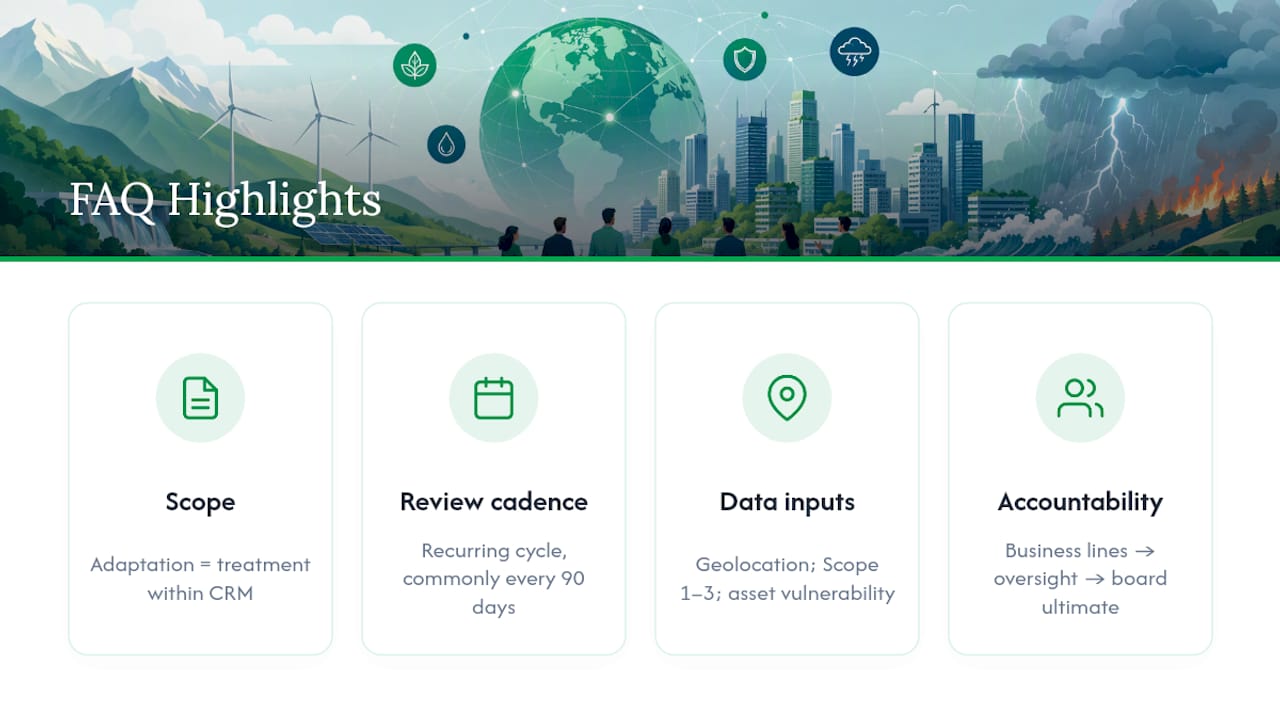
Climate risk management is the broader enterprise framework covering identification, assessment, treatment, and monitoring of climate risk. Adaptation is one treatment category within it, focused specifically on adjusting operations and assets to withstand climate effects already underway.
How often should organizations reassess residual climate risk?
Leading practice points to a recurring cycle, commonly every 90 days, with formal sign-off from the risk owner at each review, tied to broader ERM and audit governance.
What data do climate risk assessment tools typically require?
Core inputs include geolocation data for physical assets, Scope 1, 2, and 3 emissions figures, and asset vulnerability details such as construction materials and existing flood or heat defenses. Gaps are common, particularly in Scope 3 data, and documented proxies are an accepted substitute.
Who is accountable for climate risk management inside an organization?
Accountability runs through the full governance chain: business-line managers handle day-to-day identification and treatment, oversight functions validate decisions against risk appetite, and the board holds ultimate responsibility for the Climate Transition Plan.
Can smaller organizations without dedicated risk teams still build a credible climate risk program?
Yes. The framework scales down, start with exposure mapping and a simple risk appetite statement, use proxies where full data isn't available, and build formal scenario analysis capability over time through structured training rather than waiting for a large team to exist first.
Sources
Start with OSFI's climate risk guidance, the UNFCCC's adaptation resources, and Esgtraininginstitute's ESG Insights magazine for ongoing regulatory analysis.
- Climate risk management - Office of the Superintendent of Financial Institutions
- Agencies issue principles for climate-related financial risk management for large financial institutions
- Risk Mitigation Strategies: Tactics & Examples 2026