

Climate scenario analysis models plausible long-term climate and policy pathways to quantify transition and physical risks and inform strategy, disclosure, and resilience decisions. It applies structural, multi-decade pathways rather than short-term shocks, which is what separates it from conventional financial stress testing. The output feeds three things decision-makers actually use: quantified exposure figures, strategic input for capital and portfolio decisions, and evidence for regulatory or investor disclosure.
The immediate next step for most organizations is not a model. It is scope.
- Run a materiality assessment before selecting a single scenario.
- Appoint a lead owner who can coordinate risk, finance, and sustainability inputs.
- Decide your time horizon before you decide your tooling.
Key Takeaways
Climate scenario analysis works when materiality scoping, NGFS-aligned pathway selection, and documented asset-level extension happen in that order, not as afterthoughts.
| Point | Details |
|---|---|
| Scope before modeling | Run a materiality assessment to prioritize exposures before selecting scenarios or tools. |
| Use NGFS as baseline | Anchor pathway selection to NGFS scenario families, treating them as exploratory, not forecasts. |
| Match horizon to risk type | Pair short horizons with acute physical risk and long horizons with transition and chronic risk. |
| Extend to asset level selectively | Reserve granular, asset-level modeling for exposures that are both material and data-feasible. |
| Document every assumption | Log proxies and compound-scenario choices so results survive board and audit scrutiny. |
Table of Contents
- What Climate Scenario Analysis Covers and How It Differs from Stress Testing
- Why Organizations Run Climate Scenario Analysis
- How to Run a Climate Scenario Analysis Step by Step
- Choosing the Right Depth: Materiality, Horizons, and Compound Risk
- What Practitioners Get Wrong and How Training Closes the Gap
- The Gap Between Scenario Rigor and Scenario Theater
- Sources
What Climate Scenario Analysis Covers and How It Differs from Stress Testing
Conventional stress testing asks how a portfolio survives a defined, near-term shock, usually a recession or a market correction measured in months or a few years. Climate scenario analysis asks something structurally different: how does an economy, sector, or balance sheet behave under a decades-long transition or physical trajectory? Scenario analysis often spans horizons up to 30 years because it needs to capture slow-moving transition dynamics and cumulative physical damage, not a single quarter of volatility.
That distinction shapes the entire exercise. Three risk categories drive it:
- Transition risk — policy shifts, carbon pricing, technology substitution, and shifting demand that revalue assets tied to high-emission activity.
- Physical risk, acute — discrete events like floods, wildfires, and storms that damage assets or disrupt operations in a defined window.
- Physical risk, chronic — gradual shifts such as sea-level rise, heat stress, and water scarcity that erode asset value or productivity over years.
Both categories move through macro-financial transmission channels: GDP shocks, sector repricing, credit downgrades, insurance withdrawal, and collateral devaluation. Supervisors generally treat these exercises as informative rather than punitive. The ECB and Bank of England have both run system-wide climate exercises explicitly to build capability and surface data gaps, not to set capital add-ons in the way a Basel stress test might.
Why Organizations Run Climate Scenario Analysis
The business case rarely starts with compliance. It starts with a decision someone actually has to make: which assets to divest, where to build resilience into capex plans, how to price insurance risk, or how to justify a transition plan to a board.
Common use cases include:
- Portfolio alignment and sector reallocation ahead of policy shifts
- Capital allocation and capex sequencing under different transition speeds
- Insurance and credit pricing that reflects physical exposure
- Disclosure obligations tied to strategy resilience claims
Regulatory timelines are compressing this from a "nice to have" into an expectation. TCFD-derived disclosure requirements, now largely absorbed into ISSB standards, ask firms to describe scenario-based resilience testing directly. In the EU, EBA Guidelines on environmental scenario analysis will apply from January 1, 2027, formalizing expectations that many institutions are already building toward.
Statistic Callout: The ECB's good-practice review found that institutions running scenario exercises early, with multiple transition scenarios and tailored physical inputs, identify balance-sheet vulnerabilities years before they surface in conventional credit metrics.
How to Run a Climate Scenario Analysis Step by Step
A credible scenario analysis follows a repeatable sequence. Skipping steps to get to a headline number is the single most common way these exercises lose credibility with boards and auditors.
Step 1: Define objectives, scope, and materiality. Start by identifying which exposures drive most of your risk, not by modeling everything you can find data for. A double materiality assessment helps prioritize sectors, geographies, and asset classes before you touch a model.
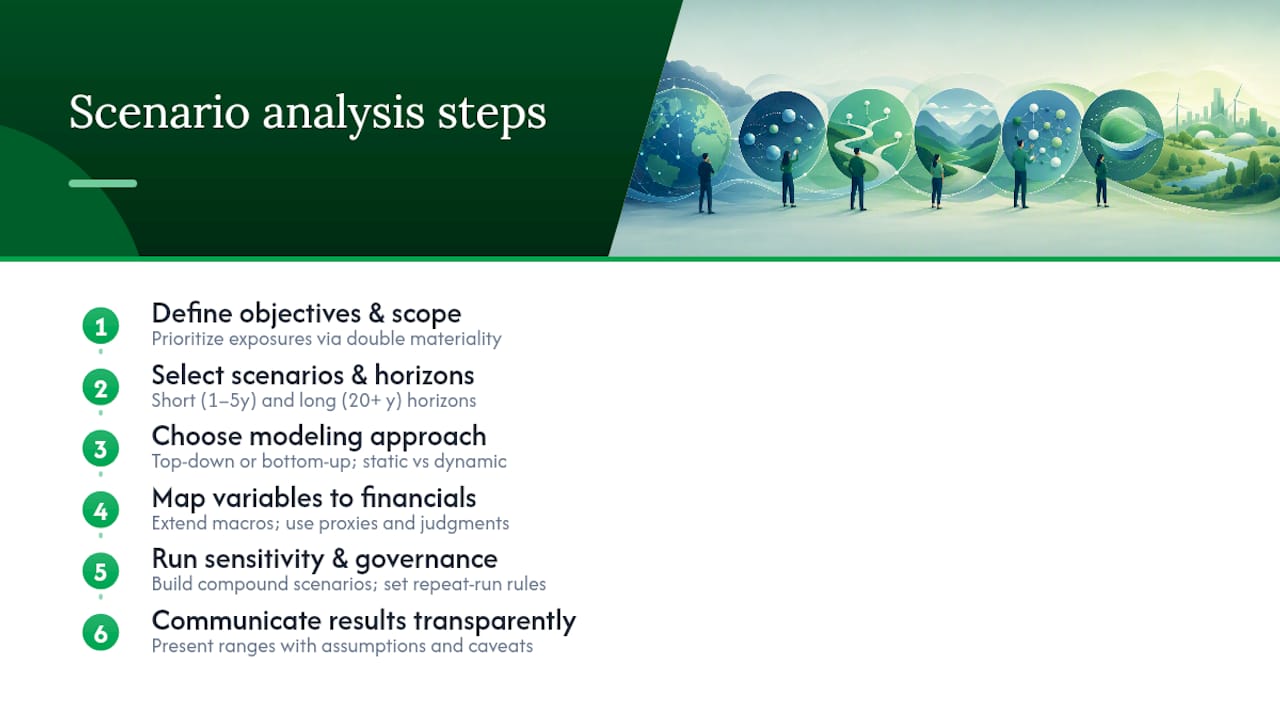
Step 2: Select scenarios and time horizons. Short horizons (one to five years) suit acute physical shocks; long horizons (20-plus years) are necessary for transition risk and chronic physical effects. Many advanced exercises run both in parallel. The NGFS long-term scenarios, grouped into Orderly transition, Disorderly transition, Hot House World, and Too little too late, are the most widely used baseline, though bespoke scenarios are sometimes justified for sector-specific exposure.

Step 3: Choose a modeling approach. Decide between a top-down extension of macro variables to your portfolio or a bottom-up, asset-level build. Also decide whether your balance sheet is static (unchanged) or dynamic (rebalancing over time), a choice that materially changes results.
Step 4: Map scenario variables to financial impacts. This is where most teams underestimate the work. Macro scenarios rarely carry the spatial granularity or related financial variables needed for asset-level analysis, so extension work, proxy assumptions, and documented judgment calls become unavoidable.

Step 5: Run sensitivity tests and set governance for repeat runs. Compound risks (a transition shock hitting during a physical event, for example) rarely appear in single scenario runs. Build a small set of compound scenarios rather than trying to model every combination.
Communicate results with the limitations attached. Boards need the number and the caveat in the same breath: scenarios are exploratory pathways, not forecasts.
Pro Tip: Present scenario results as a range tied to explicit assumptions, not a single point estimate. A board that sees only one number will treat it as certain, which undermines the entire exercise the first time reality diverges from the pathway.
Choosing the Right Depth: Materiality, Horizons, and Compound Risk
Not every exposure deserves asset-level modeling. Good practice starts with materiality: rank exposures by their share of balance-sheet risk, then extend granularity only where it changes a real decision.
- Prioritize sectors and geographies with the largest concentration risk first.
- Use dynamic balance-sheet assumptions when testing strategic responses; use static assumptions when testing pure exposure.
- Reserve asset-level extension for the exposures that are both material and data-feasible.
- Build a small, deliberate set of compound scenarios rather than exhaustive combinations.
Where data is thin, a documented proxy (regional averages substituting for site-level detail, for instance) is defensible if the assumption is disclosed. An undocumented shortcut is not.
Pro Tip: Keep a running log of every proxy and assumption used in asset-level extension. Auditors and assurance practitioners will ask for it, and rebuilding that trail after the fact costs far more time than logging it as you go.
What Practitioners Get Wrong and How Training Closes the Gap
The failure modes in scenario analysis are consistent across sectors. Teams neglect compound risk, treating transition and physical pathways as if they never coincide. They skip asset-level extension because it is laborious, then present macro-level results as if they were portfolio-specific. They lean on headline macro variables (GDP shock, carbon price) without checking whether those variables are even material to their exposure profile.
- Neglecting compound and cascading risk scenarios
- Insufficient asset-level extension despite available time
- Overreliance on a single macro variable to represent complex exposure
- Presenting scenario output as a forecast rather than an exploratory pathway
Structured training changes how teams handle materiality judgments and model governance, because it forces documentation habits that ad hoc analysis skips. Certification pathways that cover carbon accounting, disclosure standards, and scenario methodology together, rather than in isolation, produce practitioners who can defend a materiality call in front of an audit committee.
Esgtraininginstitute has trained professionals now managing over $30 trillion in ESG assets, with certification programs built around the same regulatory frameworks driving this shift.
Building this capability inside a team pays off well beyond the first exercise. Esgtraininginstitute's accreditation pathways cover climate strategy, carbon accounting, and scenario methodology for sustainability leads, risk officers, and assurance practitioners who need to run or defend these exercises to boards and regulators. Programs are standards-aligned and built around current supervisory expectations, including the frameworks discussed here, so teams that certify through Esgtraininginstitute walk into their next scenario exercise with a shared methodology rather than reinventing one under deadline pressure.
The Gap Between Scenario Rigor and Scenario Theater
Most guidance on this topic treats scenario selection as the hard part. It isn't. The hard part, and the part conventional advice skips, is the asset-level extension work that turns a macro NGFS pathway into a number a credit committee can actually use. Teams that stop at the macro output are doing scenario theater: a defensible-looking chart with no real portfolio linkage underneath it.
The evidence here points toward front-loading materiality work over front-loading model sophistication. An institution with a rough but honest asset-level extension on its three most material exposures will make better decisions than one with a beautifully calibrated macro model and no granularity. Static balance-sheet analysis gets treated as a formality when it should be the default lens for measuring pure exposure, with dynamic assumptions reserved for testing strategic responses.
Prioritize the materiality call first. Everything downstream, scenario choice, horizon, modeling depth, should follow from what you decide is actually material, not from what data happens to be easiest to pull.
— Ransford
Sources
Most credible analyses draw from a short list of authoritative sources rather than proprietary guesswork. The NGFS Scenarios Portal is the standard starting point for macro-financial pathway data, hosted through IIASA's IXMP Scenario Explorer, which supports CSV and XLSX downloads along with API and pyam access for programmatic pulls. ISIMIP (the Inter-Sectoral Impact Model Intercomparison Project) supplies sector-level physical impact projections that pair well with NGFS transition pathways when you need both risk types modeled consistently.
The modeling chain typically runs in three stages: climate and impact models (integrated assessment models, or IAMs, feeding ISIMIP-style outputs) generate physical and transition variables; macroeconomic models such as NiGEM translate those into GDP, inflation, and sector-level effects; financial mapping tools then convert macro output into asset-level or portfolio-level impact.
- NGFS Scenarios Portal
- Climate scenario analysis 101 — RFF
- Measuring climate-related financial risks using scenario analysis — Bank of England
- ECB report on good practices for climate and nature-related risk stress testing
The IIASA data supports pyam-based scripting, which cuts substantial manual effort out of pulling repeat scenario updates for teams running quarterly or annual refreshes.