

A climate transition plan is a time-bound, entity-level action plan showing how an organization will align with science-based temperature goals and cut Scope 1, 2, and material Scope 3 emissions. The verdict for practitioners: a credible plan is finance-integrated, board-owned, transparent about short-term targets, and honest about dependencies. As of 2025, 32% of CDP Disclosers reported having an active plan, up 8% since 2023.
Key Takeaways
A credible climate transition plan pairs board-owned governance and funded capex with near-term targets and honest disclosure of Scope 3 gaps and assumptions.
| Point | Details |
|---|---|
| Definition clarity | A transition plan is the time-bound "how"; a net-zero strategy is the "where." Investors want the plan. |
| Five-year cadence | Set short-term (five-year) targets with annual checkpoints rather than a single distant 2050 promise. |
| Scope 3 is the test | Weak supplier engagement on Scope 3 is the most common reason reviewers discount a plan. |
| Finance must be integrated | Tie capex schedules and executive compensation to target delivery, not just reporting. |
| Build the skills to execute | Esgtraininginstitute offers certification in science-based targets, carbon accounting, and disclosure-aligned transition planning. |
Where to go for templates and technical standards
- CDP: disclosure indicators and adoption benchmarks.
- EPA: operational guidance on plan components.
- ClimateWorks Centre: credibility criteria and governance guidance.
- Ceres: practical steps for building a plan and linking it to finance.
This article is general information, not a substitute for advice from a qualified financial advisor. Consult a qualified financial professional about your own circumstances before acting on anything here.
Table of Contents
- What Is a Climate Transition Plan, and Why Does It Matter?
- What Are the Core Components of a Credible Plan?
- How Do You Build a Climate Transition Plan Step by Step?
- What Makes a Transition Plan Credible to Investors and Regulators?
- Which Metrics and Timelines Make a Plan Operational?
- How Should Governance and Finance Support the Plan?
- What Belongs in a Publication-Ready Transition Plan Checklist?
- What Are the Most Common Red Flags in a Transition Plan?
- What Does the 2025 Evidence Say About Transition Plan Adoption?
- Build the Skills Behind a Credible Transition Plan
- Sources
What Is a Climate Transition Plan, and Why Does It Matter?
A climate transition plan answers "how." A net-zero strategy answers "where." The strategy sets the destination, usually a 2050 target. The plan lays out the operational route: which levers get pulled, in what order, funded by which capital, and overseen by whom. Investors and lenders increasingly demand the plan, not just the strategy, because it produces evidence they can underwrite.
That shift shows up in real decisions. Lenders use plan quality to price transition finance. Insurers factor decarbonization credibility into long-tail risk assessments. Acquirers now diligence a target's transition plan the way they once diligenced its balance sheet, because regulatory disclosure regimes like the CSRD are pulling plan content into mandatory reporting.
The market data backs this urgency:
- 32% of CDP Disclosers had an active transition plan in 2025, an 8-point jump from 2023.
- Over 70% of CDP Disclosers now have either a plan or a formal commitment to build one.
- A credible plan is entity-level and time-bound, not an aspirational statement layered on top of a net-zero pledge.
Statistic Callout: A substantial portion of major disclosers already operate a transition plan, and the adoption is accelerating quickly, challenging sustainability staffing capacities.
What Are the Core Components of a Credible Plan?
Every defensible plan contains the same architecture, even when sector context changes the details. Skip one of these and reviewers, investors, and rating agencies will notice.
Ambition and targets. Short-term (around 2030), medium-term (2040), and long-term (2050) targets, covering Scope 1, Scope 2, and material Scope 3 emissions. Scope 3 is where most plans lose credibility, since it usually represents the largest share of a company's footprint and the hardest to control directly.
Decarbonization levers. The specific operational changes, electrification, efficiency retrofits, product redesign, and supplier switching, that get you from today's baseline to the target.

Governance and accountability. A named executive owner, board oversight, and an escalation path when milestones slip.
Financial and capex planning. Capital budgets mapped to each lever, not a vague reference to "investment."
Scenario analysis and stakeholder engagement. Testing the plan against different policy and technology pathways, and engaging the suppliers and employees the transition actually depends on.
Monitoring and disclosure. Annual reporting against milestones, with public correction when targets are missed.
Pro Tip: Rank your levers by certainty, not by size. A smaller lever you fully control (fleet electrification) is more credible to reviewers than a larger one dependent on a technology that doesn't exist at commercial scale yet (like unproven carbon capture).
Prioritize direct decarbonization levers first. Offsets and carbon credits belong in the plan only as a supplement for genuinely hard-to-abate residual emissions, never as the primary mechanism, since reviewers treat heavy credit reliance as a credibility red flag.
How Do You Build a Climate Transition Plan Step by Step?
Building a transition plan is a sequence, not a single workshop. Each step produces a specific deliverable that the next step depends on.
- Complete an emissions inventory. Map Scope 1, 2, and 3 sources and identify your top emissions hotspots. Deliverable: a full baseline GHG inventory.
- Set science-aligned targets. Translate your baseline into short-, medium-, and long-term targets consistent with a 1.5°C pathway. Deliverable: board-approved target set.
- Identify decarbonization levers and cost them. Rank levers by abatement potential and capital intensity. Deliverable: a prioritized decarbonization roadmap.
- Plan the financing. Map each lever to a capex line and funding source. Deliverable: a multi-year CapEx schedule.
- Assign governance. Name an executive owner and define board reporting cadence. Deliverable: a governance charter.
- Pilot, then scale. Test high-uncertainty levers on a limited scope before full rollout. Deliverable: pilot results feeding a scaling decision.
- Monitor and disclose. Report progress annually and adjust ambition where evidence demands it. Deliverable: an annual progress disclosure.
Each step needs different people in the room. Finance signs off on step 4. Procurement and operations own step 3. The board owns steps 2 and 5. A plan built entirely by a sustainability team, without finance and operations at the table, rarely survives contact with implementation.
What Makes a Transition Plan Credible to Investors and Regulators?
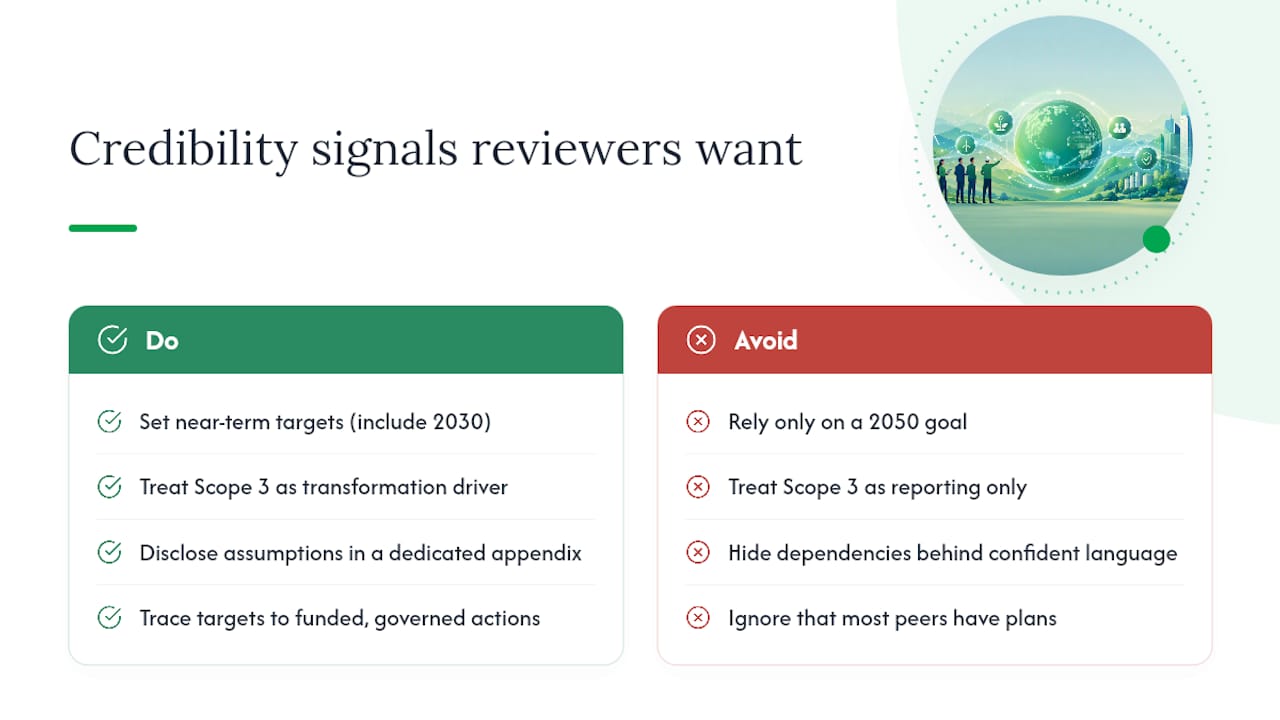
Reviewers, whether at a rating agency, a bank, or a regulator, look for the same handful of signals regardless of sector. Near-term targets matter more than distant ones: a 2050 goal with no 2030 checkpoint tells reviewers nothing about current intent. Scope 3 treatment separates serious plans from marketing exercises, since treating Scope 3 as a reporting exercise rather than a transformation driver is one of the most common failure points CDP flags.
Transparency about assumptions counts as much as the targets themselves. A plan that discloses its dependency on a specific grid decarbonization rate or an unproven technology is more credible than one that hides that dependency behind confident language.
Pro Tip: Publish your assumptions in a dedicated appendix, even the uncomfortable ones. Reviewers trust a plan more when it names its own uncertainties than when it reads as flawless.
Statistic Callout: Over 70% of CDP Disclosers now have a plan or a formal commitment to build one, which means a plan without near-term targets or Scope 3 coverage increasingly stands out against a majority of peers that have already cleared that bar.
Frameworks like the Transition Plan Taskforce approach, CDP's disclosure indicators, and CSRD/ESRS mapping all converge on the same test: can a third party trace your targets to funded, governed action?
Which Metrics and Timelines Make a Plan Operational?
Set five-year short-term targets with annual progress checkpoints, and align long-term ambition to 2050 where the sector timeline supports it. That cadence, recommended by the Climate Policy Initiative, gives reviewers a measurable trail instead of a single distant promise.
Track both absolute emissions (Scope 1, 2, and material Scope 3) and intensity metrics (emissions per unit of output or revenue). Absolute figures show real-world impact; intensity figures show efficiency gains even as the business grows. Credible plans report both, plus capital allocated to low-carbon investment and supplier engagement milestones, so growth can't quietly mask a stalled reduction curve.
How Should Governance and Finance Support the Plan?
A plan without governance teeth is a document, not a strategy. Give it authority through:
- A board committee mandate with explicit oversight of transition milestones.
- A named executive owner accountable for delivery, not just reporting.
- Executive compensation partly linked to target delivery.
- An internal carbon price or capex hurdle rate that steers investment toward low-carbon options.
- Integration with enterprise risk management, so climate risk shows up in the same audit and assurance cycles as financial risk.
This is where most plans quietly fail. Targets get set, then capital budgeting proceeds as if the targets don't exist, with no board committee ever asked to reconcile the two.
What Belongs in a Publication-Ready Transition Plan Checklist?
Before publishing, confirm the plan covers:
- Short-, medium-, and long-term targets across Scope 1, 2, and material Scope 3.
- Prioritized decarbonization levers with a delivery timeline.
- A named governance owner and board reporting cadence.
- A capex and opex plan tied to each major lever.
- Scenario analysis disclosing key assumptions.
- A Scope 3 engagement plan for suppliers and the value chain.
- A stated verification or assurance approach.
Attach the underlying GHG inventory, scenario assumptions, and CapEx outline as supporting documentation so reviewers can trace every claim to its evidence.
What Are the Most Common Red Flags in a Transition Plan?
Weak Scope 3 engagement, missing short-term targets, no finance integration, and heavy offset reliance are the four failures reviewers flag most. Fix each with a concrete step: launch supplier pilots, publish five-year KPIs, tie capex to targets, and cap credit use to residual emissions only. Disclosed uncertainty beats confident silence every time.
What Does the 2025 Evidence Say About Transition Plan Adoption?
Statistic Callout: 32% of CDP Disclosers reported an active transition plan in 2025, up 8% since 2023, with over 70% now holding a plan or formal commitment. Guidance from the EPA and ClimateWorks Centre converges: time-bound targets, real governance, and transparent assumptions separate credible plans from aspirational ones.
A practitioner's honest take on what actually moves the needle
Most organizations over-invest in modeling the 2050 endpoint and under-invest in funding the next five years. Prioritize a funded, short-term decarbonization roadmap and genuine Scope 3 supplier engagement before polishing the long-range narrative. Transparent limits beat overconfident claims.
Build the Skills Behind a Credible Transition Plan
Writing the components list is the easy part. Setting Scope 3 boundaries that hold up to investor scrutiny, structuring capex schedules finance will actually approve, and running scenario analysis that satisfies a CSRD reviewer takes trained judgment, not a template. Esgtraininginstitute's certification pathways cover exactly this ground: science-based target methodology, carbon accounting, and disclosure-aligned transition planning, built for the sustainability leads, risk officers, and finance professionals who have to defend these plans to a board or a regulator.

If your organization's transition plan is due for a credibility check, or you're building one from scratch, explore accreditation options at Esgtraininginstitute and enroll in the program that matches your role on the transition team.
Sources
- Climate Transition Plans - CDP
- Guide to credibility for corporate climate transition plans - ClimateWorks Centre
- Climate Transition Planning | US EPA
- What Makes a Transition Plan Credible? - Climate Policy Initiative (CPI)
- Ceres — Create your climate transition plan