

The Corporate Sustainability Due Diligence Directive requires in-scope companies to run continuous, risk-based due diligence across their own operations, subsidiaries, and the relevant chain of activities. That means identifying human rights and environmental risks, preventing or mitigating them, remediating harm, monitoring effectiveness, and publicly accounting for it through annual statements where required. Before anything else, confirm your scope status against the revised thresholds, assign a single accountable owner, and launch a scoping exercise.
TL;DR:
- Companies exceeding 5,000 employees and €1.5 billion in global turnover must implement continuous risk-based due diligence, focusing on human rights and environmental risks across the entire supply chain.
- Governance ownership, scope mapping, risk prioritization, and operational protocols like remediation and grievance mechanisms are core recurring obligations under CSDDD, not just one-time tasks.
- Enforcement varies by country, with Member States setting their own penalties; compliance requires monitoring national legislation updates and penalty structures for each jurisdiction.
- CSDDD's conduct obligations are distinct from, but linked to, CSRD reporting, requiring coordinated data collection and scope alignment between the two frameworks.
- Operational skills, such as impact assessments and supplier engagement, are common gaps; targeted training enhances effectiveness more than policy updates alone.
Table of Contents
- What Are CSDDD Requirements at the Operational Level?
- Who Must Comply, and by What Date?
- Building a 12-Month CSDDD Implementation Roadmap
- What Records Prove Audit Readiness Under CSDDD?
- How Will CSDDD Be Enforced Across EU Member States?
- CSDDD vs. CSRD: Two Different Regulatory Jobs
- Where Compliance Teams Underinvest
- Where CSDDD Training Fits Your Implementation Plan
- Where to Verify CSDDD Legal Text and Updates
- Sources
What Are CSDDD Requirements at the Operational Level?
CSDDD compliance guidelines rest on six interlocking obligations, and understanding CSDDD means recognizing that these are not sequential checkboxes. They function as a loop that repeats as your risk profile changes.
Governance comes first. Someone inside the organization, typically a chief sustainability officer or general counsel, must own due diligence outcomes, not just the paperwork. That owner integrates due diligence into existing policies and a code of conduct, and revisits both at least every 24 months.
Scope mapping follows, and this is where most teams stumble. The directive's "chain of activities" concept covers upstream partners (suppliers, raw material sourcing) broadly, but downstream coverage is narrower after the Omnibus amendments, limited largely to distribution, transport, and disposal tied to the company's own products. Supplier mapping exercises need to reflect that asymmetry rather than treating upstream and downstream with equal weight.
Risk identification and prioritization happens in two stages: a broad scoping pass using reasonably available information, followed by in-depth assessment for the segments flagged as highest risk.
From there, the operational requirements for CSDDD approval of a due diligence program include:
- Prevention and mitigation plans, backed by contractual assurances and escalation triggers when a supplier fails to act
- Corrective action templates that specify timelines and responsible parties
- Remediation processes, with suspension or termination of a business relationship reserved as a last resort
- Grievance mechanisms accessible to workers and affected communities, paired with genuine stakeholder engagement
- Monitoring routines feeding into the Article 16 statement that links back to CSRD reporting
Practitioner analysis is blunt about a common failure mode: treating supplier questionnaires as sufficient evidence of due diligence. Regulators and courts are likely to expect actual changes to procurement terms, product design, or supplier investment, not just a paper trail.
Who Must Comply, and by What Date?
The Omnibus amendments narrowed CSDDD's reach considerably compared to the original 2024 text, so the first task for any compliance lead is confirming whether the company is actually in scope.
EU companies fall under CSDDD only if they exceed both thresholds simultaneously: more than 5,000 employees and global net turnover above €1.5 billion. Non-EU companies face a single test: net turnover of at least €1.5 billion generated within the EU, with no employee count involved at all, which catches large multinationals with a light EU headcount but heavy EU sales.
By the numbers: Member States must transpose CSDDD into national law by 26 July 2028, national measures apply from 26 July 2029, and Article 16 reporting obligations begin for financial years starting in 2030 or later.
Practical implications worth flagging early:
- Group-level scoping matters: a parent company's turnover and headcount can pull subsidiaries into scope even when an individual entity would not qualify alone.
- Non-EU groups with concentrated EU sales should model exposure now, since the €1.5 billion EU turnover test can trigger obligations faster than expected.
- The Commission still owes delegated acts specifying Article 16 reporting content, due by 31 March 2029, so reporting templates will firm up closer to the deadline.
Building a 12-Month CSDDD Implementation Roadmap
CSDDD implementation steps work best as a sequenced roadmap rather than a single sprint. Here is a realistic sequence for a mid-sized compliance function starting from zero:
- Immediate (weeks 1 to 4): Confirm scope status against the revised thresholds, assign an accountable owner with real authority, and pull existing spend and supplier coverage data from procurement systems.
- Months 0 to 3: Run the initial scoping exercise using reasonably available information, then segment suppliers by inherent risk category and business criticality rather than spend alone.
- Months 3 to 9: Conduct in-depth assessments for the priority segments identified in scoping, and draft prevention, mitigation, and remediation protocols specific to each risk type.
- Operationalization: Build contract clauses that embed due diligence expectations, set up evidence capture workflows, stand up grievance intake and case management, and invest in supplier capacity building, particularly for smaller suppliers without compliance infrastructure.
- Reporting alignment: Draft Article 16 statement language early and align data collection efforts with existing CSRD reporting cycles to avoid duplicate work.
- Ongoing: Monitor program effectiveness, review policies on a 24-month cadence, and update the risk register as suppliers, geographies, or products change.
Pro Tip: Segment suppliers by risk and criticality before you spend a single hour on assessment. Teams that assess alphabetically or by contract size waste months on low-risk suppliers while high-risk ones sit unreviewed.
What Records Prove Audit Readiness Under CSDDD?
CSDDD documentation needs go well beyond a signed policy. Supervisory authorities and courts will expect a defensible evidence trail that shows how decisions were made, not just what the final policy says.
What to keep on file:
- Scoping exercise outputs, including the criteria used to prioritize risk areas
- Assessment evidence for each in-depth review, with dates and methodology
- Corrective action plans and their completion status
- Supplier correspondence tied to specific remediation requests
- Grievance case files, including outcomes and any follow-up
Records should be searchable, time-stamped, and tagged with an owner and a decision rationale, since a five-year gap between an assessment and a regulator's question is common. Retaining records for at least five years is a reasonable baseline for most in-scope companies.
Proportionality matters here. CSDDD does not require eliminating every risk. It requires appropriate, proportionate measures given the severity and likelihood of harm, so your documentation should show reasoning, not just outcomes.
Pro Tip: Keep a living risk register rather than a static annual document. A register that only updates once a year cannot demonstrate the "continuous" due diligence the directive actually demands.
How Will CSDDD Be Enforced Across EU Member States?
Enforcement runs through supervisory authorities designated by each Member State, and civil liability now sits with national law following the Omnibus amendments rather than a single harmonized EU standard.
Earlier drafts of CSDDD set harmonized penalty floors; Omnibus removed that harmonization, leaving Member States to set their own penalty levels, with recent guidance discussions referencing maximum penalties around a low single-digit percentage of turnover as a benchmark, subject to local confirmation.
This makes national transposition tracking essential:
- Monitor draft national legislation in every jurisdiction where the company has significant EU turnover.
- Update legal risk registers as each Member State finalizes its supervisory authority and penalty structure.
- Stress-test grievance and case management workflows against the kind of scrutiny a national regulator is likely to apply.
CSDDD vs. CSRD: Two Different Regulatory Jobs
CSDDD regulatory standards govern conduct. CSRD governs disclosure through the European Sustainability Reporting Standards. They use different thresholds, run through separate enforcement tracks, and answering to one does not satisfy the other.
The two frameworks connect at a specific point: Article 16 statements overlap with ESRS E1 climate disclosures, and data gathered for CSRD reporting can support CSDDD evidence capture. Reported figures alone do not prove that due diligence actually happened.
- Assign clear internal ownership: one team for conduct obligations, one for reporting, with a documented handoff.
- Align data templates so supplier risk data feeds both processes without duplicate collection.
- Reconcile scope boundaries carefully, since CSDDD's chain of activities and CSRD's materiality assessment rarely map onto each other exactly.
Coordinating supply-chain mapping work across both teams early avoids rebuilding the same supplier dataset twice.
Where Compliance Teams Underinvest
The gap I see most often isn't legal knowledge. It's operational skill: designing an impact assessment that actually holds up, running a grievance case to a defensible close, negotiating supplier engagement that changes behavior rather than just generating a signed form. Structured, role-based training closes that gap faster than another policy rewrite, and CPD-style refreshers keep teams current as national transposition reshapes the details.
— Ransford
Where CSDDD Training Fits Your Implementation Plan
Building the capabilities above, in-depth risk assessment, grievance case management, evidence capture, and supplier engagement, is where most compliance teams lose time, not where they lack effort. Training programs are designed to address these operational gaps: due diligence program design, impact assessment methodology, grievance mechanism operation, and assurance-ready documentation practices, taught by instructors who track CSDDD requirements as national transposition unfolds.

Corporate teams building CSDDD capability at scale can pursue training pathways designed for sustainability leads, risk officers, and assurance practitioners working through the same scoping and evidence challenges covered here. If your team needs a shared standard for how due diligence should actually run, not just what the directive says, review the accreditation pathways available now and match a course track to your implementation timeline.
Where to Verify CSDDD Legal Text and Updates
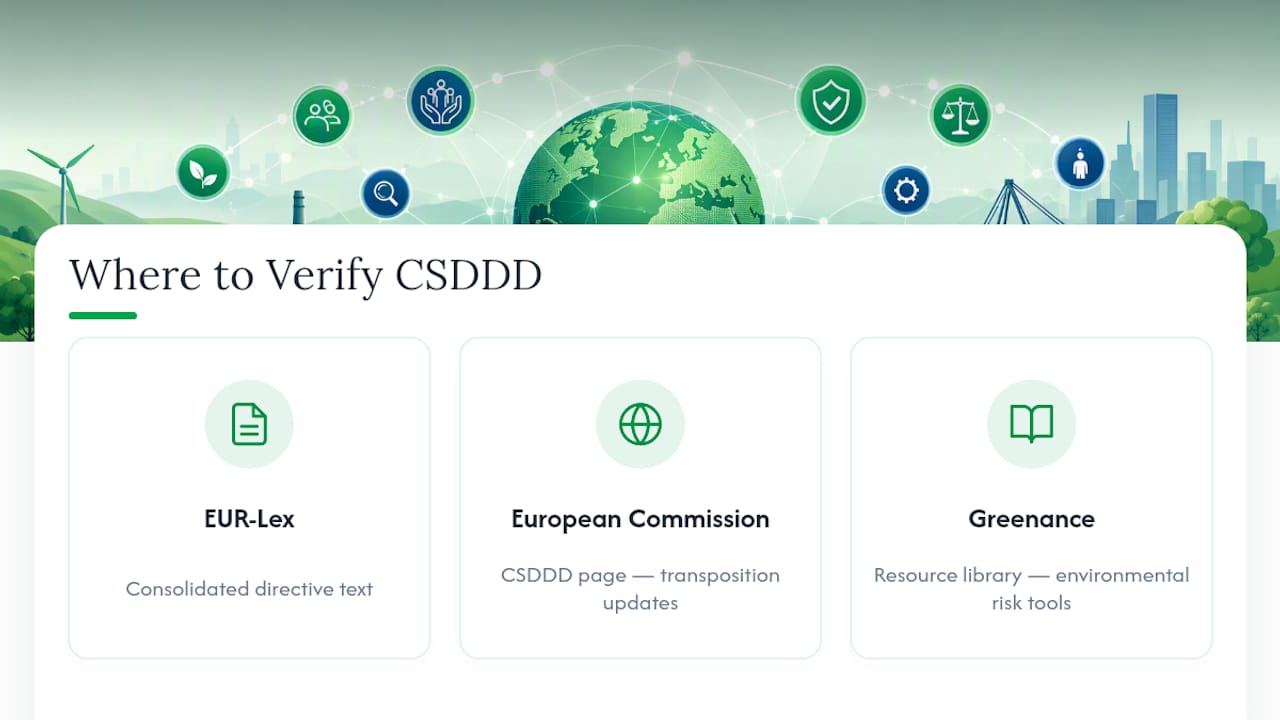
Consult the consolidated directive text on EUR-Lex and the European Commission's CSDDD page for transposition updates, plus Greenance's resource library for environmental risk methodology tools.
Sources
- European Commission — Corporate sustainability due diligence
- EUR-Lex — Directive (EU) 2024/1760 (CSDDD)
- CSRD Tools — CSDDD guide