

Under the revised Corporate Sustainability Reporting Directive, companies fall in scope only if they exceed both a high employee count threshold and a high net turnover threshold. In-scope reporters must prepare a sustainability statement using the European Sustainability Reporting Standards, apply double materiality, digitally tag the disclosures, and obtain limited third-party assurance from year one. The next major milestone lands with newly captured companies reporting for financial years beginning on or after January 1, 2027.
TL;DR:
- Companies are only in scope if they exceed both employee count and net turnover thresholds at the consolidated group level, with non-EU parent companies meeting specific EU turnover criteria.
- Mandatory disclosures include strategy resilience, due diligence, targets, and Scope 1, 2, and likely Scope 3 emissions, all assessed through double materiality.
- Limited assurance from auditors is required from the first reporting year, focusing on ESRS compliance, the double materiality process, and digital tagging accuracy.
- Preparing for CSRD involves a 12 to 24-month process of governance, materiality assessment, data mapping, and early engagement with assurance providers.
- Missing governance documentation and misjudged materiality are the most common failure points; targeted training aligned with ESRS standards can significantly reduce compliance risks.
Table of Contents
- Who Is in Scope for CSRD After the Omnibus Revisions?
- What Does CSRD Actually Require You to Report?
- When Do You Need to Start CSRD Reporting?
- What Do Auditors Check Under CSRD Assurance Rules?
- An 8-Step Checklist to Get CSRD-Ready
- Why Standards-Aligned Training Reduces CSRD Compliance Risk
- A Practitioner's View on Scaling CSRD Across Large Organizations
- Get Your Team CSRD-Ready with Esgtraininginstitute
- Where to Verify CSRD Requirements Directly
- Sources
Who Is in Scope for CSRD After the Omnibus Revisions?
The scope test is now a single cumulative hurdle, not a set of alternatives. A company must exceed both thresholds, a high number of employees and a high net turnover, to fall under mandatory CSRD reporting. Fall below either one and the obligation disappears, regardless of how the other metric looks. This is the central change introduced by Omnibus I, which also removed listed small and medium enterprises from mandatory scope entirely.
Group structure complicates the calculation. Thresholds generally apply at the consolidated level for parent undertakings, meaning a holding company with several smaller subsidiaries can still be captured once group-wide figures cross the line. Non-EU parents face a separate test: they're in scope where EU-generated turnover exceeds €450 million and they control a qualifying EU subsidiary or branch above a specified size, with first reports expected to align with FY2028 reporting filed in 2029.
Three scenarios are worth checking against your own structure:
- An EU parent with consolidated headcount and turnover both above threshold, which pulls in the whole group.
- A non-EU parent whose EU subsidiary or branch independently clears the qualifying size threshold.
- A previously in-scope listed SME that Omnibus I has now exempted from mandatory reporting, though some may continue voluntarily or under buyer pressure from larger customers.
Companies that already published a Wave 1 report generally continue reporting on the existing timetable rather than reverting to a lighter regime, so early movers shouldn't assume the new thresholds retroactively excuse them.
What Does CSRD Actually Require You to Report?
Two cross-cutting standards, ESRS 1 and ESRS 2, set the architecture for every sustainability statement. ESRS 1 lays out reporting principles and structure; ESRS 2 covers general disclosures that apply to every reporter regardless of sector, including governance arrangements, strategy, and how the business model connects to sustainability risk. Beyond those two, topical standards apply only where a company's own materiality assessment says they matter, covering climate (E1), pollution (E2), water and marine resources (E3), biodiversity (E4), circular economy (E5), workforce topics (S1 through S4), and business conduct (G1).
Double materiality is the mechanism that decides which topical standards actually apply to you. It requires assessing both impact materiality (how the company affects people and the environment) and financial materiality (how sustainability issues affect enterprise value), then documenting the reasoning, thresholds, and stakeholder input behind each conclusion. Regulators and auditors expect this process to be traceable, not asserted.
Typical mandatory disclosures include:
- Strategy and business model resilience under different sustainability scenarios.
- Due diligence processes across operations and the value chain.
- Time-bound targets with year-over-year progress tracking.
- Scope 1, 2, and, where material, Scope 3 emissions data.
- Capital and operating expenditure linked to EU Taxonomy alignment.
Pro Tip: Run your materiality assessment before you build your data collection plan, not after. Teams that reverse the order end up gathering datapoints for topics that never clear the materiality bar, then scrambling later for the ones that do.
The simplified ESRS adopted in July 2026 meaningfully changes this workload. Expect fewer mandatory datapoints and more explicit flexibility to declare a topic immaterial without exhaustive narrative justification, a practical relief for mid-sized first-time reporters.
When Do You Need to Start CSRD Reporting?
The compliance calendar has shifted more than once since the original directive, and tracking your specific wave matters more than memorizing the directive's original dates.
- Wave 1 reporters (large public-interest entities already reporting under the old Non-Financial Reporting Directive) continue on their existing schedule and don't get pulled back by the higher thresholds.
- Newly in-scope large companies crossing both revised thresholds report for financial years beginning on or after January 1, 2027.
- Non-EU groups with a qualifying EU footprint align to FY2028, with statements published in 2029.
- Simplified ESRS apply from their 2026 adoption date forward, with early voluntary adoption permitted for FY2026 reporters who want a head start.
- Assurance standards at limited-assurance level are due from the European Commission by October 2026, with reasonable assurance under consideration for October 2028.
Member states retain some discretion on transposition timing, so confirm your specific jurisdiction's transposition status rather than assuming EU-wide uniformity.
What Do Auditors Check Under CSRD Assurance Rules?
Limited assurance is mandatory from the very first year a company reports, there's no assurance-free grace period the way some early guidance suggested. The European Commission's FAQ confirms auditors must verify three things: compliance with ESRS content requirements, the integrity of the double materiality process, and correct application of digital tagging. That last point catches teams off guard, since it treats tagging as an assurance object, not a formatting afterthought.
Until the EU adopts its own harmonized limited-assurance standard, national standards fill the gap on a temporary basis. Assurance scope specifically includes:
- Traceability from source systems (HR records, emissions calculators, procurement data) to the final reported figure.
- Governance evidence showing who approved materiality conclusions and when.
- Consistency between narrative claims and underlying KPI data.
Digital tagging follows the ESEF/XHTML framework using iXBRL markup, the same technical family used for financial statement tagging, which means finance and sustainability teams increasingly need shared tooling rather than separate systems. Assurance readiness tends to be the single biggest bottleneck in first-year CSRD programs, and early auditor engagement through mock assurance runs shortens the path to a clean opinion considerably.
An 8-Step Checklist to Get CSRD-Ready
Building a credible CSRD program from scratch generally takes 12 to 24 months, and the sequence matters more than the individual tasks.
- Assign governance: board oversight, a CFO sponsor, a sustainability lead, and named data owners per topic.
- Run and document a formal double materiality assessment to fix your topical ESRS scope.
- Map existing data sources against required datapoints and flag gaps, especially Scope 3 supplier data.
- Set measurable targets and connect CapEx and OpEx reporting to Taxonomy alignment where relevant.
- Engage an assurance provider early and schedule a mock assurance engagement well before year-end.
- Select digital tagging tools and pilot the iXBRL workflow with real data, not placeholder figures.
- Build an evidence and control framework so every published KPI has a traceable source and approval trail.
- Translate all of the above into a phased project plan tied to your statutory reporting deadline and internal review dates.
Pro Tip: Treat step five as a rehearsal, not a formality. Auditors flag gaps in governance evidence and materiality documentation more often than gaps in the numbers themselves, catching that in a mock run saves months.
Review the full phase-in timeline against your own wave before locking internal milestones.
Why Standards-Aligned Training Reduces CSRD Compliance Risk
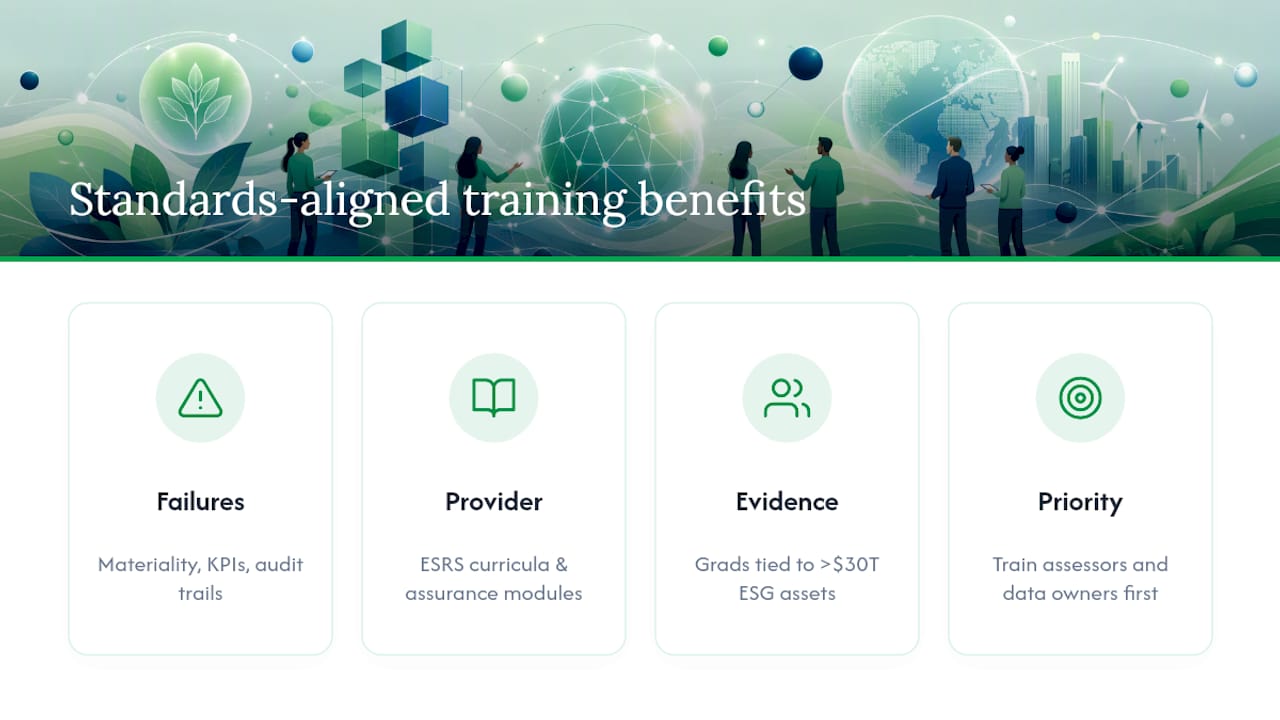
Materiality misjudgments, mislabeled KPIs, and thin audit evidence trails are the recurring failure points in first-year CSRD reports, and most trace back to teams learning ESRS on the fly. A provider with ESRS-aligned curricula, assurance-readiness modules, and role-specific certification paths closes that gap faster than ad hoc internal training. Esgtraininginstitute builds its programs around exactly that standards alignment, drawing on a graduate base connected to over $30 trillion in managed ESG assets. Prioritize training for materiality assessors and data owners first; they carry the highest error risk.
A Practitioner's View on Scaling CSRD Across Large Organizations
Most CSRD programs stall on data fragmentation and unclear ownership, not on regulatory ambiguity. Emissions data sits in one system, HR data in another, and nobody owns the handoff. Start with your highest-impact disclosures, get those traceable and assured, then widen scope. Treat materiality as a living process you revisit annually, not a one-time exercise. If your team hasn't scheduled a mock assurance run yet, that's the next call to make.
— Ransford
Get Your Team CSRD-Ready with Esgtraininginstitute
Reading the regulation tells you what to report. It doesn't train your materiality assessors to defend their conclusions to an auditor, or teach your data owners how to build a traceable evidence trail before assurance season arrives. That gap is where most first-year CSRD programs lose time.
Esgtraininginstitute offers standards-aligned programs built specifically around this gap: ESRS foundations courses, double materiality workshops, and assurance-readiness modules that mirror what auditors actually check. Programs run as exam-based certification tracks, CPD modules for ongoing upskilling, and corporate cohort training for teams that need everyone aligned before year-end. If your organization is mapping its CSRD readiness timeline now, start with a team training cohort or review the accreditation pathways to see which certification track fits your reporting lead, data owners, and assurance liaisons.
Where to Verify CSRD Requirements Directly
Cross-check any secondary guidance, including this article, against primary sources before finalizing internal policy. The CSRD directive text on EUR-Lex is the legal baseline. The European Commission's finance page tracks ESRS adoption status. Its implementation FAQ clarifies assurance and tagging mechanics, and BDO's Omnibus summary explains the revised thresholds in practitioner terms.
Sources
- Directive (EU) 2022/2464 (CSRD) — EUR-Lex
- Corporate sustainability reporting - Finance
- Frequently asked questions on the implementation of the EU corporate sustainability reporting rules — European Commission / DG FISMA
- CSRD Post-Omnibus revised scope and requirements — BDO