

Start with the U.S. EPA GHG Emission Factors Hub, EPA's AP-42/WebFIRE, the IPCC Emissions Factor Database, DEFRA, eGRID, Ember, and ecoinvent. No single source covers every inventory line. The rule that governs emission factors sourcing across all of them: match geography, activity unit, vintage, and system boundary to your specific data point, then confirm the dataset's metadata actually documents those four things before you trust the number.
TL;DR:
- Using locally sourced, source-tested factors for combustion and energy use ensures higher accuracy than default or spend-based estimates, especially for stationary sources.
- For Scope 2 emissions, a subregional grid factor from eGRID or Ember outperforms national or global averages when assessing specific facilities or regions.
- Always verify emission factor metadata, including vintage, geographic scope, and sample size, to prevent errors that can lead to restatements or audit issues.
- Document the source URL, dataset version, and calculation assumptions meticulously to create a defensible and audit-ready emission inventory.
- Building a disciplined sourcing process and team training around these best practices reduces reliance on low-tier data and improves credibility in disclosures.
Table of Contents
- Directory of Authoritative Databases for Emission Factors Sourcing
- How Are Emission Factors Actually Developed?
- How Do You Choose the Right Emission Factor?
- How Do You Convert Emission Factors to CO2e Correctly?
- What Are the Most Common Emission Factor Pitfalls?
- A Practitioner's Checklist for Defensible Factor Sourcing
- Why Sourcing Discipline Is the Real Test of an Inventory
- Build Sourcing Discipline Into Your Team's Practice
- Sources
- FAQ
Directory of Authoritative Databases for Emission Factors Sourcing
Every practitioner building a greenhouse gas inventory eventually hits the same wall: dozens of datasets claim authority, but only a handful are built for the way your organization actually reports. Knowing which database answers which question saves hours and prevents restatements later.
- U.S. EPA GHG Emission Factors Hub. The default starting point for organizational reporting in the United States. It covers Scope 1, 2, and 3 defaults, updates annually, and as of January 2025 includes revised grid gross loss percentages in Table 6 to support Scope 3, Category 3 transmission and distribution loss calculations.
- EPA AP-42 / WebFIRE. Built for stationary-source air pollutant factors, not corporate GHG inventories directly, but essential when you need combustion or process factors backed by actual source-test data rather than desk estimates.
- IPCC Emissions Factor Database (EFDB). A global library spanning agriculture, energy, industrial processes, and waste, with background documentation attached to each entry. It's the natural reference for international operations or work that needs to align with IPCC-sourced methodology under the GHG Protocol.
- DEFRA and other national factor sets. Use DEFRA when reporting under UK-specific frameworks; most countries maintain an equivalent national set, and reputable sourcing means matching the factor set to the jurisdiction your reporting boundary actually covers.
- eGRID and Ember. eGRID delivers subregional grid intensity for U.S. electricity; Ember covers country and year-level grid data internationally. Pick eGRID for domestic Scope 2, Ember when your operations sit outside the U.S.
- ecoinvent and other LCI databases. These are cradle-to-gate or full lifecycle datasets, licensed rather than free, and the right tool when you need product-level or purchased-goods factors instead of national averages.
- GreenCalculus. A methodology directory that maps factor sources to specific use-cases, useful as a quick reference when you're unsure which database fits a given activity type.
Accessibility varies sharply. EPA, DEFRA, IPCC EFDB, eGRID, and Ember are free and public. Ecoinvent requires a paid license, which matters for budgeting if your Scope 3 work leans on product-level LCA data.
How Are Emission Factors Actually Developed?
Every factor traces back to one of four development methods, and the method shapes how much you should trust the number. Source-test factors come from actual stack or process measurements, the gold standard for accuracy but expensive to produce at scale. Engineering or stoichiometric estimates derive from chemical or physical calculations when direct testing isn't feasible. Spend-based (EEIO) factors convert dollars spent into emissions using economic input-output models, useful for Scope 3 screening but the weakest link when precision matters. LCI datasets like ecoinvent build factors from full lifecycle inventories, strong for product-level claims but bound by the assumptions baked into their system models.
Before adopting any factor, check the metadata that determines whether it fits your use case:
- Datum year or vintage, and how far it sits from your reporting period
- Geographic representativeness, down to the subregion where possible
- Sample size and supporting test data behind the number
- System boundary and allocation method used to derive it
- Measurement method (direct test, estimate, or model)
- Units and the exact activity basis the factor was built against
- Stated uncertainty or representativeness rating
EPA's own procedures for developing emissions factors treat test-data quality and outlier handling as central to representativeness scoring, and the agency has shifted its lowest quality label from "poorly" to "minimally" representative, a small but telling signal that thin-data factors can still be useful estimates as long as they're flagged.
Pro Tip: Don't stop at the representativeness rating. A factor labeled "high" quality built on three source tests from a single facility can be less defensible than a "medium" factor backed by fifty tests across a wider fleet. Read the sample size before you read the grade.
How Do You Choose the Right Emission Factor?
Picking a factor is a matching exercise, not a shopping trip. Work through it in order and stop as soon as you find a dataset that satisfies all four criteria.
- Match the activity unit first. Liters of fuel, kilowatt-hours of electricity, tons of material, or dollars of spend. A factor expressed per unit of heat content is not interchangeable with one expressed per unit of mass.
- Match geography at the finest grain available. A specific plant beats a subnational grid, which beats a national average, which beats a regional or global default. eGRID's subregion data will always outperform a blended national U.S. grid figure for Scope 2 accuracy.
- Match vintage. Use a factor from the same reporting year when possible. When you can't, document the vintage gap and your rationale for the adjustment.
- Prefer source-specific or measured data over defaults. If a supplier or facility can provide a measured factor, use it. Otherwise fall back to national or regional defaults, and for purchased products, prefer LCI datasets like ecoinvent over spend-based proxies.
A few worked scenarios make this concrete. For grid electricity, a U.S. company should pull the eGRID subregion factor for the facility's location rather than a national average. For stationary fuel combustion, AP-42 source-test factors beat a generic engineering estimate when your equipment matches the tested category. For purchased goods, an ecoinvent product factor beats a spend-based EEIO proxy whenever supplier-specific data isn't available. For freight, a factor built on actual ton-miles and mode-specific fuel data outperforms a blanket distance-based estimate.
Pro Tip: Treat the hierarchy as measurement first, supplier-specific factor second, national or subnational third, and global average last, always documenting why you dropped to a lower tier. That documentation is what an auditor will ask for first.
Red flags that should push you toward higher-tier data: a factor with no stated vintage, no geographic scope, or a sample size the source doesn't disclose. Any of those means you're one restatement away from a problem.
How Do You Convert Emission Factors to CO2e Correctly?
Unit mismatches are one of the quietest ways inventories go wrong, and they rarely get caught until an assurance provider starts asking pointed questions. Get the mechanics right before you touch a spreadsheet.
- Match units exactly. If the factor is expressed per unit of heat content, convert your activity data to heat content, not mass or volume, before multiplying.
- Use supplier-provided higher heating value (HHV) when available rather than a default heat-content factor. EPA guidance treats supplier HHV as the more accurate input for fuel-based calculations, and it removes a common source of conversion error.
- Convert non-CO2 gases to CO2e using the Global Warming Potential values from the IPCC Assessment Report your framework requires, generally AR5 or AR6 depending on your reporting standard.
A worked example. A facility burns 10,000 gallons of diesel with a supplier-reported HHV of 137,000 Btu per gallon rather than the generic default. Multiply gallons by HHV to get total heat input in Btu, convert to the factor's native unit (often MMBtu), then apply the CO2 factor per MMBtu, plus the smaller CH4 and N2O factors converted to CO2e using the applicable GWP. For grid electricity, a Scope 2 location-based calculation multiplies kWh consumed by the eGRID subregion factor for that facility's grid region, not a national blended average.
Statistic callout: GreenCalculus's methodology documentation flags substituting global averages for local or subregional data as one of the most common drivers of inventory restatements, precisely because it's an easy shortcut that quietly breaks the geography-matching rule.
What Are the Most Common Emission Factor Pitfalls?
Most inventory errors trace back to a handful of repeat offenders, and nearly all of them are avoidable with a five-minute metadata check before the number goes into a spreadsheet.
- Mixing vintages across categories, pairing a 2020 fuel factor with 2025 activity data without noting the gap
- Blending geographies, using a national default when a subregional or facility-specific factor was available
- Adopting undocumented third-party factors with no traceable source URL or version number
- Double-counting scope items, particularly where Scope 2 market-based and location-based methods get conflated
- Applying a factor with a mismatched unit basis, mass where the factor expects heat content, or vice versa
Auditors and assurance providers will ask for a specific paper trail, so retain it as you go rather than reconstructing it later. At minimum, keep the exact source URL and dataset version, the factor's vintage, a written justification for its representativeness, any conversion steps or assumptions applied, and the underlying calculation spreadsheet. Teams building out this discipline often find it pairs naturally with broader work on building a sustainability assurance practice.
When a category carries material weight in your inventory and available factors are all low-tier estimates, that's the signal to escalate. Commission direct measurement or bring in an LCA specialist rather than defending a thin factor through an audit cycle.
A Practitioner's Checklist for Defensible Factor Sourcing
Good emission factor sourcing is a discipline, not a one-time lookup. A short checklist, applied consistently, closes most of the gaps that turn into audit findings later.
- Always record the source URL, dataset name, and exact vintage the moment you pull a factor
- Prefer supplier-provided HHV over default heat-content values whenever it's available
- Use the most granular grid subregion or facility-level data you can access
- Document every allocation or system-boundary choice in writing, not just in your head
- Record the sample size and stated uncertainty behind any factor you rely on
- Flag every lower-tier substitution and the reason behind it
Teams that formalize this into standard practice rarely get surprised by an assurance finding. That's largely a training gap rather than a tooling gap. Practitioners who complete structured carbon accounting certification tend to apply the geography-vintage-boundary matching rule automatically, rather than reconstructing it under deadline pressure, which is exactly where restatement risk tends to originate. Building that capability internally is also covered in five skills every ESG auditor needs.
Why Sourcing Discipline Is the Real Test of an Inventory
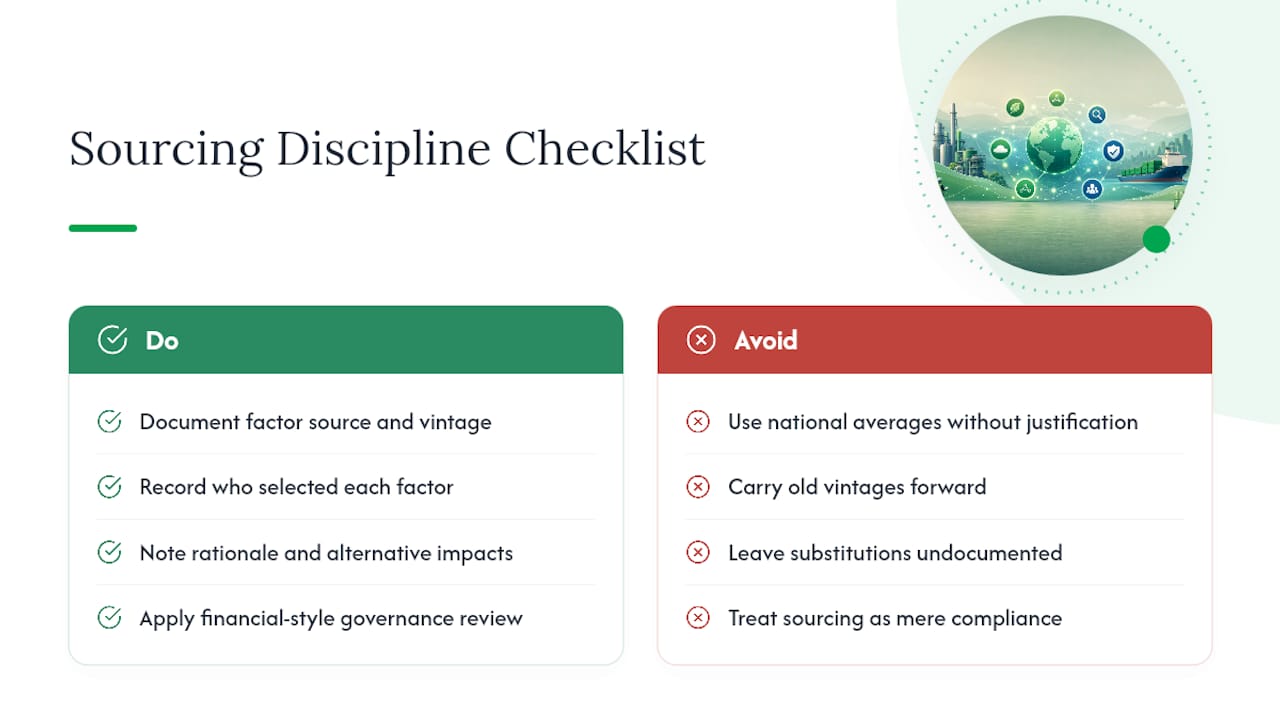
Most inventory restatements don't come from a calculation error. They come from a factor that was defensible on the surface, a national average standing in for a subregional grid figure, a 2019 vintage quietly carried into a 2025 report, and nobody documented why. That single undocumented substitution is often the finding an assurance provider flags first, because it's the easiest thing to check.
Rigor in emission factors sourcing isn't a compliance box. It's what makes a transition plan or disclosure credible to the people who have to sign off on it, internally and externally. Governance around factor selection, who chose it, why, and what the alternative would have shown, deserves the same scrutiny organizations already apply to financial data.
— Ransford
Build Sourcing Discipline Into Your Team's Practice
Reading a database directory gets you the right starting sources. Turning that into a repeatable, audit-ready process across a reporting team is a different skill, and it's the gap most restatements come from. Carbon accounting and reporting certification programs can walk practitioners through the sourcing, documentation, and QA discipline covered here, taught by instructors with real assurance review experience.

When you're evaluating any training program, check three things before enrolling: whether the learning outcomes map to real reporting tasks, whether the certification carries recognized accreditation, and whether the curriculum works through actual case studies rather than abstract theory. Esgtraininginstitute's accreditation details lay out exactly how its credentials are structured against those criteria. If your team is preparing a Scope 1 through 3 inventory for external assurance this reporting cycle, start there and see which certification track matches your current gap.
Sources
The major databases cover stationary combustion, mobile combustion, purchased electricity, industrial processes, purchased goods and services, and freight and logistics, with different datasets specializing in each category.
- GHG Emission Factors Hub | US EPA
- Procedures for the development of emissions factors from stationary sources | US EPA
- Emission Factor Databases & Data Sources | GreenCalculus
FAQ
What Are Emission Factors?
An emission factor is a value that converts a unit of activity, such as a gallon of fuel burned or a kilowatt-hour consumed, into an estimated quantity of greenhouse gas emissions, typically expressed as CO2e per activity unit.
What Are the U.S. EPA Emission Factors for 2026?
The EPA GHG Emission Factors Hub updates its Scope 1 through 3 default factors annually, so the current-year figures should always be pulled directly from the Hub's latest published edition rather than cited from memory, since values including grid loss percentages change year to year.
How Do You Calculate Emission Factors?
Emission factors are calculated through direct source testing, engineering or stoichiometric estimation, spend-based input-output modeling, or full lifecycle inventory analysis, with source-test methods generally carrying the strongest documentation and lowest uncertainty.
Where Should You Start When Sourcing Factors for a New Inventory?
Start with the database that matches your geography and activity type first, EPA or eGRID for U.S. operations, DEFRA for the UK, Ember or IPCC EFDB for international work, then confirm the vintage and system boundary align with your specific reporting line before applying it.