

An ESG committee charter is the written mandate that defines a board committee's purpose, composition, and authority over sustainability oversight. Boards without a current charter, or one that predates IFRS S2, should adopt or update one this quarter, and assign clear reporting lines to management. The payoff is immediate: defined oversight for directors and disclosure readiness for the next reporting cycle.
TL;DR:
- Boards should adopt or update their ESG committee charters this quarter to ensure clarity on purpose, scope, authority, and reporting lines in line with IFRS S2.
- The minimum composition should include three independent members with expertise in climate, finance, risk, or legal fields, and clearly specify appointment, removal, and quorum procedures.
- The charter must explicitly assign oversight responsibilities, such as approving policies, monitoring targets, reviewing disclosures, and escalating issues, with specified management accountability.
- Formal procedures for meetings, agenda setting, adviser access, and review frequency are essential for credible oversight and regulatory compliance.
- Ensuring the committee's skills through targeted training programs aligned with international standards helps sustain effective governance and disclosure performance.
Table of Contents
- Charter template: clauses you can copy into your governance manual
- Who should sit on the committee, and what skills they need
- What the committee should and should not be doing
- Running the committee: meetings, agendas, and adviser access
- Writing charter language that satisfies IFRS S2 disclosure expectations
- Keeping oversight and execution separate across committees
- How often to review the charter and assess committee performance
- Building the skills to run the charter well
- Standalone committee or shared duties: a quick test for your board
- Where training fits once the charter is in place
- Sources
- FAQ
Charter template: clauses you can copy into your governance manual
A charter does not need to be invented from scratch. World Bank guidance on sustainability committee charters, along with representative filings such as Organon's ESG committee charter, converge on a predictable structure. Boards can adapt the following clause headings directly.
- Purpose: state why the committee exists, naming the sustainability-related risks and opportunities it oversees on behalf of the board.
- Scope: define what falls inside the committee's remit (climate, human capital, nature, supply chain) and what stays with Audit or Risk.
- Authority: grant the committee power to request information from management and to retain independent advisers at the company's expense.
- Membership: set minimum size, independence expectations, and the skills the board wants represented.
- Duties: list oversight responsibilities separately from management's execution duties.
- Meetings: fix cadence, quorum, and how materials reach members before each session.
- Reporting: require a report to the full board after each meeting and specify which disclosures the committee reviews before publication.
- Confidentiality: apply the same confidentiality standard used by other board committees to sustainability data and adviser findings.
- Amendment: require board approval for any charter change and set a review interval.
The mandatory items a charter needs for both governance credibility and disclosure readiness include a named adviser-access clause, a fixed reporting cadence to the board, and an annual review requirement. World Bank guidance is explicit that boards should avoid what it calls "over-governing": a charter that reads like an operating manual invites constant amendment as standards evolve, while a charter written in broad, principle-based language stays current longer.
That tradeoff matters when choosing how much detail to write into each clause. A purpose clause can stay general ("oversee the organization's approach to climate-related and other sustainability risks"), but the authority clause should be specific: name the right to engage external assurance providers, legal counsel, or climate consultants without separate board approval each time. Detailed phrasing earns its place wherever the committee needs leverage it might otherwise have to ask permission for; broad phrasing earns its place everywhere else.

Who should sit on the committee, and what skills they need
Composition decisions shape whether the committee can credibly oversee disclosure or merely rubber-stamp management reports. World Bank guidance and representative charters such as Organon's point to a few recurring practices worth writing into the charter itself.
- Size: a minimum of three members gives the committee enough perspective without becoming unwieldy.
- Independence: where exchange or regulatory rules call for independent directors on board committees, the charter should mirror that requirement rather than leave it implicit.
- Skills mix: prioritize climate literacy, financial reporting experience, enterprise risk management, human capital expertise, and legal or compliance background, and name these categories directly in the membership clause.
- Appointment and removal: state that the board appoints and removes members by majority vote, sets term lengths (commonly one to three years, renewable), and fills vacancies promptly.
- Quorum: a majority of members present, with provision for remote participation, keeps meetings from stalling.
- Chair role: the chair sets the agenda, liaises with management between meetings, and reports to the full board, so the charter should name who selects the chair and how often that role rotates.
Documenting skills in the charter, rather than leaving them to informal board discussion, gives the nominating committee a clear brief when recruiting new directors and gives disclosure teams language to cite when IFRS S2 asks how the governance body's skills support its oversight role.
What the committee should and should not be doing
The clearest charters separate oversight from execution in the opening sentence of the duties clause, then list specific responsibilities underneath it. World Bank guidance frames this as the central discipline of charter drafting: the committee directs and reviews, management executes and reports.
- Oversee strategy, reviewing management's sustainability strategy and its alignment with the organization's broader business strategy.
- Approve policy, reviewing and recommending for board approval the organization's ESG-related policies before they take effect.
- Monitor targets, tracking progress against climate, social, and governance targets set by management and flagging material shortfalls.
- Review disclosures, examining sustainability reports, climate disclosures, and related regulatory filings before they reach the full board.
- Oversee stakeholder engagement, reviewing how management engages investors, employees, and communities on sustainability matters without conducting that engagement itself.
- Coordinate assurance, confirming that external assurance providers have the access and independence needed to verify reported data.
- Escalate material issues, requiring management to bring any significant control failure, data restatement, or regulatory inquiry to the committee's attention between scheduled meetings.
Each duty should name the management role accountable for delivering it, whether that is a chief sustainability officer, chief financial officer, or head of risk, so the charter itself becomes a map of who reports what to whom.
Running the committee: meetings, agendas, and adviser access
An ESG committee earns credibility the same way an audit committee does: through a documented, repeatable process. Organon's charter and World Bank guidance both point to a handful of procedural clauses that make that process auditable.
- Cadence: quarterly meetings are typical, with the chair authorized to call additional sessions when a material event (a regulatory change, a data restatement, an incident) requires it.
- Quorum and calling meetings: a majority of members constitutes quorum, and any member or the chair can call a meeting with reasonable notice.
- Agenda and materials: the chair sets the agenda with management input, and board materials go to members at least a few days before each meeting so directors arrive prepared.
- Executive sessions: the committee should meet periodically without management present, particularly before signing off on assurance findings.
- Minutes and adviser access: minutes record decisions and open items, and the charter should confirm the committee's standing authority to retain outside advisers at company expense.
These are the same formalities that make audit committee output defensible in a regulatory review, and ESG oversight increasingly faces the same scrutiny.
Writing charter language that satisfies IFRS S2 disclosure expectations
IFRS S2 requires companies to disclose which governance body is responsible for climate-related risks and opportunities, how that responsibility is reflected in its terms of reference, and how often it is briefed. A charter written with this standard in mind does three things: names the body explicitly, states its duties in terms a disclosure team can quote directly, and records briefing frequency as a fact rather than a habit.
IFRS S2 governance disclosure requirements ask companies to identify the responsible governance body and describe its skills and briefing frequency, which means a charter that leaves these details vague forces the disclosure team to reconstruct them after the fact every reporting cycle.
Practical drafting choices that close that gap:
- Name the management-level reporting line explicitly, typically the chief sustainability officer or a management ESG steering committee, and state how often that function reports to the committee (quarterly is common, with biannual as a minimum).
- Require the committee to review the sustainability report, climate disclosure, and any assurance statement before the board gives final approval.
- Add a cross-reporting clause with the audit committee covering internal controls over sustainability data, since IFRS S2 governance disclosures work best when assurance and audit coordinate rather than operate on separate tracks.
- Reference the organization's transition from TCFD-style reporting to ISSB where relevant, so the charter's vocabulary matches current disclosure standards rather than a retired framework.
Keeping oversight and execution separate across committees
Sustainability risk rarely sits neatly inside one committee's lane. Climate exposure touches financial reporting, physical risk touches enterprise risk management, and human capital metrics touch remuneration. A charter that does not address this overlap invites either duplicated work or gaps nobody owns.
- Write an explicit clause stating that the committee oversees and reviews, while management, under the CEO's authority, executes sustainability strategy and controls.
- Require joint briefings or shared agenda items with the audit and risk committees at least once a year, so assurance findings and risk register updates reach both bodies without separate retelling.
- Specify which materials get shared automatically between committees (assurance reports, internal control findings, material incident logs) rather than leaving sharing to informal requests.
Pro Tip: Require management to deliver "audit-ready" ESG data for every reporting stream, and name the accountable role, chief sustainability officer, chief financial officer, or head of risk, next to each data category in the charter itself.
How often to review the charter and assess committee performance
Charters go stale fast in a field where disclosure standards shift year over year. The discipline that keeps a charter useful is a fixed review cycle paired with an honest self-assessment.
- Review the charter annually, timed to follow the year's disclosure cycle so lessons from the latest reporting season feed directly into revisions.
- Run an annual committee self-assessment covering the quality of information received, whether meeting frequency matched the actual workload, and any coverage gaps between the committee and other board committees.
- Present recommended amendments to the full board with a short rationale for each change, rather than a wholesale rewrite, so directors can track what shifted and why.
Building the skills to run the charter well
A charter only works as well as the people executing it. Boards frequently discover that directors and sustainability staff need targeted training to close gaps in climate literacy, assurance standards, or carbon accounting before the charter's duties can be carried out with confidence.
Certifications are mapped directly to current international standards, including ISSB, ESRS, GRI, and ISSA 5000, with server-validated assessments and CPD recognized by professional bodies, and some programs have reached graduates managing significant ESG assets. Relevant learning paths include:
- For board members: the Certificate in ESG Governance builds the governance vocabulary needed to draft and oversee a charter.
- For sustainability leads: Mastering IFRS S1 & S2 Sustainability Reporting translates disclosure standards directly into reporting practice.
- For reporting and assurance teams: the Certificate in Carbon Accounting and Sustainability Assurance under ISAE 3000 build the technical base that makes committee data "audit-ready." Readers comparing training paths to their specific jurisdiction can also review broader certification options before choosing a track.
Standalone committee or shared duties: a quick test for your board
The honest answer is that most boards overthink this choice. If climate or sustainability exposure is material to the business and regulators expect named governance disclosures, a standalone committee is worth the overhead; IFC climate governance guidance supports that view for high-exposure companies. If exposure is low, strengthening an existing committee with a clear cross-reporting clause does the job without adding a layer nobody has time to staff properly. The real risk is not picking the wrong model, it is picking one and never reassessing it as exposure or regulation shifts.
— Ransford
Where training fits once the charter is in place
Once a board adopts or updates its charter, the gap that shows up fastest is skills, not paperwork. Unlike a generic consultancy engagement, ESG Training Institute offers fixed-price, standards-mapped courses that a director or sustainability lead can complete without committing to a long engagement. For boards onboarding new committee members, the Certificate in ESG Governance at $199 one-off builds the governance literacy a charter assumes. For teams preparing disclosures under the new framework, Mastering IFRS S1 & S2 Sustainability Reporting at $129 one-off addresses the exact requirements referenced in your charter's reporting clause.
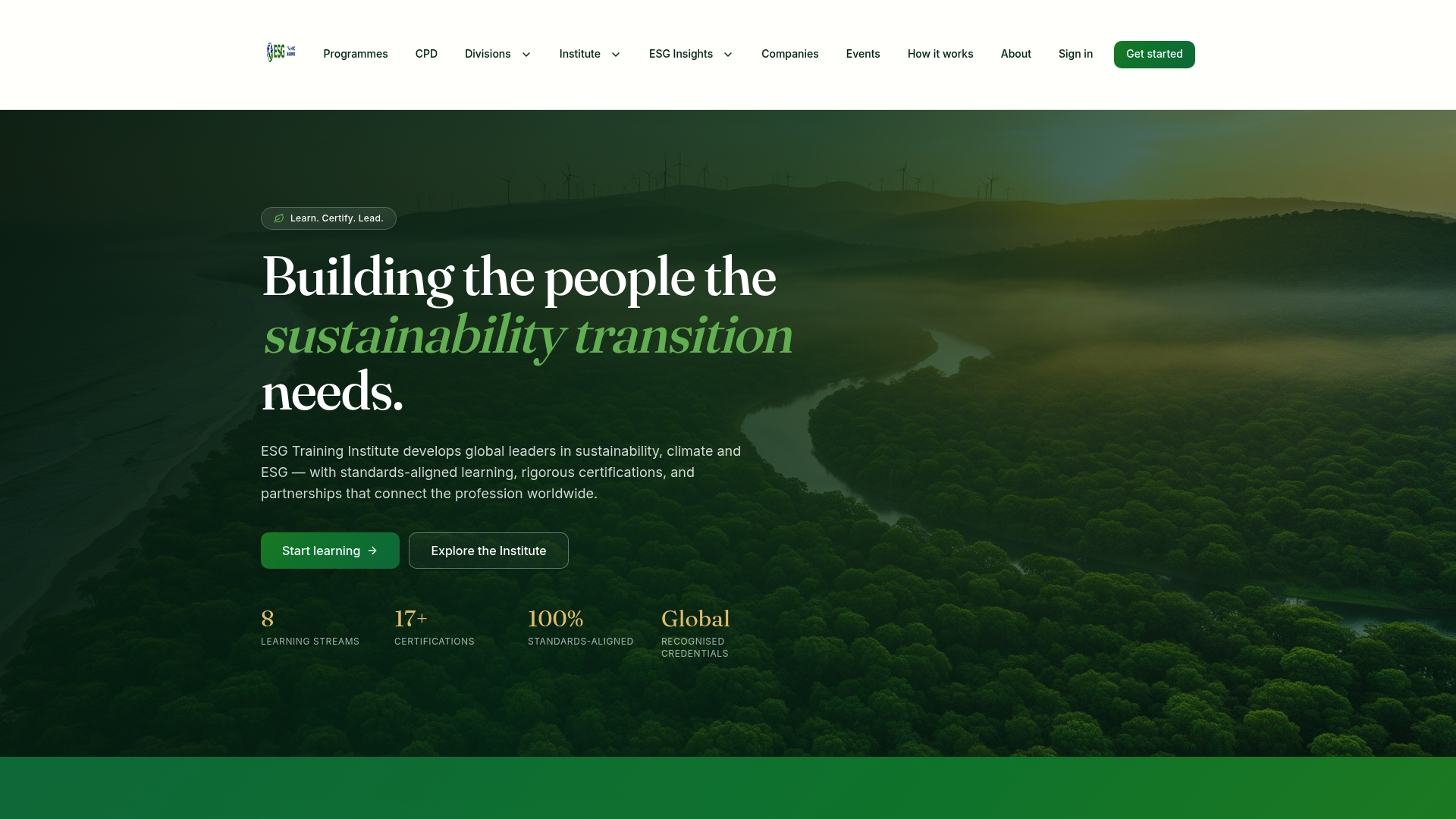
Organizations training multiple staff across reporting, assurance, and risk can use the All-Access CPD Pass at $599 per year for ongoing access rather than purchasing courses one at a time. The practical next step is a short board briefing followed by one targeted course for the directors or managers closest to the gap. Visit the course catalog to match a program to your committee's immediate needs.
Sources
- World Bank — Appendix 6. Sustainability Committee Charter
- IFRS S2 — Transition plan disclosure (supporting implementation)
- Organon — ESG Committee Charter (example wording and duties)
FAQ
Is ESG still relevant in 2026?
Yes, regulatory disclosure requirements under frameworks like IFRS S2 continue to expand globally, which keeps board-level ESG oversight a practical governance requirement rather than a discretionary initiative. Investor and regulatory expectations for named governance bodies and climate disclosure have not receded.
What is the purpose of a committee charter?
A committee charter is the board's written mandate defining a committee's purpose, membership, authority, and duties so directors and management both know what the committee oversees. For ESG specifically, World Bank guidance frames the charter as the document that prevents the board from either neglecting oversight or over-governing management's execution.
What are the big 4 ESG standards?
Definitions vary across jurisdictions, but the frameworks most frequently referenced in governance and disclosure work include the ISSB standards (IFRS S1 and S2), the European Sustainability Reporting Standards (ESRS), the GRI Standards, and sector-specific frameworks such as TNFD for nature-related disclosure. Boards should confirm which combination applies to their jurisdiction and listing requirements before drafting disclosure language.
What does Trump think about ESG?
Political positions on ESG shift with administrations and are not a governance standard; boards should base charter decisions on applicable disclosure rules and investor expectations in their own jurisdiction rather than on any single political viewpoint. The regulatory requirements referenced in this article, including IFRS S2, remain the relevant benchmark for charter drafting regardless of political debate.