

ESG data governance organizes ownership, controls, lineage, and mapping so that sustainability data holds up under audit and drives real decisions. The concrete outcome is defensible, assurance-ready disclosure aligned to frameworks like TCFD, ESRS, and ISSB. Without that architecture, ESG figures remain guesses dressed up as metrics.
TL;DR:
- Strong ESG data governance requires clear ownership, defined processes, and traceability to ensure data accuracy and defendable disclosures.
- The operating model—centralized, hybrid, or decentralized—directly impacts data reliability and the ability to pass assurance reviews, with organizational alignment crucial.
- Building ongoing governance capabilities involves phased implementation, regular monitoring, and continuous training to adapt to shifting regulations and standards.
- Assurance readiness hinges on documented evidence, data lineage, and method transparency, with organizations embedding controls across collection, calculation, and reporting stages.
- Integrating ESG data systems with existing enterprise architecture and establishing shared responsibilities between IT and sustainability teams prevents data fragmentation and reduces restatements.
Table of Contents
- What Are the Core Pillars of ESG Data Governance?
- Which Operating Model Fits Your ESG Data Domain?
- Who Owns, Stewards, and Approves ESG Data?
- What Data Quality Standards Do Auditors Expect?
- How Does ESG Data Flow From Collection to Disclosure?
- How Do You Map Governance to ESRS, ISSB, and GHG Protocol?
- What Does a 12-Month Governance Roadmap Look Like?
- What Mistakes Derail ESG Data Governance Programs?
- How Does Training Build Governance Capability?
- How Should ESG Data Governance Connect to Enterprise IT?
- How Do You Keep Pace With Changing ESG Regulations?
- Author Perspective: Governance Is a Capability, Not a Project
- Build Governance Skills With Esgtraininginstitute
- Sources
- FAQ
What Are the Core Pillars of ESG Data Governance?
ESG data governance rests on four pillars borrowed directly from the TCFD framework: governance, strategy, risk management, and metrics and targets. These pillars now anchor ESRS and ISSB requirements too, which is why treating them as a checklist rather than an architecture is the first mistake most organizations make.
- Governance establishes who owns ESG data decisions at board and management level, and who signs off before numbers leave the building.
- Strategy connects data collection to the material topics your organization has actually identified, not a generic industry template.
- Risk management treats data gaps and calculation errors as risk events with owners and remediation timelines.
- Metrics and targets require that every published figure trace back to a defined calculation method and a named accountable party.
ESRS structures its disclosures around these same four areas, layering in a double-materiality requirement. Double materiality asks organizations to assess both how sustainability issues affect financial performance and how the business affects people and the environment. For data governance, that means your control framework has to support two distinct lines of evidence rather than one, and stewards need clarity on which materiality lens a given datapoint serves before they can defend it to an assurer.
Which Operating Model Fits Your ESG Data Domain?
An ESG data domain is a defined, governed set of data assets covering emissions, workforce, safety, and governance metrics, with agreed definitions, owners, and lineage. KPMG points to this domain structure as what separates reliable ESG data from data that collapses under scrutiny, because it gives every stakeholder a single source of truth instead of six spreadsheets claiming to be the same number.
Three operating models are common in practice:
- Centralized — a single ESG data team owns collection, calculation, and quality checks across the organization. Best for smaller organizations or early-stage programs where consistency matters more than local nuance.
- Hybrid — a central team sets standards and owns the data domain, while business units or regions execute collection under that governance. This fits most mid-size and large organizations because it balances consistency with local operational reality.
- Decentralized — each business unit or region manages its own ESG data independently. This scales poorly for reporting and is the model most likely to fail an assurance review, since KPMG's research identifies fragmented ownership as a leading cause of program failure.
An ESG Data Quality Board, meeting monthly or quarterly, gives the hybrid model teeth. It resolves definitional disputes, approves changes to calculation methodologies, and keeps finance, sustainability, and IT aligned before restatements become necessary.
Who Owns, Stewards, and Approves ESG Data?
Clear roles are what turn a governance framework from a document into a working system. Four roles recur across mature programs, each with a distinct job.
- Data owner — accountable for the accuracy and completeness of a specific dataset (say, Scope 1 emissions), typically a business unit leader.
- Data steward — handles day-to-day data quality, definitions, and issue resolution; the person auditors will actually call.
- Domain lead — oversees the entire ESG data domain, coordinating owners and stewards across topics.
- Executive sponsor — a board or C-suite figure who owns governance accountability and signs external disclosures.
Control points matter as much as titles. Every reported figure needs a defined approval checkpoint before publication, and finance should sign off on any metric feeding financial statements or investor-facing reports, since ESRS increasingly treats sustainability and financial data as one reporting chain rather than two.
Pro Tip: Give stewards a standing seat in your financial close calendar, not a separate ESG timeline. Data quality issues surface faster when the same rigor and deadlines apply to both.
Training closes the gap between role definition and role competence. Owners need materiality and risk literacy; stewards need calculation methodology and data lineage skills; assurance leads need standards fluency across ISAE, ESRS, and GHG Protocol.
What Data Quality Standards Do Auditors Expect?
Assurance providers evaluate ESG data against the same lens they apply to financial data, and third-party standards like ISAE 3000 and ISAE 3410 assess five dimensions specifically.
- Accuracy — does the reported figure match the underlying source document and calculation?
- Completeness — are all required entities, sites, and time periods included?
- Timeliness — was the data collected and reported within the disclosure window?
- Consistency — do definitions and methods stay stable period over period, with restatements flagged and explained?
- Provenance and lineage — can you trace a number back through every transformation to its original source?
Source-document linkage and calculation logs are what make lineage real rather than aspirational. Every emissions figure should link to the invoice, meter reading, or utility bill behind it, alongside a log noting which emission factor and vintage year was applied. Version control matters just as much: when a factor updates or a boundary changes, the system needs to show what changed, when, and who approved it.
Organizations that build these dimensions into ongoing monitoring, rather than a pre-audit scramble, catch discrepancies months before assurance season starts. That gap in timing is often what separates a clean assurance opinion from a qualified one.
How Does ESG Data Flow From Collection to Disclosure?
The ESG data lifecycle moves through five stages, each needing its own control point: collection, calculation, storage, approval, and mapping to disclosure. Skipping controls at any single stage tends to surface as a restatement later, which is far more expensive than catching it early.
- Collection — data enters from utility bills, HR systems, supplier surveys, or IoT sensors; control point is source validation at intake.
- Calculation — raw data becomes a reportable metric using a defined method and emission factor; control point is a documented calculation log.
- Storage — data sits in a governed repository with access controls and retention rules; control point is version history.
- Approval — a named owner or steward signs off before the figure moves downstream; control point is a documented approval trail.
- Mapping to disclosure — the approved figure feeds specific framework datapoints; control point is a maintained mapping layer, kept separate from raw data so the same measurement can feed ESRS, ISSB, and GRI without re-collecting anything.
On tooling, extend what you already run in enterprise data management, such as an existing data catalog or lineage tool, before buying a specialized ESG platform. Most organizations only need new connectors for genuinely novel ESG-specific sources like biodiversity or supply-chain surveys.
How Do You Map Governance to ESRS, ISSB, and GHG Protocol?
ESRS disclosure pillars require governance, strategy, impact and risk management, and metrics and targets, each with specific mandatory datapoints under the double-materiality lens described earlier. ISSB's IFRS S1 and S2 follow a closely related structure, focused on sustainability-related financial disclosures and climate specifically, and both standards are increasingly built for interoperability rather than duplication.
The GHG Protocol sets the rules your emissions calculations must follow underneath both frameworks: defined operational and organizational boundaries, documented emission factors with their source and vintage year, and consistent treatment of Scope 1, 2, and 3 across reporting periods.
Assurance readiness comes down to four checkable things:
- Evidence — a source document behind every figure, not a spreadsheet cell with no trail.
- Traceability — a lineage path from source through calculation to disclosure.
- Methodology — a written, version-controlled description of how each metric is calculated.
- Sign-off — a documented approval chain ending with an accountable owner's name attached.
Assurors reject data that cannot show all four, regardless of whether the underlying number happens to be correct.
What Does a 12-Month Governance Roadmap Look Like?
Building ESG data governance from scratch, or repairing a broken one, follows a phased sequence rather than a single big rollout. Trying to do everything at once is the fastest way to stall a program in month three.
- Months 1 to 2 (Phase 0 to 1) — secure an executive sponsor, run or refresh a materiality assessment, define reporting scope, and choose your operating model (centralized, hybrid, or decentralized).
- Months 3 to 6 (Phase 2) — build the ESG data domain: agree definitions, assign owners and stewards for each dataset, and deploy or extend a data catalog with lineage tracking.
- Months 6 to 9 (Phase 3) — define data quality rules for each metric, set up the ESG Data Quality Board, and start logging calculations and source documents systematically.
- Months 9 to 12 (Phase 4) — map governed data to your target frameworks, run a pilot disclosure internally, complete a pre-assurance check against the ISAE-based checklist, and establish ongoing monitoring KPIs.
Pro Tip: Run your pilot disclosure at month 9, not month 12. A dry run with three months of runway left gives stewards time to fix gaps before real assurance pressure hits.
Organizations that compress this timeline under six months almost always skip the data domain build in Phase 2, and pay for it during assurance with scramble-mode evidence gathering.
What Mistakes Derail ESG Data Governance Programs?
Treating ESG data governance as a one-off reporting project, rather than an ongoing operating discipline, is the single most common failure mode. Regulatory requirements shift yearly, and a governance structure built for last year's disclosure will not hold up unchanged.
- Fragmented ownership across HR, finance, operations, and procurement, with no single data domain tying definitions together, is what the EDM Council flags as the top structural weakness in failed programs.
- Buying new tools before applying existing frameworks wastes budget. Map your ESG data needs against DCAM and COSO ICSR first; most gaps close with process changes, not new software licenses.
- Ignoring the data footprint itself is an emerging blind spot. Practices like consolidation, deduplication, and energy-efficient storage reduce the carbon cost of running your ESG systems, which matters when your own emissions inventory includes IT infrastructure.
How Does Training Build Governance Capability?
Capability gaps, not framework gaps, are what usually stall ESG data governance. A well-designed operating model still fails if stewards cannot read a calculation log or owners cannot defend a materiality judgment to an assuror.
- Data owners benefit most from training in materiality assessment and risk-based data governance.
- Data stewards need calculation methodology, lineage tooling, and quality control training specific to GHG Protocol and ESRS datapoints.
- Assurance and audit leads need standards fluency across ISAE-based assurance, ESRS, and ISSB, plus practical assurance skills for 2026 and beyond.
Esgtraininginstitute builds standards-aligned certification tracks around exactly these role distinctions, which shortens the distance between "we have a framework" and "we passed assurance."
How Should ESG Data Governance Connect to Enterprise IT?
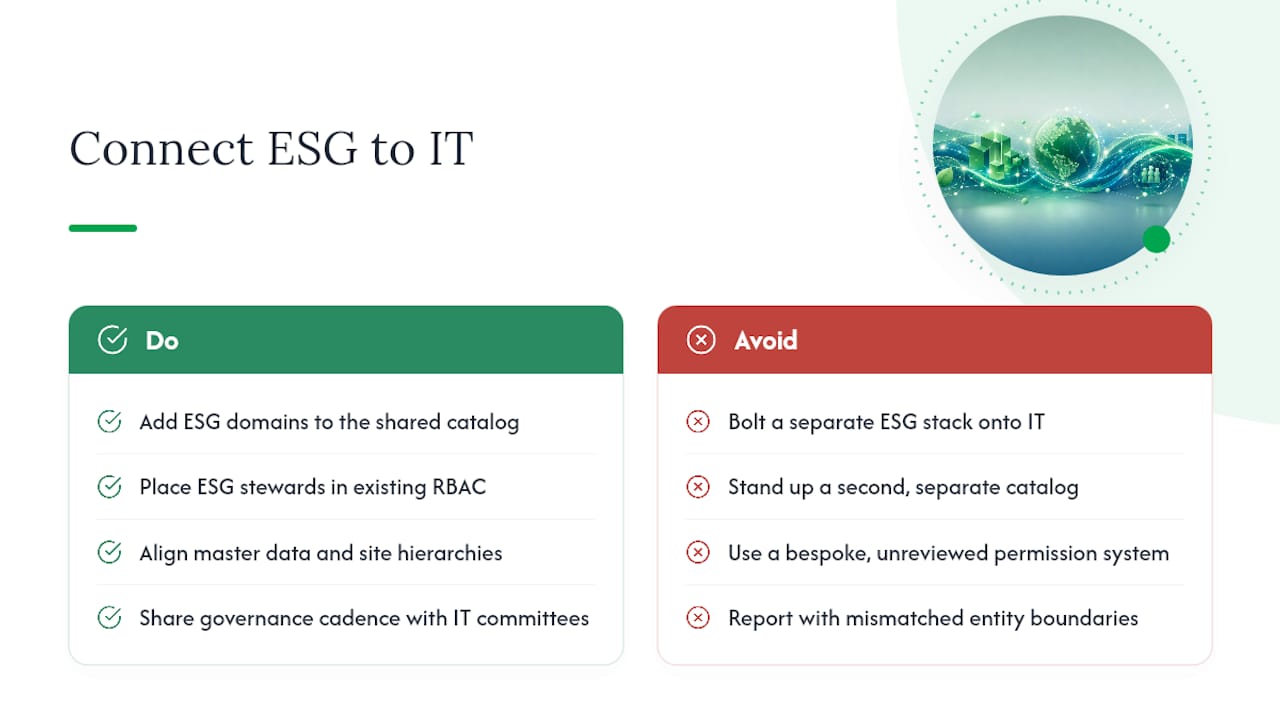
ESG data governance fails when it operates as a parallel system disconnected from the data infrastructure the rest of the organization already trusts. Finance, HR, and operations systems already have master data management, access controls, and audit trails built in. Bolting a separate ESG stack onto that architecture, rather than extending it, is how organizations end up with duplicate definitions of the same headcount or energy figure.
Practical integration starts with a shared data catalog. If IT already maintains one for financial and operational data, add ESG data domains to it rather than standing up a second catalog nobody outside sustainability ever opens. The same logic applies to identity and access management: ESG data stewards should sit inside existing role-based access frameworks, not a bespoke permission system that IT security has never reviewed.
Master data alignment matters too. Entity structures, site hierarchies, and organizational boundaries used for financial consolidation should match the boundaries used for GHG Protocol emissions accounting wherever legally possible. Mismatched boundaries between finance and sustainability reporting are a recurring source of restatement, because a site that rolls up differently in each system produces two different "correct" answers to the same question.
IT governance committees and ESG Data Quality Boards should also share a meeting cadence, even informally, since infrastructure changes like a new ERP migration or a data warehouse consolidation directly affect ESG data lineage and need joint sign-off before they happen.
How Do You Keep Pace With Changing ESG Regulations?
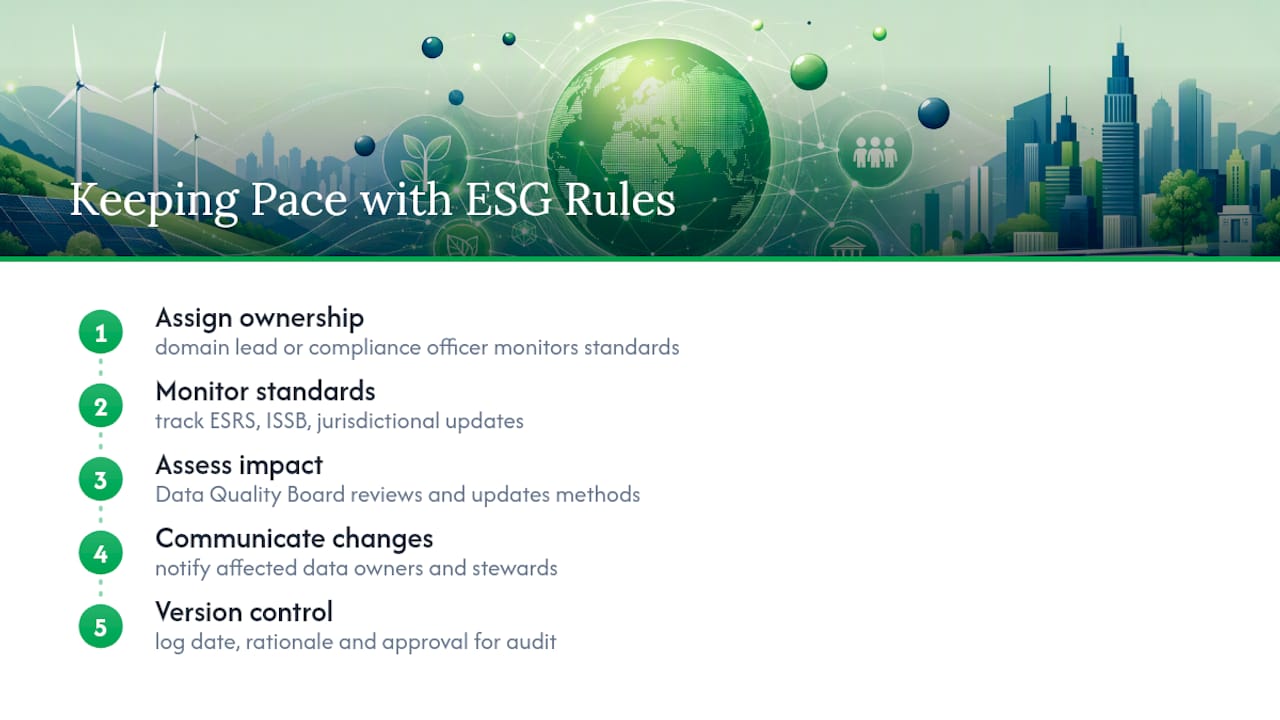
ESG reporting requirements shift on a rolling basis, and a governance framework calibrated for one regulatory snapshot will drift out of compliance within a reporting cycle or two. Building a monitoring mechanism into the governance structure itself, rather than relying on annual legal reviews, is what keeps disclosures current.
A practical approach assigns regulatory monitoring as an explicit responsibility, usually sitting with the domain lead or a compliance officer working alongside them, rather than leaving it as an informal task nobody owns. That person or team tracks updates from bodies issuing the standards your organization reports against, whether that is the ESRS delegated acts process, ISSB's ongoing standard-setting, or jurisdiction-specific climate disclosure rules.
Change management within the data governance framework matters just as much as awareness of the change itself. When a reporting requirement shifts, whether a new mandatory datapoint under ESRS or an updated emission factor set under GHG Protocol, the ESG Data Quality Board should have a defined process to assess impact, update calculation methodologies, and communicate the change to every affected data owner and steward before the next reporting cycle closes.
Version control again does heavy lifting here. Every regulatory-driven change to a definition or calculation method should be logged with a date, rationale, and approval, so a future assuror or auditor can see exactly why a figure calculated differently this year than last. Organizations that treat this as routine maintenance, rather than a crisis response each time a regulator issues an update, adapt faster and restate less.
Author Perspective: Governance Is a Capability, Not a Project
The mistake I keep seeing is treating ESG data governance like a reporting deadline rather than an operating discipline that lives inside finance and audit permanently. A framework built for one disclosure cycle decays the moment a regulator issues an update or a business unit reorganizes. Start with ownership and lineage before anything else. If you cannot name who owns a number and trace where it came from, no amount of framework mapping will save you at assurance time.
— Ransford
Build Governance Skills With Esgtraininginstitute
Governance frameworks only work when the people running them know the standards cold, and that is precisely the gap Esgtraininginstitute closes. Data owners get materiality and risk-based governance training, stewards get calculation methodology and lineage-specific coursework, and assurance leads get standards fluency across ISAE, ESRS, and ISSB, all mapped to the roles this article just walked through.
Certified teams move through assurance cycles faster because they already speak the language an assuror expects, rather than learning it under deadline pressure. Esgtraininginstitute's accreditation programs are built around these exact role distinctions, whether you are training your first data steward or preparing an internal audit team for its next assurance engagement. Details about the current program catalog and enrollment options can be found on the institute's website.
FAQ
What Does ESG Governance Mean?
ESG governance refers to the oversight structures, roles, and controls that ensure environmental, social, and governance data is accurate, traceable, and fit for regulatory disclosure. It covers who owns data, how it is calculated, and how it maps to standards like ESRS and ISSB.
Is ESG Still Relevant in 2026?
Yes. Mandatory disclosure regimes under ESRS and ISSB continue expanding globally, and investors increasingly treat ESG data with the same scrutiny as financial statements, making governance rigor more relevant, not less.
What Are the Big Four ESG Reporting Frameworks?
The most commonly referenced frameworks are TCFD, ESRS, ISSB (IFRS S1/S2), and the GHG Protocol, each covering distinct but overlapping disclosure and calculation requirements.
What Data Management Frameworks Support ESG Governance?
DCAM and COSO ICSR are the two frameworks the EDM Council recommends applying to ESG data, since both let organizations reuse existing enterprise data discipline instead of building a separate governance model from scratch.
How Can I Build ESG Data Governance Skills for My Team?
Structured certification tracks, such as those offered through Esgtraininginstitute, build role-specific competence for data owners, stewards, and assurance leads, shortening the time it takes a team to reach audit-readiness.