

ESG due diligence is a structured, risk-based process to identify, prevent, mitigate, and account for environmental, social, and governance impacts across a company's operations and value chain. Investors run it for three reasons: to quantify ESG risk and opportunity before pricing a deal, to inform contract terms and integration plans, and to build a regulatory-ready evidence trail. The OECD's due diligence guidance supplies the framework most practitioners follow, and the EU's Corporate Sustainability Due Diligence Directive is turning that framework into law for companies operating in Europe. The stakes are already visible in deal data.
- Value creation drives adoption. 58% of dealmakers say quantifying ESG risks and opportunities is the primary reason they run ESG due diligence, while 44% cite regulatory response.
- Frameworks are converging. OECD guidance and CSDDD now use the same due diligence steps, so building to one standard largely satisfies both.
- This is a controls process, not a reporting exercise. Evidence, remediation, and tracking matter as much as disclosure.
Key Takeaways
ESG due diligence works when it combines a risk-based OECD-aligned process with procurement authority, continuous evidence tracking, and CSDDD-ready documentation.
| Point | Details |
|---|---|
| Define it correctly | ESG due diligence is a continuous risk-management process, not an annual reporting exercise. |
| Follow the six-step model | Embed, identify, prevent, track, communicate, and remediate, per OECD guidance. |
| Prioritize by severity and likelihood | Escalate high-severity, high-likelihood risks first; avoid auditing everything equally. |
| Package evidence for scrutiny | Corrective action logs and closure rates matter more to regulators than policy statements. |
| Prepare for CSDDD now | Map value chains and build grievance mechanisms ahead of phased transposition deadlines. |
Table of Contents
- What Is ESG Due Diligence, and How Does It Differ From ESG Reporting?
- The ESG Due Diligence Process: A Step-by-Step Framework
- How Do Investors Use ESG Due Diligence in Deals?
- Prioritization and Materiality: Focus Effort Where It Counts
- What Data and KPIs Actually Prove a Program Works?
- What Does CSDDD Actually Require, and by When?
- Common Pitfalls in ESG Due Diligence
- How Professional Training Builds Credible ESG Due Diligence Capability
- Why the Six-Step Model Is Underused Where It Matters Most
- Sources
What Is ESG Due Diligence, and How Does It Differ From ESG Reporting?
ESG reporting tells stakeholders what happened. ESG due diligence is the operational discipline that prevents bad outcomes in the first place, then documents how the company responded when problems surfaced anyway. Reporting is retrospective and often annual. Due diligence is meant to run continuously, embedded in how a company sources, contracts, and manages its business relationships.
Scope matters here. A defensible due diligence program covers a company's own operations, its subsidiaries, and both direct and indirect business partners, not just tier-one suppliers with signed contracts.
- Own operations: policies, training, incident records
- Subsidiaries: consolidated governance and shared controls
- Direct business partners: contracts, audits, corrective action tracking
- Indirect partners: traceability programs, sector-level risk mapping
High-risk sectors (mining, apparel, agriculture) warrant continuous monitoring. Lower-risk service businesses can often rely on periodic reviews, escalating only when a red flag appears.
The ESG Due Diligence Process: A Step-by-Step Framework
Practitioners generally build their programs around the OECD's six-step model: embed, identify/assess, prevent/mitigate, track, communicate, and remediate. Translated into deliverables an investment or risk team can actually produce, it looks like this:
- Embed in policy and governance. Assign ownership (usually a sustainability lead paired with procurement or deal counsel) and write the ESG due diligence policy into vendor and investment approval workflows.
- Identify and assess impacts. Scope the assessment using public filings, supplier self-assessments, and sector risk indexes; screen for severity and likelihood before doing deep-dive work.
- Prevent and mitigate. Use contractual clauses, corrective action plans, and commercial leverage (renewal terms, volume commitments) to push change where you have found real risk.
- Track performance. Monitor corrective action closure rates and recurrence of the same issue year over year; verification cadence should match risk tier.
- Communicate and remediate. Maintain a grievance mechanism, and package evidence (audit trails, corrective action logs, remediation outcomes) in a format auditors and regulators can actually review.
Pro Tip: Build your evidence packaging around what a regulator or acquirer would ask for on day one of a review, not what is convenient to produce internally. Retrofitting evidence after the fact is where most programs lose credibility.
Every step generates a document deal teams and compliance officers will eventually need: a policy, a risk register, a corrective action tracker, a KPI dashboard, and a grievance log.
How Do Investors Use ESG Due Diligence in Deals?
Investment committees do not want narrative ESG commentary. They want specific answers that map to deal terms. Standard investor questionnaires probe four areas: written ESG policies and their enforcement history, past incidents and how they were resolved, remediation timelines and outcomes, and the strength of supplier-level controls.
Findings from these questionnaires flow directly into deal mechanics. A pattern of unresolved supplier incidents can shift purchase price, trigger specific representations and warranties, or push part of the consideration into escrow pending remediation. BCG's framework for commercial due diligence treats ESG findings the same way it treats any other value driver: benchmark performance, flag material gaps, and identify where fixing them creates value rather than just avoiding loss.
A practical scoping checklist by deal stage:
- Screen: sector risk flags, sanctions and controversy checks, public disclosure review
- Diligence: on-site or virtual site checks, supplier questionnaires, policy and incident review
- Post-close: 100-day remediation plan, KPI baseline, integration of ESG controls into the combined entity's governance
Prioritization and Materiality: Focus Effort Where It Counts
Not every finding deserves the same attention. A severity times likelihood framework keeps due diligence teams from drowning in low-value checklist work. An impact that is severe and likely (child labor risk in a tier-two supplier region, for instance) gets escalated to a site-level assessment immediately. An impact that is minor and unlikely gets logged and monitored, not investigated to exhaustion.
- Sector changes the baseline: extractives and apparel carry higher inherent risk than professional services.
- Geography matters: operations in jurisdictions with weak labor enforcement warrant deeper scrutiny regardless of sector.
- Supplier criticality (revenue concentration, substitutability) should raise or lower the diligence intensity independent of the ESG risk itself.
Nearly half of dealmakers name regulatory response as their top driver for running ESG due diligence at all, which is exactly why a defensible, risk-based prioritization method matters more than an exhaustive one. Regulators and courts tend to ask whether effort was proportionate to risk, not whether every supplier was audited. Read more on how to weigh significance in a double materiality assessment.
What Data and KPIs Actually Prove a Program Works?
Policies on paper prove nothing. Evidence does. Credible programs pull from public filings, supplier self-assessments, third-party ESG ratings, and, for higher-risk relationships, on-site checks that go beyond a supplier's own paperwork.
The KPIs that matter to both investors and regulators are operational, not aspirational:
- Corrective action closure rate (what percentage of flagged issues actually get fixed, and how fast)
- Recurrence rate (whether the same violation shows up again after remediation)
- Supplier improvement trends over multiple audit cycles
- Percentage of high-risk suppliers under continuous monitoring versus periodic review
Third-party verification earns its cost for high-severity findings or wherever a supplier's self-reported data cannot be reconciled with independent sources.
What Does CSDDD Actually Require, and by When?
The Corporate Sustainability Due Diligence Directive makes the OECD's voluntary steps legally binding for in-scope EU companies, with obligations phasing in across company size bands through the end of the decade. In-scope firms must identify and address adverse human rights and environmental impacts across their own operations, subsidiaries, and business partners, and back that work with documented evidence, not policy statements.
- Map your value chain now, even before your exact transposition date is confirmed.
- Stand up a grievance mechanism that meets the directive's accessibility requirements.
- Treat stakeholder engagement as an ongoing input, not a one-time consultation.
Regulatory scrutiny raises the evidentiary bar considerably. A human rights due diligence review under CSDDD increasingly expects documented remediation outcomes, not just a signed supplier code of conduct.
Common Pitfalls in ESG Due Diligence
Supplier-paid audits are notoriously easy to game, so verify audit scope and auditor independence directly. Traceability often breaks down beyond tier-one suppliers. And when sustainability teams lack authority over procurement contracts, findings rarely translate into enforceable change.

How Professional Training Builds Credible ESG Due Diligence Capability
Running a defensible ESG due diligence program requires skills most teams do not have in-house yet: carbon accounting, structured stakeholder engagement, and assurance-ready evidence packaging. Esgtraininginstitute's certification pathways build exactly these competencies, mapped to what regulators and investment committees actually expect to see.
- Foundation and professional certifications cover carbon accounting, governance, and supply chain risk
- Corporate training packages build in-house capability across a full sustainability or risk team
- Credentials align directly with CSDDD-era evidence and disclosure expectations
Pro Tip: If your team is building its first supplier risk register, start certification with the people who own procurement relationships, not just the sustainability function. That is where diligence findings actually turn into contract changes.
Explore accreditation pathways built for sustainability leads, risk officers, and assurance practitioners who need regulator-ready skills fast, or review course options at ESG Training Institute.
Why the Six-Step Model Is Underused Where It Matters Most
The research is fairly clear on one point that conventional advice glosses over: most ESG due diligence programs fail not from lack of policy, but from lack of procurement authority. You can write a flawless risk register and still watch corrective actions stall because the sustainability team has no say over contract renewal terms.
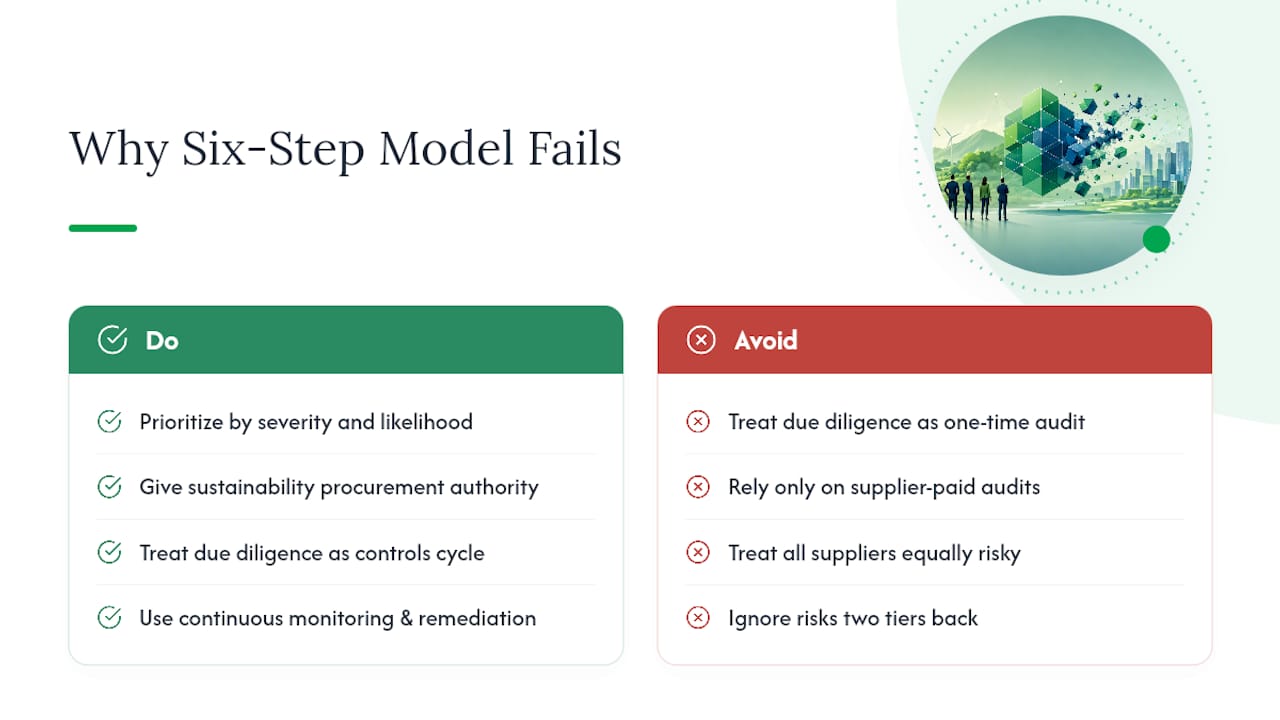
The bigger miscalculation I see is treating due diligence as an audit event rather than a controls cycle. Supplier-paid audits get gamed constantly, and tier-one visibility means little when the real risk sits two tiers back in the supply chain. Regulators writing CSDDD clearly understood this, which is why the directive rewards continuous monitoring and documented remediation over one-time certification.
If you take one thing from this guide, prioritize ruthlessly. Severity and likelihood should decide where your team spends its hours, not a checklist that treats every supplier as equally risky. Firms that get this right treat ESG due diligence as a value-creation tool first and a compliance obligation second, which is exactly what the dealmaking data shows separates programs that work from programs that just produce paperwork.
— Ransford
Sources
- OECD Due Diligence Guidance for Responsible Business Conduct — OECD
- Directive (EU) 2024/1760 on corporate sustainability due diligence — EUR-Lex
- Elevating ESG in commercial due diligence — BCG