

An ESG governance structure assigns board oversight, names a management owner, and documents controls and reporting cadence for sustainability performance. The recommended posture pairs board or committee oversight with a dedicated executive owner, backed by written charters and a fixed reporting rhythm. Organizations without this in place should start with a short diagnostic and appoint an ESG owner before drafting any charter.
TL;DR:
- Implementing a clear ESG governance structure requires appointing a dedicated owner and establishing formal oversight, reporting cadence, and decision rights.
- Regulation demands detailed disclosure of board and management responsibilities for ESG, with specific focus on control processes and linked executive incentives.
- The most effective oversight models balance board involvement with committee specialization or a dedicated ESG committee, avoiding siloed structures.
- Building a phased rollout—from diagnostic to measurement—ensures accurate data flow, aligned KPIs, and reliable external disclosures within a year.
- Training and capacity-building for ESG roles, backed by certification, are essential to ensure data integrity, effective governance, and compliance with evolving reporting standards.
Table of Contents
- What Is an ESG Governance Structure?
- Why Does ESG Governance Now Demand Board Attention?
- Which Board Oversight Model Fits Your Company?
- How Should Management Own ESG Day to Day?
- What Does a Phased Rollout Actually Look Like?
- What Metrics and Controls Belong in Your Reporting Framework?
- What Belongs in Your Governance Charters and Disclosures?
- How Do You Sequence Implementation Over the Next Year?
- How Does Training Close the Capability Gap?
- A Practitioner's View on What Actually Slows Governance Down
- Build the Capability Your Governance Structure Depends On
- Sources
What Is an ESG Governance Structure?
An ESG governance structure is the formal arrangement of board oversight, executive accountability, and internal controls that directs how a company sets sustainability strategy, tracks performance, and reports results. It is not a separate discipline bolted onto corporate governance. It is corporate governance extended to cover environmental, social, and governance risks and opportunities the same way it already covers financial reporting and internal audit.
The distinction matters because ESG governance intersects directly with existing board duties: fiduciary oversight, risk appetite, and internal control assurance now extend to climate exposure, workforce practices, and ethical governance policies. Boards that treat these as adjacent, informal add-ons tend to produce inconsistent disclosures and weak audit trails.
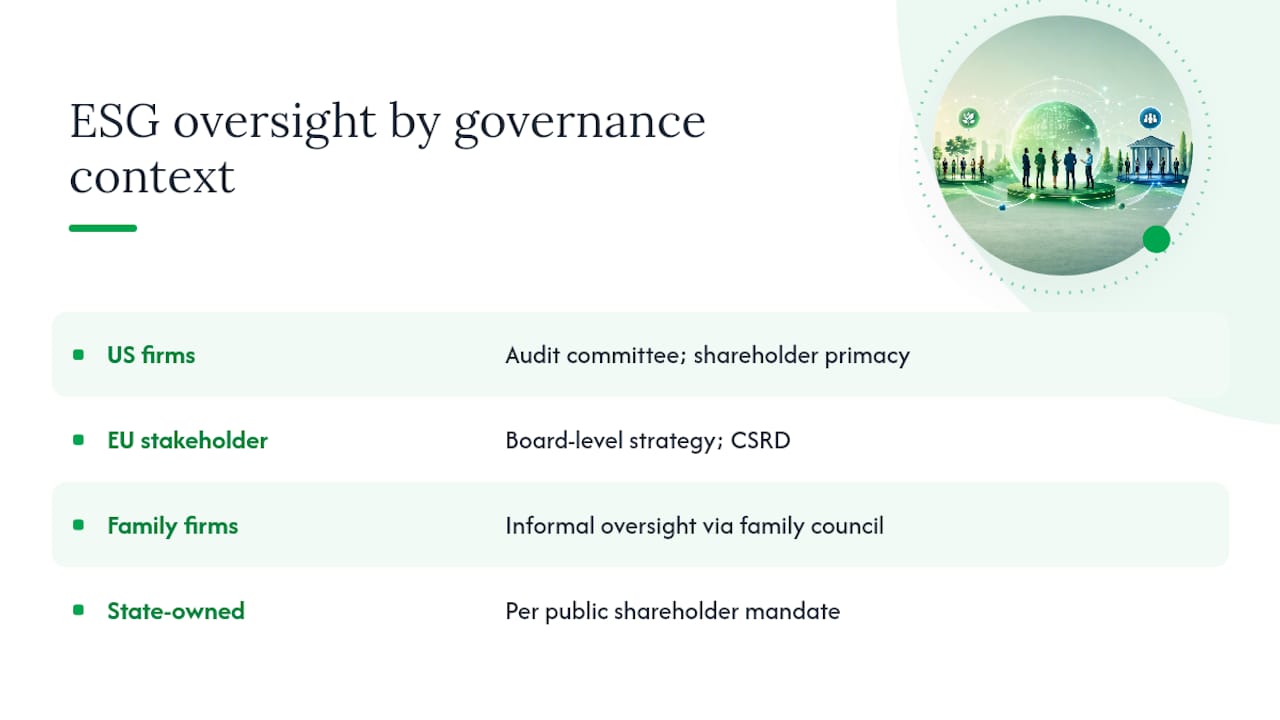
How this plays out depends on the underlying governance model. A shareholder-primacy company in the United States typically routes ESG oversight through an audit or nominating committee. A stakeholder-oriented company in continental Europe often integrates it into board-level strategy discussions under CSRD. Family-owned firms frequently assign oversight informally to a family council member, while state-owned enterprises tend to follow whatever sustainability mandate their public shareholder sets. The G20/OECD Principles of Corporate Governance offer the closest thing to a universal reference point across these models.
Why Does ESG Governance Now Demand Board Attention?
Regulation is the biggest driver. The Corporate Sustainability Reporting Directive and its European Sustainability Reporting Standards require detailed disclosure of who oversees sustainability matters, how responsibility is delegated, and whether performance metrics feed into executive remuneration. The IFRS Sustainability Disclosure Standards, particularly IFRS S2, impose a parallel expectation outside the European Union: companies must disclose the governance processes and controls used to monitor sustainability-related risks and opportunities under ISSB guidance.
The OECD's Corporate Governance Factbook found that a majority of surveyed jurisdictions now require some form of board-level sustainability responsibility disclosure, and sustainability reporting is mandated by law or regulation in a large share of those markets.
Investors have moved in step with regulators. Stewardship codes, proxy voting guidelines, and third-party assurance requests all assume a company can name who on the board is accountable for ESG oversight and produce evidence to back it up. Companies that get governance right also tend to see it pay off operationally: cleaner risk identification, steadier access to sustainability-linked financing, and fewer surprises during audits.
Which Board Oversight Model Fits Your Company?
Boards generally choose from three structures, and no single option is objectively superior. The Harvard Law School Forum on Corporate Governance frames the decision as one of fit, not hierarchy.
- Full board oversight. Works well for smaller companies or those where ESG risk is concentrated and strategic enough that delegating it would dilute accountability.
- Existing committee oversight. Audit, risk, or nominating and governance committees absorb ESG duties alongside their current mandate. This suits companies where ESG risk overlaps heavily with financial or compliance risk already inside that committee's scope.
- Standalone ESG or sustainability committee. Appropriate for companies with high sustainability exposure, complex supply chains, or heavy investor scrutiny, where dedicated board time produces better decisions than an add-on agenda item.
The standalone model carries one real risk: siloing. If the ESG committee never talks to the audit or risk committee, sustainability oversight drifts away from the controls and incentives that make it credible. The fix is structural, not aspirational: require joint sessions at least twice a year, put a cross-committee member on both rosters, and route all ESG-linked risk items through the enterprise risk management framework rather than around it.
Whichever model a board picks, the charter should record the allocation of duties, meeting cadence, reporting lines to the full board, and how the committee interacts with management's ESG structure. That charter language then becomes the backbone of investor disclosure.
Pro Tip: Draft the committee charter and the disclosure paragraph at the same time. Writing them separately is how companies end up with a charter that says one thing and a sustainability statement that says another.
How Should Management Own ESG Day to Day?
Board oversight only works if management has a clear owner underneath it. Most companies now build this around two or three anchor roles rather than scattering ESG duties across departments.
- Chief Sustainability Officer (CSO). Owns strategy, target setting, and external communication; reports to the CEO or directly to the board committee.
- ESG controller. Owns data integrity, source systems, and evidence trails; typically sits inside or alongside finance, mirroring the internal control role finance already plays for financial reporting.
- Cross-functional ESG steering committee. Brings together finance, legal, HR, operations, and risk on a monthly or quarterly cadence to resolve cross-departmental issues and prepare board packs.
The steering committee is where most governance structures either succeed or quietly fail. Membership should include someone senior enough from finance to sign off on data quality, someone from legal to flag disclosure risk, and someone from HR when social metrics such as pay equity or workforce composition are material. KPMG's research on ESG governance notes that companies rarely need to invent an entirely new structure. Most succeed by threading ESG accountability through committees, reporting lines, and controls that already exist for financial governance.
Linking this structure to internal audit closes the loop: audit should periodically test ESG data controls the same way it tests financial controls, not treat sustainability reporting as a separate, lower-assurance category.
What Does a Phased Rollout Actually Look Like?
Building an ESG governance structure from scratch, or fixing a fragmented one, works best as a sequence rather than a single project. KPMG's phased approach, moving from assessment to design to operationalization to measurement, maps cleanly onto four stages most governance teams can execute within a year.
- Diagnostic. Map material topics against your sector and stakeholders, assess current data maturity, identify who already touches ESG data informally, and flag quick wins, such as consolidating scattered spreadsheets into one reporting owner.
- Design. Choose the board oversight model, set target KPIs, draft committee charters, and build a RACI matrix that names who is Responsible, Accountable, Consulted, and Informed for each ESG data point and disclosure line.
- Implementation. Stand up data pipelines connecting source systems to the reporting function, run a pilot reporting cycle, and produce a mock board pack before the real one goes to the committee.
- Change and capability. Train the people now holding new responsibilities, tie ESG performance to incentive structures where appropriate, and embed governance expectations into normal performance management rather than treating them as a side project.
Pro Tip: Run the pilot reporting cycle at least one full quarter before your first real disclosure deadline. It is the only reliable way to catch data gaps before an external auditor or investor does.
Most governance failures trace back to skipping the diagnostic phase and jumping straight to design. Charters written before anyone has mapped the actual data flow tend to assign responsibility for information nobody can currently produce.
What Metrics and Controls Belong in Your Reporting Framework?
KPI selection should follow disclosure obligations backward, not intuition forward. Group metrics into categories that map to what regulators and investors actually ask for: climate and emissions data tied to ESRS E1 and IFRS S2, workforce and social metrics tied to ESRS S1, and governance metrics, board composition, committee attendance, and remuneration linkage, tied to ESRS 2's general governance disclosures.
- Governance metrics: board and committee meeting frequency, attendance, and skills coverage.
- Process metrics: time from data collection to board reporting, number of control exceptions identified.
- Outcome metrics: emissions intensity, workforce turnover, supplier audit completion rates.
- Assurance-readiness metrics: percentage of disclosed data points with a documented evidence trail.
An ESG controller role, distinct from the CSO, is the practical answer to the data governance problem. This person owns the source-of-truth systems, maintains the evidence trail auditors will eventually request, and works alongside finance and internal audit rather than in a silo next to sustainability strategy.
ESRS 2 explicitly requires disclosure of whether sustainability performance is factored into executive remuneration, which means your control framework needs to trace not just what you measure, but what you pay people to achieve.
Aligning KPIs with ESRS and IFRS S2 metrics early avoids a costly rework later: companies that build reporting frameworks around internal preferences first and regulatory taxonomies second usually end up remapping everything before their first assured disclosure.
What Belongs in Your Governance Charters and Disclosures?
Charters and disclosure text are where governance design becomes evidence. A charter that only states good intentions gives auditors and investors nothing to test.
- State the committee's scope, decision rights, and escalation path to the full board.
- Name the meeting cadence and quorum requirements.
- Define delegation of responsibility for management, using RACI language rather than vague references to "relevant teams."
- Describe how sustainability performance connects to executive incentive structures, since ESRS disclosure rules require this to be addressed directly.
- List the data sources and control owner (typically the ESG controller) responsible for figures used in external reporting.
Disclosure text should mirror the charter almost line for line. If the charter says the audit committee reviews ESG data quality quarterly, the sustainability statement should say the same thing, not a softer or vaguer version of it. Consistency between internal governance documents and public disclosure is one of the first things assurance providers and investors check.
How Do You Sequence Implementation Over the Next Year?
- Months 0 to 3: Appoint an ESG governance owner, run the materiality and data maturity diagnostic, and update existing committee charters to explicitly reference ESG oversight.
- Months 3 to 6: Finalize KPIs mapped to ESRS or IFRS S2 categories, pilot a reporting cycle and mock board pack, and formally appoint or designate an ESG controller.
- Months 6 to 12: Embed data controls into standard internal audit cycles, roll out role-based training across the steering committee, and prepare the first externally assured or investor-facing disclosure package.
Teams that compress this timeline usually skip the pilot cycle, and it shows up later as inconsistent figures across the sustainability statement and the annual report.
How Does Training Close the Capability Gap?
Structure alone does not produce reliable disclosure. The people sitting in the CSO, ESG controller, and committee seats need working knowledge of ESRS mechanics, GHG accounting, and assurance expectations, not just a job title. Role-based training closes that gap faster than learning through trial and error during the first audit cycle.
Naming an accredited certification in a role description or committee charter also signals competence to auditors and investors reviewing governance disclosures, a detail that carries real weight when ESRS 2 requires disclosure of the skills available to those overseeing sustainability matters. Organizations building out an ESG controller function often lean on CPD-style modules during the implementation phase specifically because that role sits at the intersection of finance controls and sustainability data, a combination few professionals arrive with already.
A Practitioner's View on What Actually Slows Governance Down
Governance teams rarely fail because they picked the wrong committee structure. They fail because they design charters before they understand their own data. Two patterns come up constantly: companies that build a beautiful RACI matrix for data nobody can currently produce, and companies that assign an ESG controller role without giving that person real authority over source systems.
If your team is stretched, prioritize the diagnostic over the charter. A charter you rewrite in six months costs less than a disclosure you have to restate. Run the diagnostic first, then design around what you actually find.
— Ransford
Build the Capability Your Governance Structure Depends On
A well-drafted charter is only as credible as the people executing it. Role-based certification can close that gap: providing training for CSOs, ESG controllers, and assurance practitioners named in governance structures but needing practical competence. Unlike traditional generalist courses on ESG concepts, some programs map directly to these roles, offering credentials focused on reporting, assurance, carbon accounting, and governance aligned with real disclosure requirements rather than abstract theory.

Sustainability officers preparing for their first ESRS-aligned disclosure cycle, and risk teams standing up an ESG controller function for the first time, tend to benefit most, since both roles carry direct exposure to the control and evidence-trail expectations covered above. Review the accreditation standards behind Esgtraininginstitute's certifications to see how they align with the skills your charter language already promises investors, and check current course and certification options to match training to the roles in your governance rollout.
Sources
- KPMG — ESG governance: why everyone’s business
- Harvard Law School Forum on Corporate Governance — ESG governance: board and management roles & responsibilities
- G20/OECD Principles of Corporate Governance (2023)
- EUR-Lex — Delegated Regulation (EU) 2023/2772 (ESRS) and related texts