

An ESG metric is a raw data point; an ESG KPI is that same metric tied to a target and a management decision. Scope 1 emissions, percentage of women in leadership, and lost time injury frequency rate (LTIFR) all start as metrics. They become KPIs the moment a company sets a baseline, a target, and a governance action attached to them. The first move for any organization still sorting metrics from KPIs is a materiality assessment.
TL;DR:
- Most organizations mistake tracking metrics for setting meaningful KPIs, leading to dashboards filled with data points that no one uses for decision-making.
- Effective ESG KPIs are linked to clear targets, ownership, and specific management actions, and should be selected based on materiality.
- Data gaps, especially in Scope 3 emissions, require transparent estimation methods and documented assumptions to ensure auditability and reliability.
- ESG frameworks like ESRS, IFRS, GRI, and SASB have similar minimum disclosure standards, emphasizing clarity, boundaries, and comparability for each KPI.
- Focusing on a small set of decision-driven KPIs, rather than numerous disclosure-oriented metrics, significantly improves ESG program impact and stakeholder trust.
Table of Contents
- What Is the Difference Between an ESG Metric and an ESG KPI?
- What Are the Main ESG KPI Categories and Examples?
- How Do You Choose the Right ESG KPIs?
- How Do You Measure ESG KPIs and Handle Data Gaps?
- How Do ESG KPIs Map to ESRS, IFRS, GRI, and SASB?
- How Do You Turn ESG KPIs Into Targets and Management Action?
- Who's Behind This Guide (and How Training Fits In)
- Where to Find Authoritative ESG KPI Standards
- The Real Problem With Most ESG KPI Programs
- Sources
What Is the Difference Between an ESG Metric and an ESG KPI?
An ESG metric is any quantifiable data point tracked over a defined period, such as "a certain quantity of Scope 1 emissions" or "18% employee turnover." It describes a condition. It does not, by itself, drive a decision.
An ESG KPI takes that metric and wraps it in accountability. A KPI has a baseline value, a target, an owner, and a consequence if it misses. For example, Scope 1 emissions become a KPI once a company sets a baseline, commits to cutting it by a significant target percentage by a certain year, and links progress to capital allocation decisions on facility upgrades. The same logic applies to intensity metrics, which express a raw figure relative to output, such as tCO2e per €1 million of revenue or liters of water per unit produced. Intensity figures matter because they let a growing company separate genuine efficiency gains from reductions that only reflect a slower year.
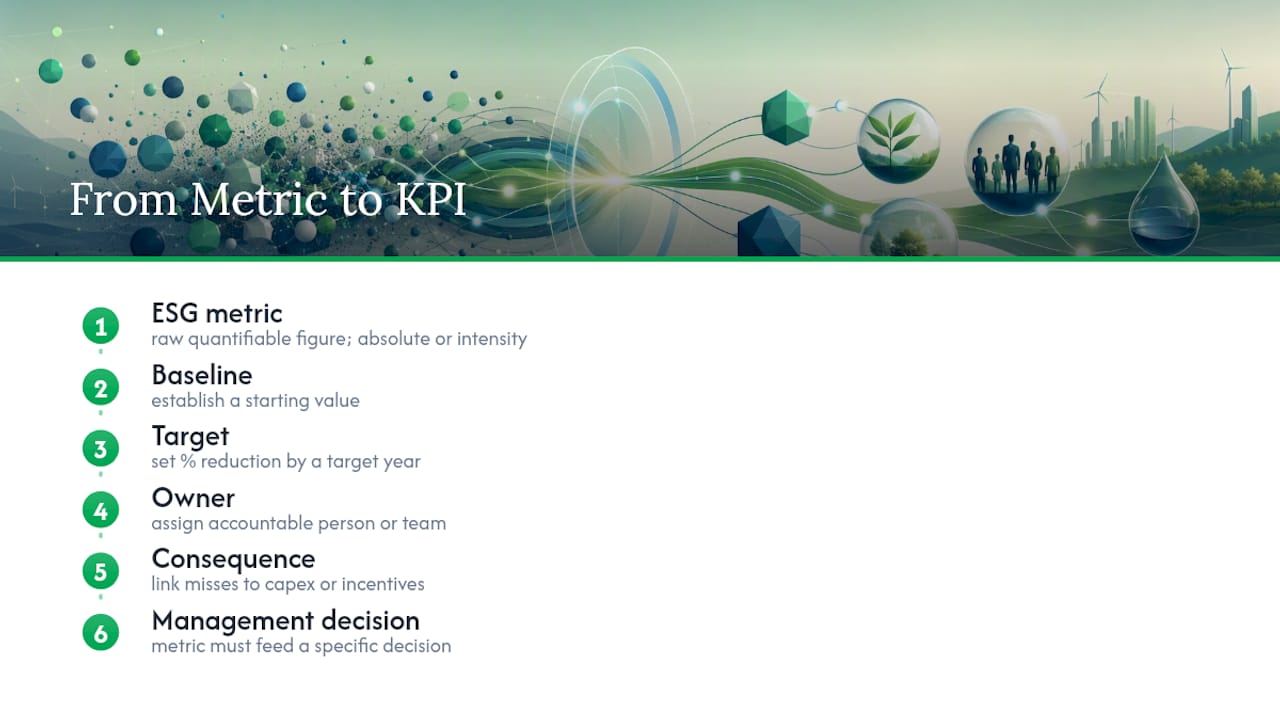
The mistake most organizations make is treating every tracked number as a KPI. That inflates dashboards with metrics nobody acts on. A metric earns KPI status only when it feeds a specific management decision, whether that's a supplier remediation plan, a capex approval, or an executive incentive threshold.
What Are the Main ESG KPI Categories and Examples?
Practitioners generally organize ESG performance indicators into three buckets, and each one carries its own units and typical intensity variants.
Environmental KPIs tend to anchor a sustainability scorecard because they connect directly to regulatory disclosure:
- Scope 1, 2, and 3 GHG emissions (tCO2e), the most commonly tracked KPI set across commonly tracked sustainability metrics, typically drives fleet electrification and supplier engagement decisions.
- Emissions intensity (tCO2e per €1 million revenue) informs whether growth is decoupling from carbon output.
- Energy consumption (MWh) and renewable energy share (%) guide procurement contracts and on-site generation investment.
- Water withdrawal and water intensity (m3, m3 per unit of output) shape facility siting and process redesign in water-stressed regions.
- Waste diverted from landfill (%) informs packaging redesign and circular-supply agreements.
Social KPIs measure how a company treats the people inside and around its operations:
- LTIFR or TRIR (incidents per million hours worked) triggers safety audits and contractor prequalification when it trends upward.
- Employee turnover (%) flags retention risk and often sits behind compensation review decisions.
- eNPS (employee Net Promoter Score) feeds culture and management-training investment.
- Training hours per employee supports workforce development budgeting and skills-gap closure.
Governance KPIs tell stakeholders whether oversight structures actually function:
- Board independence (% of independent directors) informs nominating-committee decisions.
- Percentage of executive pay linked to ESG performance signals whether incentive design matches stated commitments.
- Number of substantiated whistleblower cases drives ethics-training refreshes and internal-control reviews.
A 2026 review of enterprise sustainability practice found many corporate frameworks stay fragmented and overly disclosure-oriented, and it recommends balanced indicator sets that support decisions rather than checklist compliance. That finding matters here: a scorecard with twelve well-chosen KPIs tied to real decisions beats one with forty metrics nobody reviews quarterly.
How Do You Choose the Right ESG KPIs?
Selection starts with materiality, not with a template borrowed from a competitor's sustainability report. Materiality assessment identifies which environmental, social, and governance issues genuinely affect the business or its stakeholders, then prioritizes them through a repeatable process:
- Identify candidate issues across value chain, operations, and stakeholder feedback.
- Prioritize by financial impact and stakeholder concern, often using a scoring matrix.
- Validate the shortlist with internal leadership and external stakeholders, including investors and employee representatives.
- Document the reasoning, since auditors and regulators will ask why a topic was included or excluded.
Once material topics are set, run each candidate KPI against six criteria:
- Relevance: does it connect to a material issue? Board gender diversity matters for a governance-heavy material topic; it says little about water risk.
- Measurability: can you get a number, not just a description?
- Comparability: can you benchmark it year over year or against peers?
- Consistency: does the calculation method stay stable across reporting periods?
- Assurability: could an external auditor verify the underlying data trail?
- Decision-usefulness: does a change in this number change what management does?
Most organizations settle on a core set of KPIs for board-level reporting, with a larger extended set feeding operational teams. Assign an owner to every KPI. A metric without an owner rarely survives its first data-quality audit.
Pro Tip: *Before finalizing any KPI, ask five questions: Who owns this number? Where does the underlying data live? Can we recalculate last year's figure using this year's method? Would an auditor accept our evidence trail?
How Do You Measure ESG KPIs and Handle Data Gaps?
Primary data comes directly from your own systems: utility invoices for energy, payroll records for turnover, safety logs for LTIFR. Secondary data comes from third parties, industry averages, or supplier disclosures, and it carries more uncertainty by nature.
Gaps are normal, especially across Scope 3 value-chain emissions, where few companies have full supplier-level data. When primary data isn't available, organizations rely on estimation methods such as spend-based emission factors or industry benchmarks, and credible sustainability reporting requires disclosing those assumptions rather than presenting estimates as measured fact.
Build an auditable trail from day one:
- Document the emission factor source and version used for every calculation.
- Record which figures are measured versus estimated, and flag the estimation method.
- Keep baseline-year calculations reproducible so restatements are traceable.
- Link KPI inputs to existing operational data (fuel invoices for Scope 1, HR systems for turnover) to cut manual entry and reduce reliability risk.
Auditors reviewing assurance readiness care less about perfect precision and more about whether your methodology is documented, consistent, and defensible under questioning.
How Do ESG KPIs Map to ESRS, IFRS, GRI, and SASB?
Frameworks differ in audience and scope, but they converge on similar minimum disclosure expectations. ESRS, built for EU-scoped companies under the CSRD, structures topical standards that require minimum metric disclosures with defined baselines and methodology. IFRS S1 and S2 under the ISSB target investors and emphasize financially material sustainability risk. GRI serves a broader multi-stakeholder audience with topic-specific standards. SASB, now folded under IFRS, focuses on industry-specific, financially material metrics.
Regardless of framework, expect these minimum elements for every disclosed KPI:
- A clear label and definition
- Defined organizational and time boundaries
- A baseline value and stated target
- Documented calculation methodology
- Comparability across reporting periods
The efficient approach is building one internal data architecture, then mapping each KPI to the specific fields each framework demands, rather than running separate data-collection processes per framework. The SDG global indicator framework, with its 234 unique indicators, also offers a useful cross-reference for benchmarking beyond mandatory disclosure.
How Do You Turn ESG KPIs Into Targets and Management Action?
A KPI only earns its place once it drives a decision. Setting a SMART target (specific, measurable, achievable, relevant, time-bound) converts a tracked number into an accountability tool. Cutting Scope 1 emissions 30% against a 2025 baseline by 2030 is a SMART target; "reduce emissions" is not.
- Set the baseline and target, documented with methodology.
- Build a scorecard that weights KPIs by materiality, not by ease of collection.
- Define escalation thresholds: a 5% miss triggers a review; a 15% miss triggers board escalation.
- Link outcomes to action, whether that's capex approval, supplier remediation, or executive incentive payout.
Who's Behind This Guide (and How Training Fits In)
This guide reflects a practitioner-focused approach to ESG measurement, drawing on frameworks applied across organizations managing significant ESG assets globally. That scale matters because KPI design isn't theoretical for these teams. They build the materiality assessments, carbon accounting models, and assurance-readiness documentation that regulators and auditors actually review.
Building internal capability to run the process above, materiality assessment, KPI selection, data governance, and assurance preparation, requires specific skills. Carbon accounting training builds the technical grounding for Scope 1 through 3 calculations. Assurance-readiness modules teach teams to build the documentation trails auditors expect, a skill set covered in more depth in Esgtraininginstitute's guide to auditor skills. For teams standardizing KPI reporting across multiple frameworks, understanding assurance standards like ISSA 5000 also helps, as explored in this overview of the new global assurance standard.
Where to Find Authoritative ESG KPI Standards
For benchmarking against a globally recognized indicator set, consult the UN SDG indicator framework. For mandatory disclosure requirements and minimum metric fields, use ESRS guidance through PwC's sustainability reporting resources. For a practical KPI catalog with units, TechTarget's sustainability KPI breakdown offers a solid working reference, and Esgtraininginstitute's ESG Insights hub tracks framework updates as they land.
The Real Problem With Most ESG KPI Programs
Most organizations don't fail at ESG measurement because they lack data. They fail because they collect data first and ask what it's for later. Conventional advice tells companies to "align with GRI" or "adopt ESRS metrics" as if framework compliance were the goal. It isn't. Compliance is a byproduct of good decision-making, not a substitute for it.
The research here points to a sharper problem: fragmented, disclosure-driven frameworks produce dashboards full of numbers nobody acts on. The fix isn't more metrics. It's fewer KPIs, chosen through materiality, each one tied to an owner, a target, and a real management lever. A company tracking eight decision-linked KPIs will outperform one drowning in forty disclosure-driven metrics, every time an auditor or investor asks "so what did you do about it?"
If there's one place to start, it's the materiality assessment, not the KPI spreadsheet. Get the material issues right first. The units, the targets, and the scorecard design all follow from that one decision, and skipping it is the single most common reason ESG programs stall at "we measure it" and never reach "we changed something because of it."
— Ransford
Sources
- SDG Indicators — Global indicator framework for the Sustainable Development Goals
- Circular Economy and Sustainability — study on fragmented enterprise sustainability frameworks
- 17 sustainability KPIs businesses track and what they measure | TechTarget
- 5.4 Measurements in sustainability reporting | PwC Sustainability Reporting Guide