

Two documents make or break green bond compliance: an annual allocation report and an impact report. Together they must show, in audit-ready detail, exactly where bond proceeds went, what environmental outcomes resulted, and how those figures were calculated. Reporting continues every year until the proceeds are fully allocated, and where a framework requires it, an external reviewer signs off on the numbers before publication.
The minimum allocation content includes a list of green bond transactions, amounts allocated by eligible category, any unallocated balance, and a stated timeline to full allocation. The minimum impact content includes core indicators such as avoided greenhouse gas emissions, renewable capacity enabled, or area conserved, alongside the methodology and baselines behind those figures. The ICMA Green Bond Principles recommend annual reporting on both fronts, and Regulation (EU) 2023/2631 makes several of these elements mandatory for issuers using the European Green Bond label.
- Transaction list with amounts allocated per eligible category
- Unallocated proceeds balance and expected timeline to close the gap
- Core impact indicators with stated methodology and baseline year
- Confirmation of external review status, where applicable
Pro Tip: Draft your allocation and impact sections as one combined document, but keep separate evidentiary trails. Reviewers verifying allocation data want bank reconciliations; reviewers checking impact claims want methodology notes and assumptions. Blending the narrative is fine. Blending the evidence is not.
Key Takeaways
Compliant green bond reporting requires an annual allocation report and an impact report, each with disclosed methodology, standardized indicators, and external review where the applicable framework demands it.
| Point | Details |
|---|---|
| Two reports, two disciplines | Allocation reporting is a financial exercise; impact reporting is a methodological one, and they need separate evidentiary trails. |
| Report until fully allocated | Annual allocation reporting continues every year until proceeds are completely allocated to eligible projects. |
| Disclose methodology, not just numbers | Baseline year, boundary rules, and emission factors must accompany every impact indicator claimed. |
| Book reviewers early | Complex portfolios often need 90 or more days of external review lead time before publication. |
| Train the team behind the report | Esgtraininginstitute's accreditation programs build template mapping, methodology, and assurance-readiness skills for reporting teams. |
Table of Contents
- Green Bond Reporting Scope: Allocation vs. Impact
- Allocation Report: Required Contents and a Practical Checklist
- Impact Report: Core Indicators, Methodology, and Common Pitfalls
- External Review, Assurance, and Reporting Timelines
- Which Templates Apply: ICMA, EuGB, and National Frameworks
- Best Practices and Red Flags in Green Bond Disclosure
- Building Reporting Into Governance, Not Just Publication
- Training Teams to Meet Reporting and Assurance Expectations
- Where to Find the Standards and Templates
- Frequently Asked Questions
- Sources
Green Bond Reporting Scope: Allocation vs. Impact
Allocation reporting tracks the flow of money. Impact reporting tracks the flow of outcomes. Confusing the two is the single most common structural error in green bond reporting, and it usually stems from treating both as one exercise owned by one team.
Allocation reporting is a financial exercise. It needs to be audit-ready, tied to transaction records, and typically sits with treasury or finance. Impact reporting is a methodological exercise. It relies on assumptions, emission factors, and sometimes ex‑ante estimates, and usually sits with sustainability or technical teams closer to the underlying projects.
Three standards define these roles clearly:
- ICMA Green Bond Principles — set the four core components: Use of Proceeds, Project Evaluation and Selection, Management of Proceeds, and Reporting
- Harmonised Framework for Impact Reporting — provides sector-specific core indicators and methodology guidance
- Regulation (EU) 2023/2631 (EuGB) — mandates specific templates and timing for issuers using the European Green Bond designation
Allocation Report: Required Contents and a Practical Checklist
A complete allocation report answers one question repeatedly: where, exactly, did the money go? That means listing every green bond issuance, the amount allocated per issuance, the breakdown by eligible category, and the balance still sitting unallocated. It also means disclosing how temporarily unallocated proceeds are managed, what share of financing is refinancing versus new financing, any co-financing arrangements, and whether any projects were reallocated or substituted during the reporting period.
| Allocation Field | What To Report |
|---|---|
| Green bond issuances | List each issuance with issue date and outstanding amount |
| Allocated amounts by category | Break down by eligible project category (renewable energy, clean transport, etc.) |
| Unallocated proceeds | State the balance and where funds are held pending allocation |
| Refinancing vs. new financing | Disclose the split, since investors weigh these differently |
| Reallocations or substitutions | Explain any project removed or replaced and why |
The evidence behind these numbers matters as much as the numbers themselves. Reporters should maintain transaction records, bank reconciliations, and a documented pro-rated allocation methodology for shared or portfolio-funded projects.
- Assign a named owner for each allocation field, not just for the report as a whole
- Define source documents in advance (ledger entries, treasury confirmations, project invoices)
- Calendar reconciliations quarterly rather than scrambling before publication
- Book external reviewer time early. Reviewer capacity fills up fast in reporting season
Impact Report: Core Indicators, Methodology, and Common Pitfalls
Investors reading an impact report want numbers they can trust, not numbers that sound impressive. That means picking indicators that match ICMA's Harmonised Framework for Impact Reporting and disclosing exactly how each figure was calculated.
Core indicators worth anchoring a report around include avoided greenhouse gas emissions in tonnes of CO2 equivalent per year, renewable capacity enabled in megawatts, energy saved in megawatt hours, area conserved in hectares, and beneficiaries reached. Ex‑ante estimates work for projects still under construction; ex‑post results belong once actual performance data exists, and reporters should say clearly which is which.
The methodology gap is where most reports lose credibility. A number without a stated baseline, boundary definition, or emission factor is a claim, not a disclosure. Reporters should specify the baseline year, what counts inside the reporting boundary, which emission factors were applied, and where the underlying data came from.
- Mixing portfolio-level impacts without clear per-project attribution
- Omitting the baseline year or assumption set behind a headline number
- Presenting estimated figures as if they were verified results
- Reusing last year's methodology note without confirming it still applies
External Review, Assurance, and Reporting Timelines
Pre-issuance review checks the framework and factsheet before a bond is sold. Post-issuance review verifies that allocation reports and, where applicable, impact reports match what was promised. These are different jobs done by different reviewers on different clocks, and treating them as interchangeable creates scheduling problems.
Regulation (EU) 2023/2631 sets some of the clearest timing rules in the market: annual allocation reports are required until full allocation, with a 270-day publication window after the relevant reporting period. The UK Government Green Financing Framework commits to a similar annual cadence with external verification until allocation is complete.
- Allocation assurance relies on financial and audit evidence: reconciliations, ledgers, confirmations
- Impact assessment relies on methodology review and plausibility checks against stated assumptions
- Reviewer lead time varies, but complex portfolios often need 90 or more days
Pro Tip: Start external review procurement the moment your fiscal year closes, not after your draft report is finished. Reviewers need time to test methodology, not just proofread a document.
Which Templates Apply: ICMA, EuGB, and National Frameworks
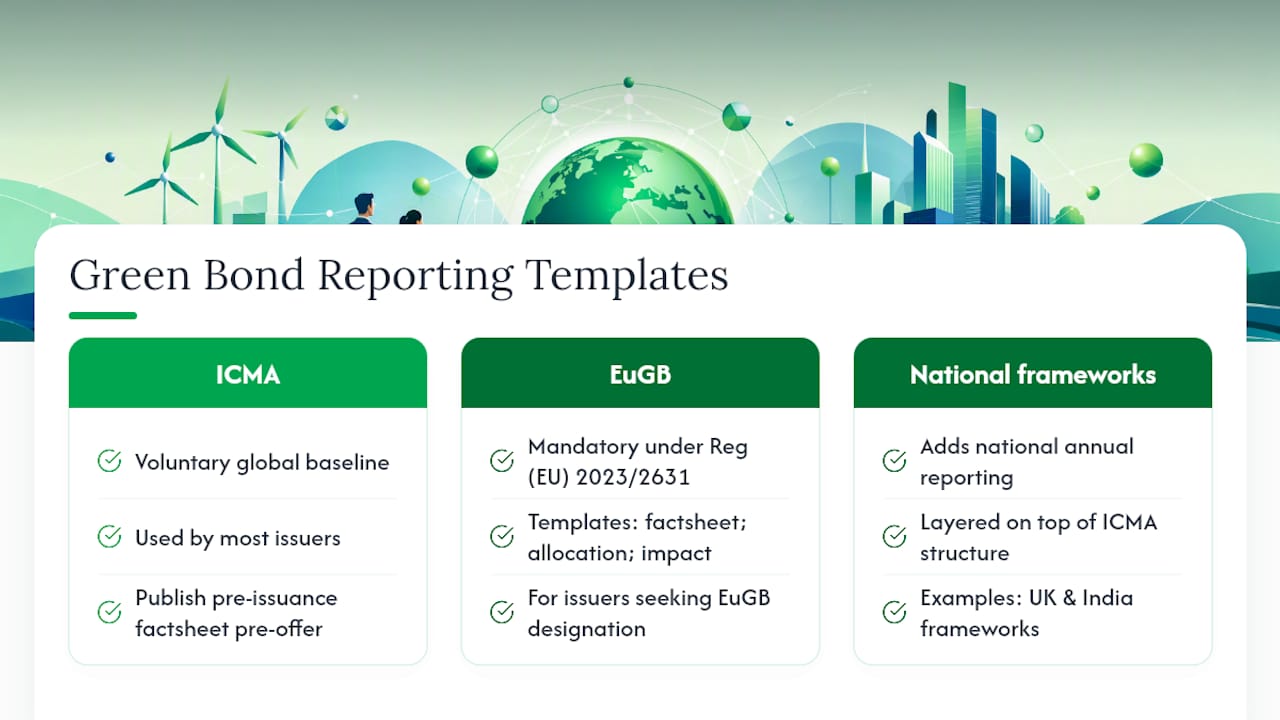
Three template families dominate green bond reporting right now, and picking the right one depends on what your issuance is designed to do. The ICMA Green Bond Principles and its Harmonised Framework remain the voluntary global baseline most issuers align to regardless of jurisdiction. Regulation (EU) 2023/2631 introduces mandatory factsheet, allocation report, and impact report templates for issuers seeking the European Green Bond designation specifically. National frameworks, including the UK Government's and the Government of India's sovereign green bond framework, typically layer their own annual reporting commitments on top of ICMA's structure.
Voluntary issuers not seeking EuGB status should default to ICMA alignment and publish the pre-issuance factsheet before the offering opens.
Pro Tip: Keep a mapping table inside your framework document that cross-references every report section to its corresponding template field and external review deliverable. It turns a scattered reporting process into something a reviewer can trace in minutes.
Best Practices and Red Flags in Green Bond Disclosure
Strong reports share a pattern: standardized indicators, disclosed methodology, named data sources, independent post-issuance review, and allocation broken out by project or category with real dollar amounts attached. Weak reports share a different pattern, and it shows up fast once you know what to look for.
Vague use-of-proceeds language with no allocated amounts. Impact numbers with no baseline year. Unallocated proceeds that go unmentioned. A report that never says who reviewed it, or whether anyone did.
Any one of these should slow a reviewer down. Two or more together suggest the report was written to look compliant rather than to be compliant.
Building Reporting Into Governance, Not Just Publication
Reporting quality depends on what happens all year, not just what gets written in the final weeks before publication. Establishing the workflow early prevents the late-stage scramble that produces thin methodology notes and mismatched numbers.
- Assign ownership across treasury, sustainability, and project management, with one name accountable for each report section
- Standardize data collection templates so every project reports the same fields from day one
- Set calendar milestones for quarterly reconciliations, pre-issuance checks, and external reviewer procurement
- Version-control methodology notes so assumptions don't quietly shift year over year
Pro Tip: Start collecting project-level data at the point of project approval, not at reporting time. Impact estimates built from day-one data are far more defensible than numbers reconstructed months after the fact.
Why Transparent Reporting Matters
Weak reporting is the fastest route to a greenwashing accusation, and accusations stick even when the underlying project was sound. Rigorous, methodical disclosure is the strongest defense a treasury team has, and it shows up directly in investor confidence and, over time, in the cost of raising sustainable capital.
Training Teams to Meet Reporting and Assurance Expectations
Most reporting failures aren't caused by bad intentions. They're caused by teams that have never mapped a green bond framework to a template field, or never sat across the table from an external reviewer before. That gap is closable, and closing it early saves months of rework later.
Esgtraininginstitute's role-based programs are built for exactly this gap: reporting officers, treasury staff, and assurance practitioners who need to move from "we published something" to "we published something that survives review." Courses cover template mapping across ICMA and EuGB structures, impact methodology construction, and how to prepare a data package an external reviewer can actually work with. Explore accreditation pathways built around real reporting and assurance workflows, and get your team ready before the next reporting cycle closes in on you.
Where to Find the Standards and Templates
Start with ICMA's Green Bond Principles for the four core components every framework should address, then consult the Harmonised Framework for Impact Reporting handbook for sector-specific indicators. For EuGB-designated bonds, Regulation (EU) 2023/2631 sets the mandatory factsheet and allocation templates directly.
For practical examples, IFC's Green Bond Framework and Canada's allocation and impact report show how project lists, allocation tables, and methodology notes come together in a published document.
- ICMA Green Bond Principles and Harmonised Framework — global voluntary baseline and indicator guidance
- Regulation (EU) 2023/2631 — mandatory EuGB templates and timing
- IFC and sovereign issuer reports — practical, project-level examples worth modeling
Frequently Asked Questions
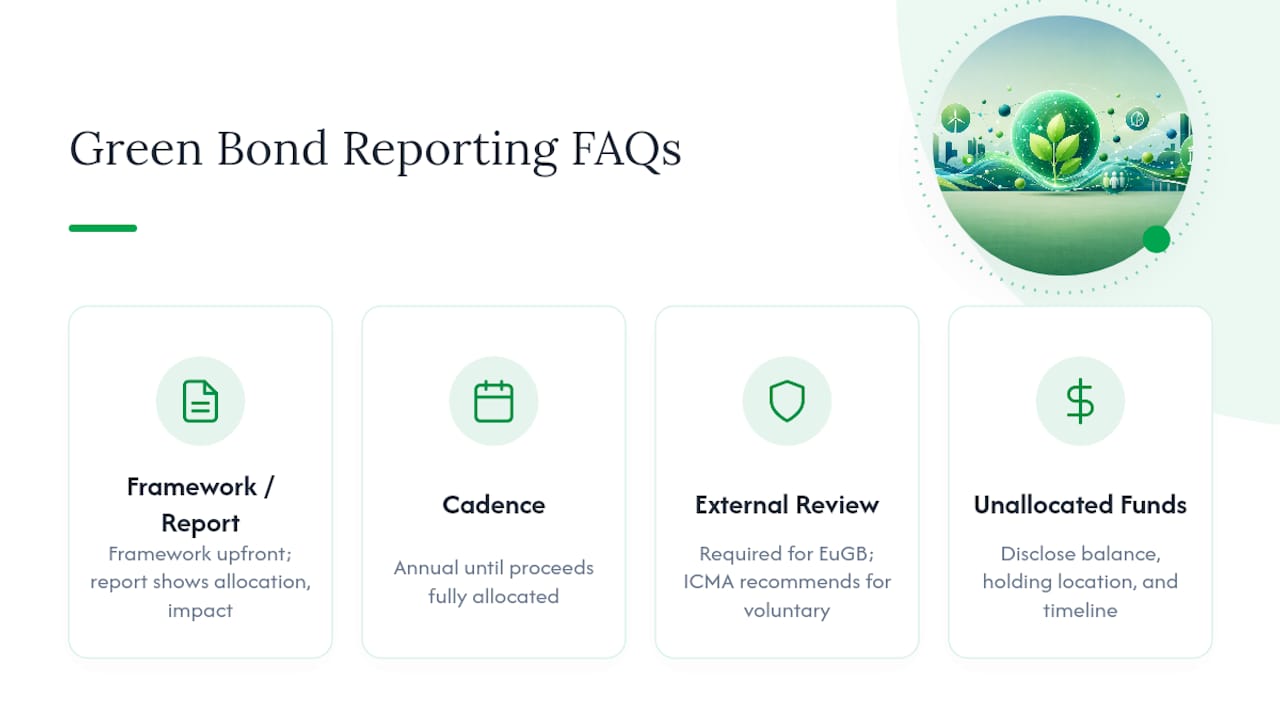
What is the difference between a green bond framework and a green bond report? A framework is the upfront document setting out eligible categories, project selection criteria, and management of proceeds. The report is the annual output showing what actually happened: allocation by category and measured or estimated impact.
How often must issuers publish green bond reporting? Annually, until proceeds are fully allocated. Regulation (EU) 2023/2631 and the UK Government Green Financing Framework both commit to this cadence, and ICMA recommends the same for voluntary issuers.
Is external review mandatory for every green bond report? It depends on the framework. EuGB-designated bonds require post-issuance review under Regulation (EU) 2023/2631. Voluntary ICMA-aligned issuers are strongly encouraged to obtain independent review even where it isn't legally required.
What happens if proceeds remain unallocated at year-end? The report should disclose the unallocated balance, where those funds are held in the interim, and a timeline for completing allocation. Silence on this point is one of the clearest red flags reviewers look for.
Can one document cover both allocation and impact reporting? Yes, and most issuers combine them into a single annual report. The key is keeping the evidentiary trails distinct: financial records for allocation, methodology notes and assumptions for impact claims.
This article is general information, not a substitute for advice from a qualified financial advisor. Consult a qualified financial professional about your own circumstances before acting on anything here.
Sources
- Green Bond Principles
- Regulation (EU) 2023/2631 on European Green Bonds
- UK Government Green Financing Framework (2025 update)
- IFC Green Bond Framework (2026)