

A green bond is a fixed-income instrument. Investors lend money to an issuer, and that issuer repays principal and interest exactly like on any conventional bond, but earmarks the proceeds for projects with environmental benefits. Repayment is the issuer's obligation, not the project's, which is why credit analysis still matters more than the color of the label. Standards from the Green Bond Principles (ICMA) and the Climate Bonds Standard give investors a way to judge whether that label is credible.
TL;DR:
- The credibility of green bonds hinges on issuer frameworks, external reviews, and consistent annual impact and allocation reports, not just environmental claims.
- Different structure types, such as use-of-proceeds, revenue, or project bonds, carry varying credit risks and liquidity profiles, impacting secondary market trading.
- Investors should prioritize issuers with transparent, repeated disclosures and external verification over solely relying on their initial framework documentation.
- Greenwashing remains a key risk due to inconsistent definitions and quality of reporting, making careful assessment of issuer disclosures essential.
- Specialized training in sustainable finance, assurance, and carbon accounting helps practitioners effectively evaluate green bond frameworks and verify claims.
Table of Contents
- What Are Green Bonds and How Do They Work?
- Types of Green Bonds and Issuance Structures
- The Core Principles Behind Credible Green Bonds
- What Projects Do Green Bond Proceeds Actually Fund?
- Who Issues Green Bonds and How the Market Got Here
- How Investors Buy and Evaluate Green Bonds
- Where the Risks Sit: Greenwashing, Credit, and Measurement
- How to Read Allocation and Impact Reports
- Where Practitioner Skills Meet Green Bond Analysis
- Tax Incentives and Investor Benefits
- What Comes Next for the Green Bond Market
- Build the Skills to Evaluate Green Bonds With Confidence
- Where to Verify Green Bond Standards and Claims
- Sources
- FAQ
What Are Green Bonds and How Do They Work?
Strip away the environmental branding and a green bond behaves like any other debt security. It has a face value, a coupon, and a maturity date. What separates it is a commitment, written into the bond's documentation, that proceeds will fund or refinance projects delivering environmental benefits.
That commitment does not change who owes you money. Repayment comes from the issuer's general revenue or balance sheet, not from the solar farm or water treatment plant the bond financed. A CISL white paper on green bond financing makes this explicit: repayment is a direct obligation of the issuer, independent of whether the underlying project ever turns a profit. If the issuer defaults, bondholders have recourse to the issuer, the same as any other unsecured creditor, unless the bond is specifically structured otherwise.
Issuers track how the money moves in several ways:
- Sub-account earmarking, where proceeds sit in a dedicated account until disbursed to eligible projects.
- Internal registers, where a corporate or bank tracks allocation against a formal list without a separate account.
- Portfolio approaches, common among banks, where proceeds fund a revolving pool of eligible loans.
The issuer base spans multilateral development banks, national governments, commercial banks, and corporations across sectors from utilities to real estate. Each brings a different credit profile, and that profile, not the environmental label, drives the bond's yield.
Types of Green Bonds and Issuance Structures
Not every green bond carries the same risk. The structure determines whether you are lending against an issuer's full balance sheet or a narrower, riskier slice of cash flow.
- Standard use-of-proceeds bonds. The most common structure. Full recourse to the issuer, meaning repayment relies on the issuer's overall creditworthiness, not any single project's performance.
- Green revenue bonds. Repayment is tied to a specific, identified revenue stream, often used by municipalities for water utilities or toll infrastructure. Credit quality depends on that revenue stream holding up.
- Green project bonds. Investors take on project-level risk directly, with repayment linked to the performance of the financed asset. These carry more concentrated risk than a standard corporate issuance.
- Secured, covered, and asset-backed green bonds. These add collateral or a specific asset pool as backing, which can improve credit quality relative to unsecured use-of-proceeds bonds but usually comes with narrower liquidity.
Structure changes both credit risk and secondary market liquidity. A large sovereign use-of-proceeds bond trades far more easily than a small municipal revenue bond tied to a single water district, and pricing reflects that difference.
The Core Principles Behind Credible Green Bonds
Every credible green bond issuance rests on four components defined by the Green Bond Principles (ICMA):
- Use of proceeds. The bond's documentation must describe the environmental project categories eligible for funding.
- Process for project evaluation and selection. Issuers explain how they decide which projects qualify and what environmental objectives they target.
- Management of proceeds. Issuers track and, ideally, isolate proceeds so investors can confirm the money reaches eligible projects.
- Reporting. Issuers publish updates on where the money went and, where feasible, what impact it had.
The Green Bond Principles are voluntary guidance, not law. Alignment means an issuer's framework addresses all four components with reasonable transparency, not that a regulator has certified it. This is where the Climate Bonds Standard adds a stricter layer: it offers sector-specific eligibility criteria and a certification process that attests a bond meets defined thresholds, going beyond ICMA's general framework.
A growing number of sovereign governments now publish their own green bond frameworks, adding country-specific detail to the ICMA structure and, in some cases, tying eligible categories to national climate plans.
Pro Tip: Before buying, pull the issuer's green bond framework and check whether an external reviewer's opinion is publicly posted alongside it. If you cannot find one, treat that as a red flag rather than an oversight.
What Projects Do Green Bond Proceeds Actually Fund?
Eligible project categories vary by framework, but most cluster around a recognizable set:
- Renewable energy, including wind, solar, and geothermal generation and related grid infrastructure.
- Energy efficiency, covering building retrofits, efficient appliances, and industrial process upgrades.
- Clean water and wastewater management, including treatment plants and water-efficient infrastructure.
- Sustainable transport, from electrified rail to low-emission vehicle fleets.
- Waste management and circular economy projects, such as recycling infrastructure and waste-to-energy facilities.
- Land use, biodiversity, and climate adaptation, including reforestation and flood defense.
Issuers often attach quantitative indicators, like tons of CO2 avoided or megawatts installed, though the depth of that reporting varies widely. Borderline categories, like large hydropower or certain forestry projects, generate genuine debate, and stronger frameworks explicitly state exclusion criteria rather than leaving eligibility ambiguous.
Who Issues Green Bonds and How the Market Got Here
The market's roots trace to multilateral development banks. The World Bank and its private-sector arm, IFC, were among the earliest issuers, and their early frameworks and impact reports became reference points other issuers still borrow from. The European Investment Bank issued one of the first climate-labeled bonds in the mid-2000s, well before the broader market existed.
From that narrow start, issuance broadened to sovereign governments, commercial banks, insurers, and corporations across utilities, real estate, and industrials. Each issuer type brings its own credit story: a sovereign green bond carries sovereign risk, a bank's green bond carries that bank's credit rating, and a corporate issuance reflects that company's balance sheet.
Institutional guidance now describes green bonds as a material segment of fixed income markets, no longer a niche product confined to development finance. That expansion has pulled in a much wider range of issuers and, with it, a much wider range of credit quality investors need to evaluate individually.
How Investors Buy and Evaluate Green Bonds
You can gain exposure to green bonds through a few practical routes: buying individual bonds directly in primary or secondary markets, holding green-bond-focused funds or ETFs, or participating in new issuance through a broker with primary market access.
Before committing capital, work through a short due-diligence checklist:
- Issuer credit quality first. A green label does not upgrade an issuer's rating or reduce default risk.
- Framework alignment. Check whether the issuer's framework addresses all four ICMA components clearly.
- External review. Confirm a second-party opinion or certification exists and is publicly available.
- Allocation and impact reporting history. Repeat issuers with a track record of timely reporting are lower risk than first-time issuers with untested disclosure practices.
- Liquidity. Smaller or project-specific issuances trade less easily than large sovereign or supranational bonds.
On portfolio role, green bonds let you align fixed-income exposure with climate objectives while largely preserving the risk-return profile of the issuer, since credit quality remains issuer-driven rather than project-driven. One nuance worth understanding: many green bonds trade with a greenium, a modest pricing premium that can compress yields relative to a conventional bond from the same issuer. Whether that premium is worth paying depends on how much weight you place on climate alignment versus pure yield.
Where the Risks Sit: Greenwashing, Credit, and Measurement
The single biggest risk in this market is not default. It is buying a bond whose "green" claim does not hold up.
Greenwashing risk stems from inconsistent taxonomies and uneven reporting quality. Definitions of what counts as an eligible green project still differ across jurisdictions and frameworks, and external review reduces but does not eliminate that risk, since reviewers evaluate a framework, not every dollar spent under it. A second-party opinion tells you the framework looks credible on paper; it does not guarantee the issuer executes flawlessly for the life of the bond.
Beyond labeling risk, three practical limitations deserve attention:
- Credit risk is unchanged by the green label. An issuer with weak fundamentals does not become safer because its bond funds solar panels.
- The greenium can erode returns if you are paying a premium for climate alignment without a corresponding reduction in risk.
- Impact measurement remains inconsistent. Some issuers report detailed, quantified outcomes; others offer vague narratives with little that can be independently verified.
None of this makes green bonds a bad instrument. It makes issuer selection and disclosure quality the two variables that matter most.
How to Read Allocation and Impact Reports
Credible issuers publish two distinct types of disclosure, and knowing the difference helps you spot a weak report quickly.
Allocation reports should appear annually until the full bond proceeds are allocated, and ICMA recommends they list specific projects funded, amounts allocated to each, and expected impacts where feasible. A report that only states a total dollar figure without a project-level breakdown gives you far less to verify.
Impact reports go a step further, translating allocations into outcomes: tons of emissions avoided, liters of water treated, megawatts of clean capacity added. Some issuers use harmonized templates that make results comparable across bonds; others write bespoke narratives that are harder to benchmark.
External review comes in layers worth distinguishing:
- Pre-issuance second-party opinions, assessing the framework before the bond is sold.
- Post-issuance assurance, verifying that proceeds were actually allocated as described.
- Climate Bonds Certification, which checks the issuance against detailed sector criteria on an ongoing basis.
If an issuer skips post-issuance verification, or if allocation figures do not add up year over year, treat that gap as a genuine warning sign rather than a paperwork lapse. Learn more about how transparency practices are evolving in ESG Training Institute's coverage of supply-chain and sustainability reporting.
Where Practitioner Skills Meet Green Bond Analysis
Reading a green bond framework well overlaps directly with skills built for sustainability reporting and assurance work. Spotting a weak allocation report draws on the same judgment used to audit a GHG inventory. Evaluating whether an external review is rigorous or superficial mirrors assurance methodology under standards like ISAE 3000.
Certification pathways covering carbon accounting and assurance are built around tasks such as interpreting disclosure frameworks, checking claims against evidence, and understanding shifting regulatory expectations. As sovereign green bond frameworks proliferate and reporting templates harmonize, practitioners who understand both the finance and the disclosure side hold a real advantage. For a look at how reporting standards keep evolving, see ESG Training Institute's explainer on the shift from TCFD to ISSB.
Tax Incentives and Investor Benefits
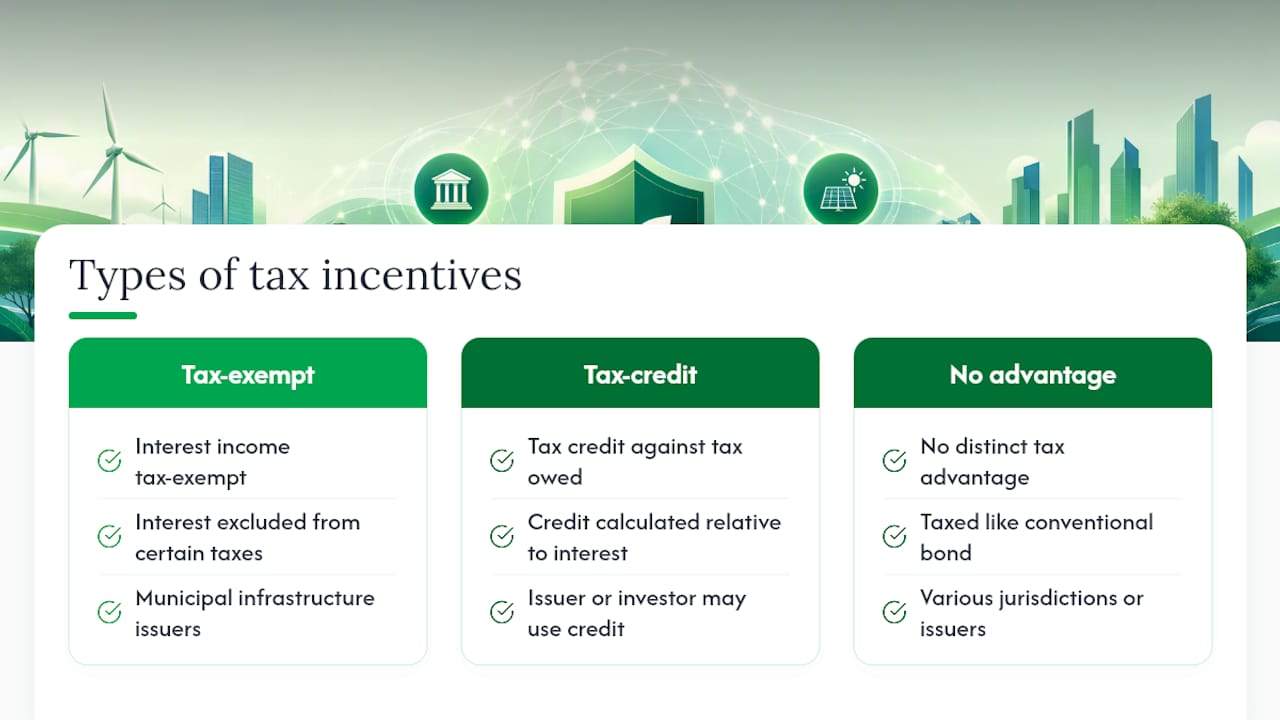
Tax treatment for green bonds is not uniform, and no single global incentive applies to every investor. Some governments have experimented with tax-exempt or tax-credit municipal green bonds, where the investor's return comes partly in the form of reduced tax liability rather than a higher coupon. Other jurisdictions offer no distinct tax advantage at all, and the green bond is taxed identically to a conventional bond from the same issuer.
Where incentives exist, they typically fall into two categories. Tax-exempt structures let investors receive interest income free of certain taxes, common among some municipal issuers financing public infrastructure like water systems or transit. Tax-credit structures instead give the investor (or sometimes the issuer) a credit against tax owed, calculated relative to the bond's interest.
Because these rules vary by country and even by issuer type within a country, the incentive should never be assumed. Confirm the specific tax treatment in the bond's offering documents or with a tax professional before factoring any benefit into your return calculation. Treat the environmental label and the tax label as two separate questions: a bond can be legitimately green without carrying any tax advantage, and a tax-advantaged municipal bond is not automatically well-verified from an environmental standpoint. The two features solve different problems, and conflating them is a common mistake among newer green bond investors.
What Comes Next for the Green Bond Market
Expect impact metrics to standardize further as harmonized reporting templates gain traction and investors push back on vague narrative disclosures. Sovereign frameworks will keep expanding their influence, since a national government's eligibility criteria often become the reference point other issuers in that market follow.
The practical takeaway for investors and practitioners alike: prioritize issuers with a track record of external review and consistent, repeated reporting over issuers offering only a compelling framework document. A framework is a promise. Allocation and impact reports, filed year after year, are the proof.
— Ransford
Build the Skills to Evaluate Green Bonds With Confidence
Understanding a green bond framework on paper is one thing. Knowing how to stress-test an issuer's allocation report, assess an external review, or spot a disclosure gap before it becomes a headline is a different skill set entirely, and it is one These skills are built directly by specialized training providers.

The Certificate in Sustainable Finance and Professional Certificate in Sustainable Finance walk through exactly the frameworks covered here, including how issuance standards and disclosure expectations interact. Professionals who need to verify claims rather than just read them can pursue the Certificate in Climate, Sustainability and ESG Assurance or the Certificate in Carbon Accounting, both built around the same evaluation skills used to check whether green bond proceeds were allocated as promised. Sustainability leads, risk officers, and assurance practitioners working across jurisdictions get credentials mapped to current international standards, not generic theory. Browse the full catalog and start with the credential that matches your role at Esgtraininginstitute's course catalog, or explore short-form options on the CPD page if you want a faster entry point into sustainable finance and assurance skills.
Where to Verify Green Bond Standards and Claims
- Green Bond Principles (ICMA), the primary voluntary framework
- World Bank/IFC green bond explainer, an early-issuer case study
- Climate Bonds Standard and Market Guide, certification criteria
This article is general information, not a substitute for advice from a qualified financial advisor. Consult a qualified financial professional about your own circumstances before acting on anything here.
Sources
- Green Bond Principles (ICMA) — June 2025
- What you need to know about IFC’s green bonds — World Bank
- Understanding green bond financing (CISL white paper)
- Article on greenwashing risks — PMC
- Green Bond Market Guide — Goldman Sachs Asset Management
FAQ
What Is a Green Bond in Simple Terms?
A green bond is a regular debt security where the issuer promises to spend the money raised on projects with environmental benefits, like renewable energy or clean water infrastructure. It pays interest and returns principal exactly like a conventional bond, and the issuer, not the project, is on the hook for repayment.
What Are the Disadvantages of Green Bonds?
The main disadvantages are greenwashing risk from inconsistent standards, a possible yield premium known as the greenium that can reduce returns, and uneven liquidity for smaller or project-specific issuances. Credit risk also remains tied entirely to the issuer, so a green label offers no protection if that issuer's finances deteriorate.
What Are the Four Principles of Green Bonds?
The Green Bond Principles from ICMA define four components: use of proceeds, process for project evaluation and selection, management of proceeds, and reporting. Together they give investors a consistent way to judge whether an issuer's green claims are credible.
How Do Green Bonds Get Paid Back?
Green bonds are repaid the same way conventional bonds are: the issuer pays interest and returns principal from its general finances, not from the specific project's revenue. This means issuer credit quality, not project performance, determines repayment risk in the vast majority of green bond structures.
Does Esgtraininginstitute Offer Training on Green Bond Analysis?
Yes. The Certificate in Sustainable Finance and related assurance and carbon accounting credentials cover the standards and reporting skills used to evaluate green bond frameworks and disclosures. Current pricing and program details are listed on Esgtraininginstitute's site.