

GRI serves organizations reporting broad stakeholder and societal impact, while SASB serves investors who need financially material, industry-specific data. Neither replaces the other. The Global Reporting Initiative and the standards now housed under the ISSB describe themselves as complementary, and most mature reporting programs eventually run both side by side. The sections below break down where they diverge, where they overlap, and how to sequence the work.
TL;DR:
- SASB standards focus on financially material, quantitative data aligned with industry-specific risks, making them faster to integrate into existing financial reporting cycles.
- GRI emphasizes impact materiality through stakeholder engagement, resulting in broader, qualitative disclosures that address non-financial effects on society and the environment.
- Organizations combining GRI and SASB should conduct a unified materiality assessment, assign a single data owner per topic, and plan assurance scopes early to avoid rework.
- Adoption of SASB is driven more by investor and financial market pressures, while GRI adoption correlates with strong governance and stakeholder expectations.
- Specialized training programs help teams develop the skills needed for effective integration of both frameworks into a defensible, efficient reporting process.
Table of Contents
- GRI vs SASB: A Side-by-Side Comparison
- What Actually Separates GRI and SASB Technically
- How To Combine GRI and SASB in One Reporting Process
- Where GRI and SASB Stand Today, and Who's Adopting What
- Building the Internal Capability To Run Both Frameworks Well
- A Practitioner's Take on Choosing Between GRI and SASB
- Get Ready To Implement GRI and SASB With Structured Training
- Sources
- FAQ
GRI vs SASB: A Side-by-Side Comparison
The fastest way to see the split between GRI and SASB is to line them up on the dimensions that actually change how your team works: who reads the report, what counts as material, and how granular the metrics get.
- Primary audience: GRI targets a broad set of stakeholders including employees, communities, regulators, and NGOs; SASB targets investors and financial analysts making capital allocation decisions.
- Materiality approach: GRI uses impact materiality, asking what the organization affects in the economy, environment, and society; SASB uses financial materiality, asking what affects enterprise value.
- Scope and sector coverage: GRI applies universal standards across any organization, supplemented by sector standards for high-impact industries; SASB provides distinct standards for 77 industries across 11 sectors.
- Disclosure types: GRI favors narrative disclosures paired with topic-specific indicators; SASB standards run roughly 75% quantitative, averaging six disclosure topics and 13 accounting metrics per industry.
- Best for: GRI fits sustainability teams building trust with a wide public; SASB fits finance and investor relations teams feeding data into annual reports and ESG ratings.
Large reporters rarely pick one and walk away from the other. Survey data cited in Deloitte's practical guide to GRI and SASB reporting shows GRI usage remains high among top global companies even as SASB adoption grows among U.S.-listed firms, which tells you the two frameworks are answering different questions rather than competing for the same answer.
What Actually Separates GRI and SASB Technically
The comparison above covers structure. The harder question for a reporting lead is what changes on the ground when you operationalize each framework.
SASB's financial materiality model forces you to ask a narrower question: does this ESG factor plausibly move revenue, costs, or capital costs for a company in this specific industry? That narrows data collection dramatically. A software company and a mining company get different disclosure topics because their financial exposure to environmental and social factors differs. The SASB materiality map is the reference tool for finding which topics apply to your sector, and the metrics tied to those topics are built to slot into existing accounting-linked reporting cycles, which is why finance teams find SASB familiar territory.
GRI's impact materiality model runs the opposite direction. Instead of starting from investor concerns, it starts from a stakeholder engagement process: interviews, surveys, and consultation with the people and communities your operations touch. That process usually surfaces a wider list of material topics than a financial screen would, because GRI's impact-oriented approach requires you to map effects that never show up on a balance sheet but still matter to affected groups.
Three practical consequences follow from that split:
- Data collection frequency and granularity differ. SASB metrics tend to align with fiscal reporting cycles; GRI often requires continuous stakeholder input that doesn't map neatly to a quarter or a fiscal year.
- System requirements diverge. SASB's quantitative bent pushes you toward activity-based data systems (energy use, water withdrawal, safety incident counts) with auditable trails; GRI often needs qualitative evidence logs alongside numbers.
- Assurance readiness looks different. Quantitative SASB metrics are easier to test against ISAE 3000-style assurance procedures; GRI's narrative content demands assurance practitioners comfortable evaluating stakeholder engagement evidence, not just numbers.
Pro Tip: Before you assign data owners, run a quick materiality gap check: list every topic your GRI stakeholder process surfaced, then flag which ones also appear on your industry's SASB materiality map. The overlap tells you where a single data pipeline can serve both frameworks; the non-overlap tells you where you need separate collection processes.
How To Combine GRI and SASB in One Reporting Process
Most organizations don't choose GRI or SASB in isolation. They pick a pattern for layering them, and three patterns dominate practice.
The first is a GRI-first narrative with a SASB appendix, where the main report tells the impact story and an appendix delivers the quantified, industry-specific metrics investors want. The second flips that: a SASB-driven investor disclosure with GRI impact sections woven in, common among companies whose primary reporting audience is capital markets. The third, more advanced approach is a fully integrated report with mapping tables that show, line by line, which GRI indicators and which SASB metrics address each disclosed topic.
Whichever pattern you choose, a short checklist keeps the combined process from collapsing into duplicated work:
- Run one combined materiality assessment that captures both impact and financial materiality inputs, rather than two separate exercises.
- Assign a single data owner per topic across finance, operations, and sustainability, so the same emissions number doesn't get recalculated three ways.
- Set a reporting cadence that satisfies your tightest deadline, usually the financial reporting calendar, then backfill narrative content around it.
- Confirm assurance scope early. Deciding after data collection which disclosures need third-party assurance forces rework.
Presenting the result well matters as much as producing it. Investors want the SASB-aligned metrics summarized in one clearly labeled section; broader stakeholders want the GRI narrative accessible without wading through accounting terminology first. A double materiality assessment can help structure that split, since it forces you to document which findings serve which audience before you start writing.
Where GRI and SASB Stand Today, and Who's Adopting What
SASB is no longer a standalone body. Its standards and materiality map now sit inside the IFRS Foundation's ISSB structure, which has pulled SASB metrics closer to mainstream financial reporting and pushed convergence with climate disclosure work that used to sit under TCFD. GRI, meanwhile, keeps expanding its sector standards program for high-impact industries and has been aligning its GHG emissions methodology with ISSB's, which is gradually improving interoperability between the major frameworks.
An empirical study of 2,046 U.S.-listed companies observed from 2017 to 2020 found that SASB adoption correlates with financial dynamics, such as capital market pressure and financial performance, while GRI adoption correlates more strongly with corporate governance quality and sustainability principles already embedded in company culture.
That finding has a practical edge to it: if your organization is adopting ESG reporting because investors or lenders are asking for comparable metrics, SASB will likely land faster and generate better internal buy-in than GRI would on its own, and vice versa for organizations driven by governance or stakeholder pressure.
Building the Internal Capability To Run Both Frameworks Well
Choosing a framework is the easy part. Running a defensible GRI and SASB process well requires people who can facilitate materiality assessments, map metrics correctly, and hold up under assurance scrutiny.
Reporting leads need the skill to run a combined materiality process without conflating impact and financial materiality. Risk officers need to understand how SASB's industry-specific metrics feed into broader risk disclosure. Finance teams need IFRS S1 and S2 readiness now that SASB content sits inside ISSB's structure, and assurance practitioners need working knowledge of ISAE and ISSA 5000 procedures before they sign off on either framework's outputs.
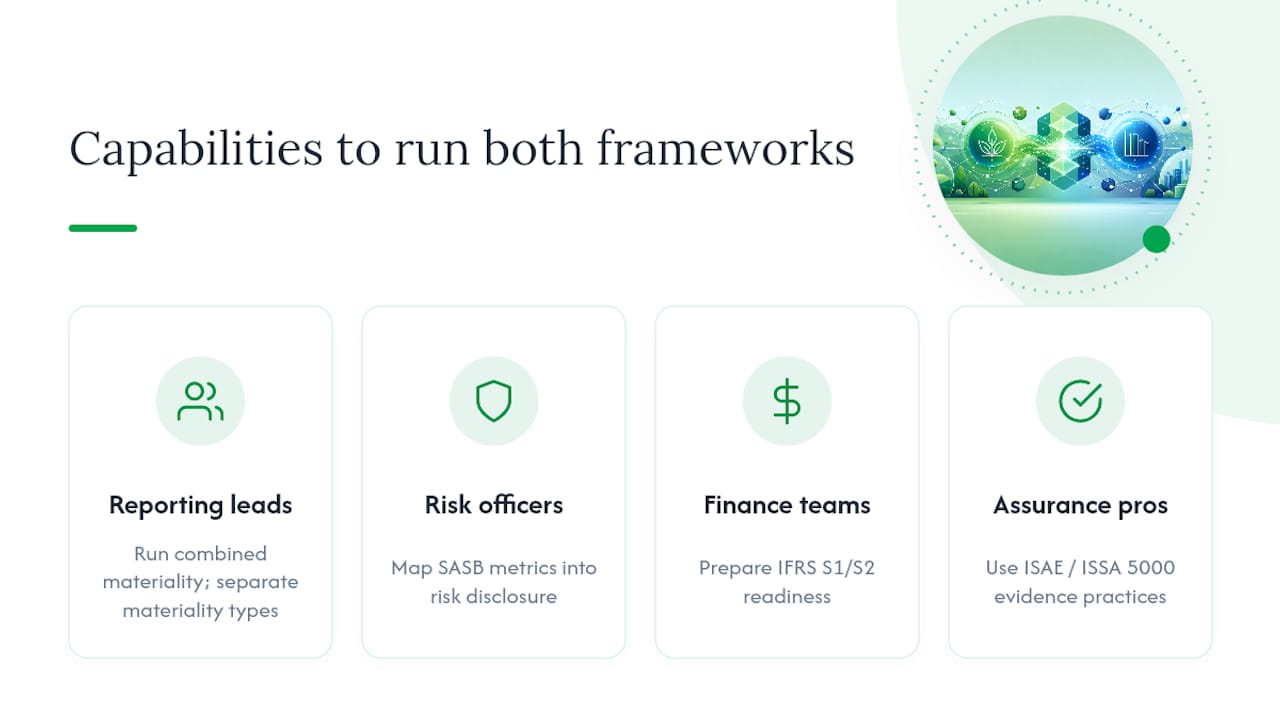
Several professional certificate programs in sustainability reporting, along with assurance and IFRS S1/S2 courses, are built around exactly those gaps: materiality facilitation, metric mapping across frameworks, and assurance-ready evidence practices.
A Practitioner's Take on Choosing Between GRI and SASB
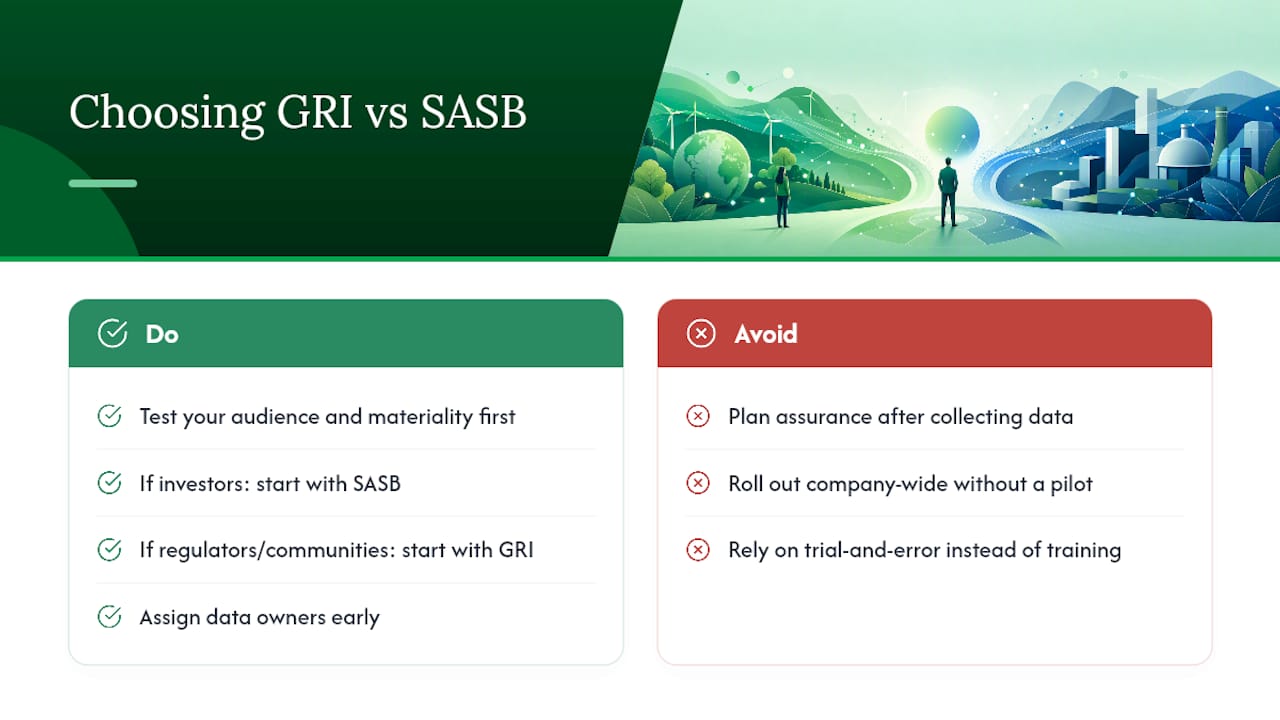
Test your audience and your materiality process before you touch a single metric. If investors are the primary reader, start with SASB's financially material topics and let GRI's narrative fill in context afterward. If regulators, communities, or broader stakeholders drive the report, run the GRI impact process first and layer SASB's quantified metrics on top where they overlap.
Pilot a combined materiality assessment on one business unit before rolling it out company-wide, assign data owners early, and plan your assurance scope before, not after, you collect the data. If your team lacks the internal capability to run that pilot cleanly, structured training closes the gap faster than trial and error.
— Ransford
Get Ready To Implement GRI and SASB With Structured Training
Reading about materiality mapping and knowing how to run one for your own organization are different skills, and that gap is exactly where certain specialized programs sit. Unlike a generic sustainability course, some certificates map directly to the standards this article just walked through, including GRI, ISSB-aligned SASB content, and IFRS S1 and S2, so the training translates straight into your reporting workflow.
The Certificate in Sustainability Reporting covers GRI and SASB fundamentals for teams building their first combined process, while the All-Access CPD Pass gives practitioners ongoing access to courses on IFRS S1/S2 readiness, carbon accounting, and assurance under ISAE 3000 for a flat annual fee. If your team is closer to sign off than setup, the Certified Sustainability Assurance Professional (CSAP) credential builds the assurance skills both frameworks now demand. Review the course outlines on the main site and pick the entry point that matches where your reporting program stands today.
Sources
Verify SASB's industry standards and materiality map directly at SASB standards and its ISSB-hosted materiality map. For adoption drivers, see the uniRoma empirical study and Deloitte's practical guide to combined reporting. For data governance practices supporting both frameworks, see this data governance overview.
- Material sustainability information and reporting standards. Exploring the differences between GRI and SASB
- SASB standards
FAQ
Is GRI still relevant given SASB's move to ISSB?
Yes. GRI remains the dominant framework for broad stakeholder and impact reporting, and its sector standards program continues to expand even as SASB content integrates into ISSB's structure. The two now function as complementary parts of a single disclosure strategy rather than competing options.
What are the "big four" of ESG reporting frameworks?
Practitioners commonly group GRI, SASB, TCFD, and the ISSB's IFRS S1/S2 standards as the four most referenced ESG disclosure frameworks. GRI covers broad impact, SASB and IFRS S1/S2 cover financially material investor disclosures, and TCFD's climate-specific approach has been folded into ISSB's structure.
What are the three types of GRI Standards?
GRI Standards are organized into Universal Standards, which apply to every organization; Sector Standards, built for high-impact industries; and Topic Standards, which cover specific issues like emissions, labor practices, or water use. Organizations select relevant Topic Standards based on the material issues their stakeholder engagement process identifies.
What is SASB in ESG reporting?
SASB is a framework of industry-specific accounting standards designed to give investors financially material, mostly quantitative ESG data. It covers 77 industries across 11 sectors and now operates as part of the IFRS Foundation's ISSB.
Does Esgtraininginstitute offer training on GRI and SASB together?
Yes. The Certificate in Sustainability Reporting and the All-Access CPD Pass both cover GRI and SASB alongside IFRS S1/S2 readiness, giving reporting professionals a single learning path for frameworks they'll likely need to run together.