

IFRS S1 requires companies to disclose sustainability-related risks and opportunities that could reasonably be expected to affect their prospects, meaning cash flows, access to finance, or cost of capital. Disclosures are organized around four pillars: governance, strategy, risk management, and metrics and targets. The standard is applied alongside topic-specific standards like IFRS S2 and draws on SASB metrics for industry detail. It has been effective for annual reporting periods beginning on or after January 1, 2024.
TL;DR:
- The scope of disclosures must focus on issues that could plausibly impact cash flows, financing access, or capital costs, not just reputational concerns.
- Preparing a clear connection between sustainability risks and financial statements is critical to meet IFRS S1 requirements, especially regarding governance, strategy, risk management, and metrics.
- Documenting materiality decisions, including value-chain and future effects, is essential to provide an audit trail and avoid disputes with assurance providers.
- Entities should link sustainability data directly to financial planning, with metrics and targets well-documented and aligned with industry standards like SASB.
- Early internal planning, assigning clear ownership, and building evidence files during drafting reduce rework and streamline assurance processes.
Table of Contents
- What Is IFRS S1 and Who Has to Apply It?
- The Four Pillars: Governance, Strategy, Risk, and Metrics
- Applying the "Prospects" Test Without Getting It Wrong
- How IFRS S1 Fits With IFRS S2, SASB, and CDSB
- A Practical Roadmap for First-Time IFRS S1 Reporters
- Where Disclosures Belong and When the Clock Starts
- Getting Ready for Assurance and External Review
- Why Structured Training Speeds Up Compliant Disclosure
- Structured Support for Your IFRS S1 Reporting Cycle
- Where to Go Deeper on IFRS S1
- Sources
What Is IFRS S1 and Who Has to Apply It?
IFRS S1's objective is to require entities to disclose sustainability-related risks and opportunities that could reasonably be expected to affect cash flows, access to finance, or cost of capital over the short, medium, and long term. It applies whenever an entity prepares sustainability-related financial disclosures alongside its general purpose financial statements, under whichever GAAP it already follows, whether IFRS Accounting Standards or another local framework.
The standard hinges on a "prospects" threshold, a deliberately investor-facing test rather than a broad stakeholder-impact test. Getting scope right up front saves rework later. Preparers typically need to:
- Confirm which entity or group boundary the disclosures cover and whether it matches the financial statement boundary.
- Identify sustainability matters that could plausibly move cash flow, financing access, or capital cost, not just reputational or operational concerns.
- Decide where disclosures will sit, whether inside the annual report or in a separate sustainability report referenced as connected information.
- Align reporting timing with the financial statements so both are issued together whenever practical.
Presentation choices matter almost as much as content. IFRS S1 expects a clear connection between sustainability disclosures and the financial statements, so a reader can trace an assumption from one document into the other without hunting.
The Four Pillars: Governance, Strategy, Risk, and Metrics
IFRS S1 centers disclosures on four content pillars adapted from the TCFD recommendations: governance, strategy, risk management, and metrics and targets. Each pillar asks a different question, and preparers who treat them as one undifferentiated disclosure blob usually end up with vague, unauditable text.
- Governance. Disclose who oversees sustainability-related risks and opportunities at the board and management level, what their mandate covers, and how performance against targets feeds into incentive structures or controls.
- Strategy. Explain how identified risks and opportunities affect the business model, and run a resilience analysis across defined time horizons. This is where IFRS S1 requires disclosure of how sustainability factors have been built into financial planning, not treated as a side narrative.
- Risk management. Describe the process for identifying, assessing, prioritizing, and monitoring sustainability-related risks, and how that process integrates with the entity's overall enterprise risk framework rather than running in parallel to it.
- Metrics and targets. Select metrics appropriate to the industry, often drawing on SASB, disclose progress transparently even when only a range is available, and flag any targets set by law or regulation separately from voluntary ones.
Pro Tip: Draft the strategy pillar last, not first. Once governance and risk management disclosures are locked, the resilience narrative in strategy almost writes itself because the supporting evidence is already organized.
Applying the "Prospects" Test Without Getting It Wrong
The single most common misstep in early IFRS S1 filings is conflating general stakeholder concern with investor-relevant materiality. A community water dispute might matter enormously to local stakeholders, but under IFRS S1 it only warrants disclosure if it could plausibly move cash flows, financing terms, or cost of capital. That distinction has to be applied deliberately, not assumed.
Operationalizing the test means walking each identified issue across short, medium, and long horizons, and extending the lens into the value chain rather than stopping at the entity's own operations. Practical pitfalls include:
- Treating a topic as immaterial simply because it lacks a current dollar impact, when the standard also captures reasonably expected future effects.
- Skipping documentation of why a topic was excluded, which leaves no audit trail if assurance providers or regulators ask later.
- Underestimating value-chain exposure, particularly for upstream supply chain risks that rarely show up in an entity's own operational data.
Document every materiality decision the same way you would document a financial estimate. That habit alone resolves most disputes before they escalate.
How IFRS S1 Fits With IFRS S2, SASB, and CDSB
IFRS S1 is the overarching standard; it sets general disclosure requirements, while IFRS S2 is topic-based for climate and is designed to be applied together with it. Think of S1 as the architecture and S2 as the first fully furnished room. Other topic standards will follow, but until they exist, preparers need a defined hierarchy for filling the gaps.
When no ISSB standard directly covers a risk category, the accompanying guidance directs preparers to a specific sequence:
- Consult SASB Standards first for industry-specific disclosure topics and metrics.
- Turn to CDSB Framework Application Guidance, particularly useful for water and biodiversity topics.
- Consider recent pronouncements from other standard setters if neither source fits.
SASB topics are explicitly non-exhaustive, so entity-specific metrics are often necessary alongside them. Keep a written record of which source you consulted and why. That record is exactly what assurance providers ask for during their first review, and the ISSB Knowledge Hub and Transition Implementation Group exist precisely to resolve the interpretive questions that arise along the way.
A Practical Roadmap for First-Time IFRS S1 Reporters
Turning the standard's language into a working disclosure process comes down to five sequential steps, and skipping ahead tends to create rework downstream.
- Set governance and ownership. Assign a named owner for IFRS S1 delivery and align the reporting timeline with the financial close calendar rather than running it as a separate track.
- Identify relevant topics. Map SASB industry topics against your prospects test to shortlist what genuinely warrants disclosure.
- Connect data to finance. Link sustainability inputs to financial planning and scenario analysis so the resilience narrative in your strategy pillar has real numbers behind it.
- Choose and document metrics. Record methods, boundaries, and data sources for every metric and target before drafting a single disclosure sentence.
- Draft, place, and prepare for assurance. Decide where disclosures live, build in connected-information cross-references, and organize evidence files as you go rather than reconstructing them at year-end.
Pro Tip: Build your evidence file in parallel with drafting, not after. Assurance reviewers spend more time chasing missing documentation than questioning the disclosures themselves. Esgtraininginstitute's implementation roadmap walks through this sequence with worked examples for reporting teams running their first cycle.
Where Disclosures Belong and When the Clock Starts
IFRS S1 is effective for annual reporting periods beginning on or after January 1, 2024, with earlier application permitted when IFRS S2 is applied at the same time. Entities still catching up should treat that date as already active, not upcoming.
- Disclosures can sit inside the main annual report or in a separate sustainability report, provided connected information is clearly cross-referenced both ways.
- A phased transition approach, prioritizing governance and strategy disclosures in year one before refining metrics precision in later cycles, tends to produce steadier investor communications than an all-at-once launch.
- Retrospective comparatives should be planned early since retrofitting them after the fact is far harder than building them in from the start.
Getting Ready for Assurance and External Review
Assurance providers look for the same things a financial auditor expects: controls, data lineage, and a clear trail from raw source to disclosed figure. Governance documentation, calculation methods, and the rationale behind every material judgment all need to be retrievable, not reconstructed on request.
Ranges and estimates are acceptable under IFRS S1, but only when disclosed consistently and with the underlying assumptions stated plainly rather than buried in a footnote. Before engagement, run an internal dry review: check that every metric ties to a documented source, that materiality exclusions are recorded, and that the governance narrative matches what the risk committee minutes actually show.
Why Structured Training Speeds Up Compliant Disclosure
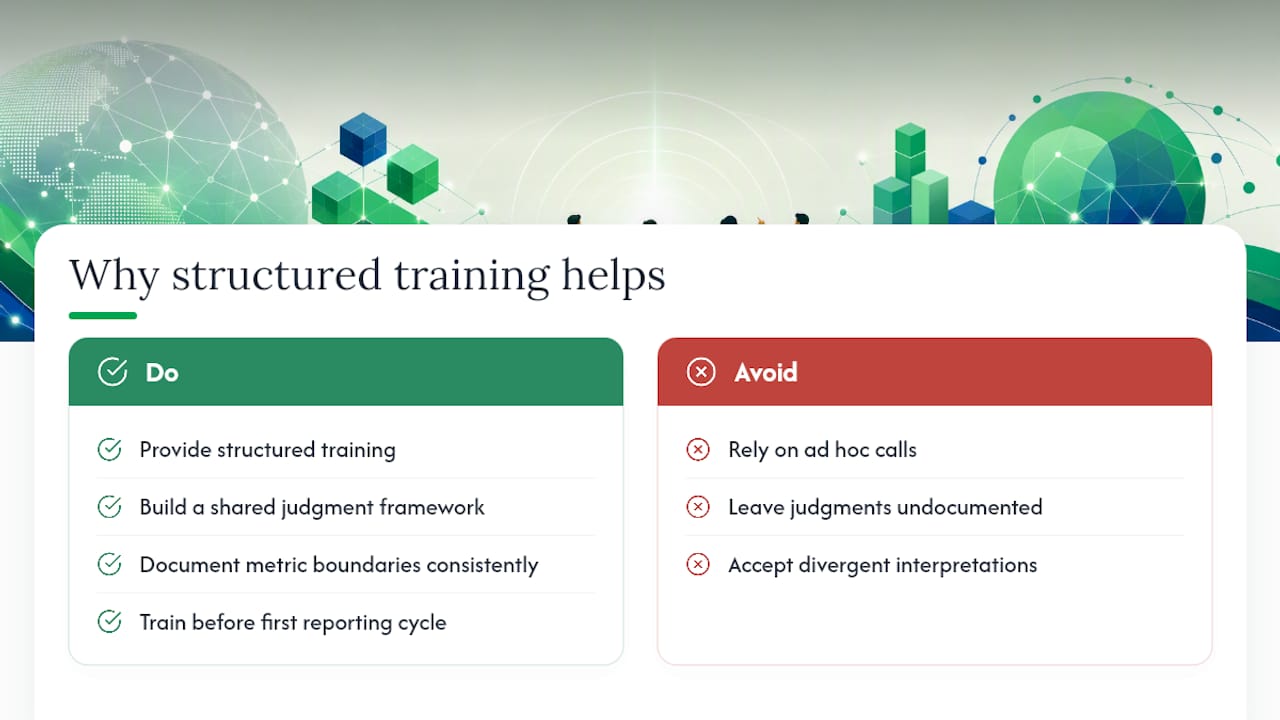
Reporting teams tackling IFRS S1 for the first time rarely fail on strategy. They stall on judgment: what counts as material, how to document a metric's boundary, how to phrase uncertainty without undermining credibility. Structured training builds a shared framework for those calls, so different preparers on the same team reach consistent, defensible conclusions instead of five different interpretations of "prospects."
Esgtraininginstitute's graduates collectively manage a very large portfolio of ESG assets, reflecting the significant weight consistent judgment carries across jurisdictions. For a first-time reporting cycle, structured training is worth weighing seriously.
— Ransford
Structured Support for Your IFRS S1 Reporting Cycle
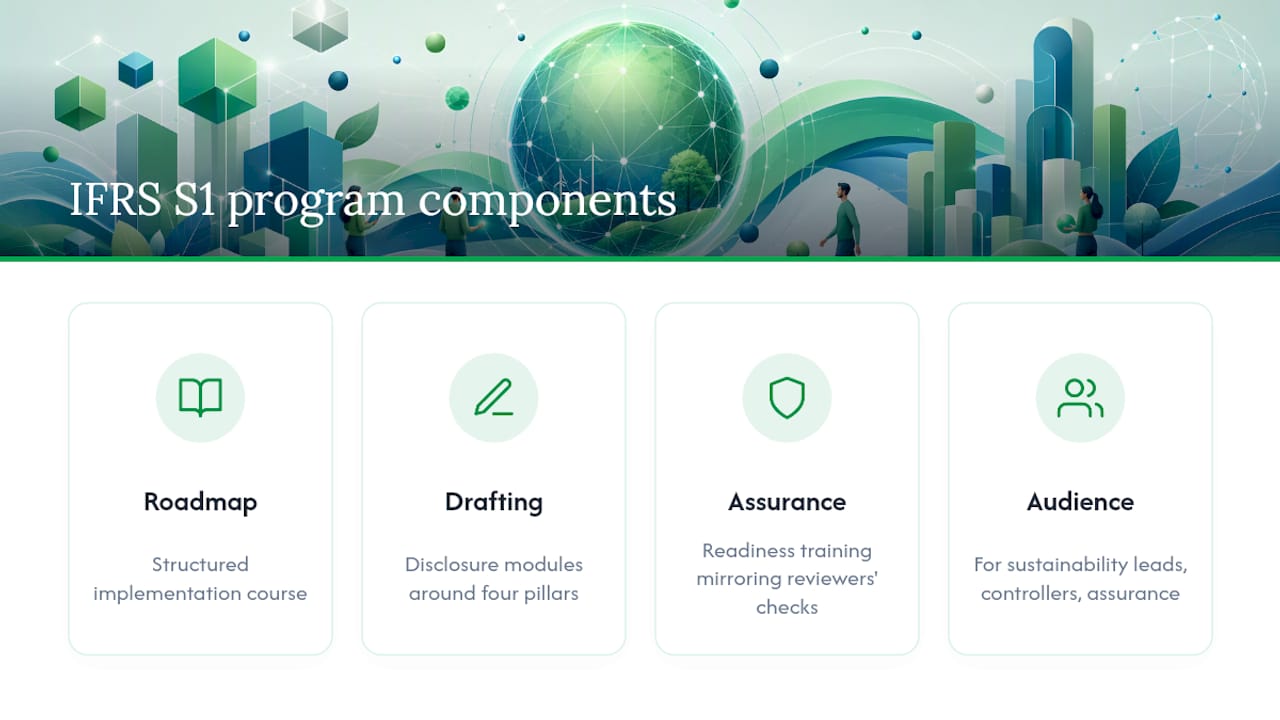
Building an IFRS S1-ready reporting function from scratch, using only internal trial and error, usually costs more in rework than in the training itself. Esgtraininginstitute's accreditation programs give reporting teams a faster, audit-ready path: a structured implementation roadmap course, disclosure-drafting modules built around the four pillars, and assurance-readiness training that mirrors what external reviewers actually check.
These programs are designed for sustainability leads, controllers, and assurance practitioners who need their first (or fifth) IFRS S1 cycle to hold up under scrutiny, not just look complete on paper. Course content is aligned to current ISSB expectations and updated as guidance evolves, so teams are not left interpreting the standard alone.
If your organization is preparing for its first full IFRS S1 disclosure cycle or tightening controls ahead of assurance, review the accreditation options or visit Esgtraininginstitute to enquire about a corporate training program tailored to your reporting calendar.
Where to Go Deeper on IFRS S1
Bookmark the IFRS S1 issued standard text, the ISSB Knowledge Hub, and SASB Standards for industry metrics. For a side-by-side comparison with regional frameworks, see Esgtraininginstitute's mapping of IFRS S1 against ESRS 2.
This article is general information, not a substitute for advice from a qualified financial advisor. Consult a qualified financial professional about your own circumstances before acting on anything here.