

Internal carbon pricing (ICP) is a monetary value that a company assigns to a tonne of CO2 equivalent and applies inside its own decision-making, before any regulator forces the issue. Finance teams use it three ways: as a shadow price to stress-test capital expenditure, as an internal fee to charge business units for their emissions and fund abatement, and as an implicit price to diagnose where climate risk already sits inside the balance sheet.
Each use case answers a different question. Shadow pricing asks whether a project still clears the hurdle rate once carbon risk is priced into the model. An internal fee asks who should pay for emissions today so the organization can fund reductions tomorrow. Implicit pricing asks, retrospectively, what carbon cost is already baked into current spending decisions.
Adoption has moved fast. By 2024, 1,753 companies across 56 countries reported using internal carbon pricing, an 89% jump from 2021, and nearly half of the world's 500 largest companies have folded ICP into strategy. Guidance from bodies like the Network for Greening the Financial System (NGFS), the High-Level Commission on Carbon Prices, and the World Business Council for Sustainable Development (WBCSD) now gives finance teams a defensible way to set that price rather than guessing.
- Shadow price: notional, used in investment appraisal, moves no cash.
- Internal fee: real, charged to business units, funds an abatement budget.
- Implicit price: diagnostic, reveals carbon cost already embedded in spend.
Key Takeaways
Internal carbon pricing works when the price is set high enough to change capital decisions and paired with governance that has enforcement authority over appraisal gates.
| Point | Details |
|---|---|
| Choose the right mechanism | Use shadow pricing for CAPEX appraisal and internal fees when you need real cash flow to fund abatement. |
| Set a corridor, not one number | Triangulate floor, central price, and ceiling across regulatory price, MAC, scenario data, and ability-to-pay. |
| Assign an accountable owner | Give the CFO's office or ICP committee authority to block noncompliant capital projects. |
| Reconcile fees to your inventory | Map every fee ledger entry to Scope 1, 2, and 3 categories before billing business units. |
| Ringfence the fund | Dedicate fee revenue to a visible carbon fund rather than general revenue to build internal buy-in. |
Table of Contents
- What Is Internal Carbon Pricing and How Does It Work?
- Why Do Companies Use Internal Carbon Pricing?
- How Do You Set and Calculate an Internal Carbon Price?
- Who Should Own Internal Carbon Pricing Inside the Company?
- What Should You Monitor Once Internal Carbon Pricing Is Live?
- How Training Builds ICP Programs That Actually Hold Up
- How Should ICP Fit Into Corporate Financial Planning?
- What Do Real ICP Implementations Look Like Across Industries?
- How Do You Communicate ICP to Skeptical Internal Stakeholders?
- Does Internal Carbon Pricing Support Net-Zero Commitments?
- The Practitioner's Verdict on Internal Carbon Pricing
- Frequently Asked Questions
- Sources
What Is Internal Carbon Pricing and How Does It Work?
Internal carbon pricing works through three distinct mechanisms, and mixing them up is one of the more common mistakes finance teams make when they build a program. Each one changes a different decision, sits with a different owner, and fails in a different way when poorly designed.
Shadow pricing adds a notional cost per tonne of CO2e into investment appraisal models. A manufacturer evaluating a new furnace, for instance, might apply a shadow price to the project's projected emissions stream, which lowers its calculated NPV relative to a lower-carbon alternative. No money changes hands. The number exists purely to change how a project ranks against its peers.
Internal carbon fees are the opposite: real, budgeted charges levied against business units based on their measured emissions. The revenue typically flows into a ringfenced internal carbon fund that finances efficiency upgrades, renewable procurement, or offset purchases. Because actual cash moves, fees carry teeth that shadow prices lack.
Implicit pricing works backward. Instead of setting a price and applying it forward, you calculate the carbon cost embedded in a decision you already made, often to benchmark against peers or to prepare for a future explicit price. It's a diagnostic tool, not a control lever.
A fourth variant, the internal carbon market, lets business units trade allowances against an internal cap, mimicking a cap-and-trade scheme inside one company. It's rare outside large, multi-division conglomerates because it needs metering and governance infrastructure most firms don't have.
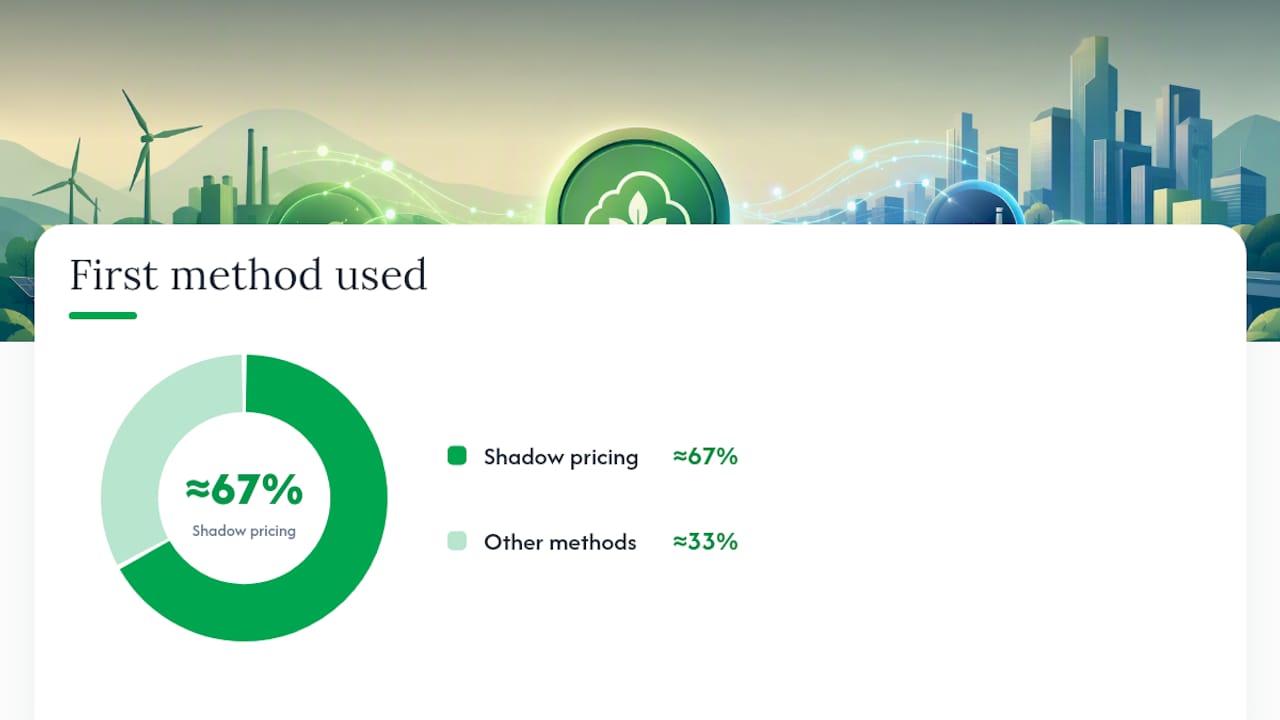
WBCSD research shows shadow pricing is the most common entry point, with roughly two-thirds of companies that have a price using this method first. Fees tend to arrive later, once a company wants operational behavior to change rather than just influence which projects get approved.
- Shadow price → changes capital appraisal and project ranking.
- Internal fee → changes operating budgets and business-unit behavior.
- Implicit price → changes nothing directly; it informs strategy.
- Internal market → changes allocation between business units.
Pro Tip: A shadow price with no enforcement authority behind it is just a spreadsheet exercise. If the CFO's office can't block a project for failing the carbon-adjusted hurdle rate, the price is advisory, and advisory prices rarely survive the next budget cycle.
Why Do Companies Use Internal Carbon Pricing?
The financial case for internal carbon pricing rests on three pillars: sharper capital allocation, reduced exposure to stranded-asset risk, and a funding mechanism for decarbonization that doesn't depend on annual budget fights.
Capital allocation improves because ICP forces carbon cost into the same NPV calculation as everything else. A project that looks marginally attractive on a standard discounted cash flow basis can fail outright once a shadow price consistent with the High-Level Commission's recommended range of USD 40 to 80 per tonne gets applied to its emissions profile. That's the point. You want capital-intensive, carbon-heavy assets to fail the screen before they get built, not after a regulator prices carbon for you.
Risk mitigation follows the same logic in reverse. Companies that price carbon internally at levels near or above expected future regulatory prices are less likely to get caught holding stranded assets when policy catches up. The 89% growth in ICP adoption between 2021 and 2024 reflects exactly this kind of defensive positioning across sectors exposed to carbon-intensive supply chains.
The third pillar, funding, is often underappreciated. Internal fees generate a predictable revenue stream for an abatement fund, which removes decarbonization projects from competing against every other line item in the annual budget.
- Sharper investment screening that catches carbon-intensive projects before capital commits.
- A self-funding mechanism for efficiency and renewable energy projects.
- Better disclosure readiness for frameworks that expect climate risk quantification.
How Do You Set and Calculate an Internal Carbon Price?
Setting a defensible internal carbon price means triangulating across four or five recognized anchors rather than picking a number that feels right. GreenCalculus methodology and World Bank guidance both point to the same core inputs, weighted differently depending on your objective.
1. Regulatory price. Start with whatever explicit carbon price already applies to your operations, whether that's an emissions trading scheme allowance price or a carbon tax rate. This is your floor in any jurisdiction where a price already exists.
2. Marginal abatement cost (MAC). Calculate what it actually costs your company to remove the next tonne of CO2e through efficiency upgrades, fuel switching, or process changes. If your MAC curve shows abatement opportunities at $35 per tonne that go unfunded, your internal price is too low to trigger action.
3. Social cost of carbon. Government-published estimates of the economic damage per tonne emitted offer a useful outside check, particularly for public reporting credibility, though they tend to run below scenario-based prices used for transition planning.
4. Scenario and SPC anchoring. The High-Level Commission's guidance recommends USD 40 to 80 per tonne in 2020, rising to USD 50 to 100 by 2030, aligned to Paris Agreement trajectories. NGFS scenario prices offer a similar anchor tied to specific transition pathways, which matters if your disclosures reference NGFS scenarios elsewhere.
5. Ability-to-pay. A price calibrated purely to scenario ambition can crush margins in low-margin, carbon-intensive segments. Ability-to-pay adjustments keep the price ambitious without triggering perverse outcomes like moving production to a less-regulated subsidiary just to dodge the fee.
The practical answer is a corridor: a floor tied to regulatory and MAC data, a central working price used in day-to-day appraisal, and a ceiling anchored to scenario prices for stress-testing. Robust programs set this corridor explicitly rather than defending a single number against every objection.
Worked example, shadow price on CAPEX: A logistics company evaluates a $12 million fleet electrification project against a diesel fleet refresh. The diesel option emits an estimated 4,200 tonnes of CO2e annually over a 10-year life. Applying a central shadow price of $65 per tonne adds roughly $273,000 in annual notional cost to the diesel option's cash flow model, which shifts the NPV comparison meaningfully in the electric fleet's favor even before fuel savings are counted.

Worked example, internal fee allocation: A manufacturer with three business units measuring 50,000, 30,000, and 20,000 tonnes of Scope 1 and 2 emissions respectively sets an internal fee of $40 per tonne. That generates $2 million, $1.2 million, and $800,000 in charges against each unit's budget, feeding a combined $4 million into the internal carbon fund earmarked for efficiency retrofits the following fiscal year.
Multinational operators should avoid a single flat global price. Regional corridors with escalation rules tied to policy exposure reflect the reality that a euro-denominated price calibrated to EU ETS exposure doesn't translate cleanly to a business unit operating where no explicit carbon cost exists yet. Review the corridor annually, and always state the price with its currency and reference year to avoid ambiguity when comparing figures across budget cycles.
Who Should Own Internal Carbon Pricing Inside the Company?
Governance decides whether an internal carbon price changes anything or just sits in a policy document. The World Bank's guidance is blunt on this point: a price that's too low or unenforceable delivers no behavioral change at all, regardless of how carefully it was calculated.
Ownership typically sits with the CFO's office or a cross-functional ICP committee that includes sustainability, finance, and operations leadership, reporting to the board through the audit or risk committee. That structure matters because the committee needs enforcement authority, not just advisory influence, over capital appraisal gates.
Reconciliation is the unglamorous part that most programs get wrong. The internal fee ledger has to map cleanly onto the GHG inventory's scope boundaries and accounting periods, or finance and sustainability teams end up arguing over numbers that were never designed to match in the first place. Build this mapping before you bill a single business unit, not after.
- Assign a named accountable owner with authority to block noncompliant CAPEX at appraisal.
- Map every fee ledger entry to a Scope 1, 2, or 3 category in the emissions inventory.
- Align billing periods to the same fiscal calendar used for GHG inventory reporting.
- Ringfence fee revenue in a dedicated carbon fund rather than the general operating budget.
- Pair the price with a profit-per-ton or cost-per-ton-avoided metric business units can act on.
The behavioral design question matters as much as the number itself. A ringfenced fund that visibly finances the abatement projects business units actually want tends to build more buy-in than a fee that vanishes into general revenue. WBCSD's analysis of corporate practice notes that change management and financial literacy are often the binding constraint on ICP success, more so than the sophistication of the price-setting methodology itself.
Pro Tip: If a business unit's controller can explain, unprompted, exactly how their carbon fee was calculated and where the money went last year, your governance model is working. If they can't, the fee is a tax they resent rather than an incentive they respond to.
Common pitfalls include setting the price so low it never changes an appraisal outcome, failing to reconcile the fee ledger to the inventory until year end, and skipping supplier and procurement engagement so the price only ever touches internal operations. Coordinating with procurement on supply-chain emissions data closes that last gap.
What Should You Monitor Once Internal Carbon Pricing Is Live?
Monitoring an internal carbon price means tracking whether it's actually changing decisions, not just whether it exists on paper. A handful of KPIs answer that question directly.
- Emissions per business unit against the prior period, segmented by scope.
- Fund balance and deployment rate for the internal carbon fund.
- Average abatement cost per tonne across funded projects, compared to the fee level.
- Number of CAPEX proposals rejected or modified at the shadow-price gate.
- Price corridor position relative to regulatory and scenario benchmarks.
Review the price annually as a baseline, with event triggers for recalibration: a material shift in regulatory carbon pricing, a new NGFS scenario release, or a strategic pivot in net-zero targets all warrant an off-cycle review.
| KPI | Reporting Frequency |
|---|---|
| Emissions per business unit | Quarterly |
| Carbon fund balance and deployment | Quarterly |
| Abatement cost per tonne vs. fee level | Annually |
| CAPEX gate rejection/modification rate | Annually |
| Price corridor vs. external benchmarks | Annually, plus triggers |
Disclosure frameworks increasingly expect this data. CSRD's ESRS E1 datapoints and IFRS S2 both ask companies to explain how carbon pricing informs strategy and scenario analysis, which means your ICP dashboard should feed directly into the same reporting workflow used for climate disclosure under the current standards. Sample wording might read: "The company applies a shadow price of $X per tonne, informed by NGFS scenario data, in evaluating capital projects exceeding $Y in emissions-intensive categories."
How Training Builds ICP Programs That Actually Hold Up
A price is only as credible as the people applying it, and that's where formal training closes a gap that pure methodology can't. Esgtraininginstitute's standards-aligned courses in carbon accounting, climate finance, and governance and assurance give finance and sustainability teams a shared vocabulary for exactly the reconciliation and enforcement questions covered above.
Graduates of Esgtraininginstitute's programs collectively manage over $30 trillion in ESG assets, a scale that reflects how deeply carbon accounting literacy has become a baseline finance skill rather than a specialist one.
- Carbon accounting courses build the inventory literacy needed to reconcile fee ledgers to Scope 1, 2, and 3 data.
- Climate finance modules cover NPV adjustment, scenario analysis, and corridor design directly.
- Governance and assurance credentials give the ICP committee auditability it needs for board reporting.
How Should ICP Fit Into Corporate Financial Planning?
Internal carbon pricing works best when it's embedded directly into the annual planning cycle rather than run as a parallel sustainability exercise. That means the shadow price shows up in the same capital appraisal template every business unit already uses, alongside currency risk and discount rate assumptions, not in a separate sustainability appendix nobody in finance reads.
Budgeting season is the natural integration point. When business units submit CAPEX requests, the carbon-adjusted NPV should sit next to the standard NPV, forcing a conversation about the gap rather than letting it disappear. Treasury and FP&A teams that already model commodity price sensitivity have the analytical muscle to do the same for carbon, they just need the price fed into their existing models.
Investment committees benefit from a standing carbon-adjusted hurdle rate rather than a one-off adjustment applied inconsistently across proposals. This consistency matters more than the exact price level, because inconsistent application invites business units to game which projects get the carbon treatment.
Longer term, the internal fee revenue stream should appear in multi-year financial plans as a committed funding source for the abatement pipeline, not as a variable that gets cut when margins tighten. Treating the carbon fund as protected capital, similar to how R&D budgets are often ringfenced, signals that the company treats decarbonization as core financial planning rather than discretionary spend.
What Do Real ICP Implementations Look Like Across Industries?
Corporate guidance frequently points to technology and industrial firms as early movers on structured internal carbon pricing, and the patterns across sectors are instructive even when the specific numbers vary by company and year.
In the technology sector, companies like Microsoft have used an internal carbon fee model where business units pay based on their emissions footprint, with proceeds funding renewable energy procurement and efficiency projects. Autodesk has similarly cited internal pricing as part of its approach to funding sustainability initiatives across its operations, using the fee to make carbon cost visible inside normal budget conversations rather than treating it as a separate environmental program.
Heavy industry and energy companies tend to lean more heavily on shadow pricing in capital appraisal, given the long asset lives and capital intensity typical of refineries, cement plants, and power generation assets. A shadow price applied at the scenario ceiling rather than the corridor midpoint gives these companies a stress test against aggressive decarbonization pathways before capital gets locked in for decades.
Financial services firms often use ICP differently again, applying it to loan and investment portfolios to estimate the transition risk embedded in financed emissions rather than in their own direct operational footprint. The common thread across all three patterns isn't the price level. It's that each sector matched the mechanism, fee, shadow price, or portfolio-level implicit pricing, to the decision it actually needed to change.
How Do You Communicate ICP to Skeptical Internal Stakeholders?
The hardest part of running an internal carbon price is rarely the math. It's convincing a plant manager, a regional sales director, or a business unit controller that a number pulled from a World Bank guidance document should change how they run their budget this quarter.
Operations teams tend to push back on the fairness of a flat fee applied to units with very different emissions intensity per unit of output. Addressing this requires transparent, published methodology, showing exactly how the fee was calculated and why the same rate applies (or doesn't) across business units with different baselines.
Finance teams outside the sustainability function often resist because carbon pricing looks like an extra layer of complexity bolted onto models that already work. The most effective response is showing the carbon-adjusted NPV next to the standard NPV on the same page, letting the numbers make the case rather than a slide deck about climate risk.
Frontline managers respond better to the fund than to the fee. Framing the internal carbon price as "here's the pool of money now available for your efficiency project" lands very differently than "here's a new charge against your budget," even though it's the identical transaction viewed from opposite ends.
Executive sponsorship from the CFO, not just the sustainability lead, changes how seriously business units treat the requirement. A price mandated by finance carries budget authority; a price recommended by sustainability often reads as optional guidance until it isn't.
Does Internal Carbon Pricing Support Net-Zero Commitments?
Internal carbon pricing is one of the few mechanisms that connects a company's net-zero target to the actual capital decisions made every quarter, rather than leaving the target as a separate strategic statement disconnected from budgeting.
Guidance on setting a net-zero-aligned internal carbon price recommends explicitly linking the price trajectory to the company's own decarbonization pathway, escalating the corridor over time in step with the emissions reduction the net-zero commitment requires. A static price set once and never revisited drifts out of alignment with an ambitious target within a few years.
The ringfenced carbon fund created by an internal fee gives the net-zero commitment a funding mechanism it often lacks otherwise. Corporate sustainability targets frequently outpace the budget allocated to achieve them; a fee-funded abatement pool closes part of that gap without requiring a fresh line item fight every year.
ICP also gives net-zero commitments credibility with external stakeholders, including investors and assurance providers, because it demonstrates the target is embedded in financial decision-making rather than existing purely as a public communications statement. That distinction increasingly matters as disclosure regimes ask companies to show, not just state, how climate targets connect to capital allocation.
Esgtraininginstitute's corporate training programs build exactly this connective tissue, equipping finance and sustainability teams to defend the link between price, fund, and target when auditors and investors start asking pointed questions.
The Practitioner's Verdict on Internal Carbon Pricing
Most of the public conversation about internal carbon pricing obsesses over what number to pick, and that's the wrong place to spend your energy. The research is fairly consistent that a defensible corridor, built from regulatory price, MACC, and scenario data, gets you close enough. The number that actually determines whether your program succeeds is the enforcement authority sitting behind it.
Conventional advice treats ICP as a pricing exercise. It's really a governance exercise wearing a pricing exercise's clothes. A committee with no power to block a bad CAPEX proposal, no matter how elegant the corridor math looks, produces the same outcome as having no price at all.
If you're starting from zero, prioritize the accountable owner and the appraisal gate before you refine the price to the second decimal. Get the enforcement structure right first, build financial and carbon-accounting literacy across the team second, and only then spend real time perfecting the corridor. Esgtraininginstitute's certification pathways exist precisely for that middle step, and it's the step most programs skip.
Frequently Asked Questions
What's the difference between a shadow carbon price and an internal carbon fee?
A shadow price is notional. It adjusts how a project ranks in investment appraisal without moving any actual money. An internal fee charges real cash to business units based on measured emissions, and that revenue typically funds an abatement program.
How do you decide what internal carbon price to set?
Triangulate across four or five anchors: your regulatory carbon price, your company's marginal abatement cost, published social cost of carbon estimates, and scenario-based prices from sources like NGFS or the High-Level Commission's recommended ranges. Set a corridor rather than a single figure.
Who should own internal carbon pricing at a company?
Ownership typically sits with the CFO's office or a cross-functional committee with representation from finance, sustainability, and operations, reporting to the board through the risk or audit committee. The owner needs authority to enforce the price at capital appraisal gates, not just recommend it.
How often should a company review its internal carbon price?
Annually at minimum, with off-cycle triggers for major regulatory changes, updated NGFS scenarios, or shifts in the company's net-zero commitment. A price left static for several years typically drifts out of step with both policy and scenario benchmarks.
Does internal carbon pricing help with climate disclosure requirements?
Yes. Frameworks including CSRD's ESRS E1 and IFRS S2 expect companies to show how carbon pricing informs capital allocation and scenario analysis, which means a well-documented ICP program directly supports the narrative and quantitative disclosures these standards require.
Ready to build the governance and carbon accounting skills an ICP program actually needs? Explore accredited certification pathways designed for finance and sustainability professionals implementing internal carbon pricing today.
Sources
For scenario-based price anchoring, consult NGFS scenario data through GHG Protocol resources. The World Bank's guidance on shadow pricing covers SPC methodology in depth. WBCSD's corporate practice guidance and C2ES's mechanism overview round out the practitioner reading list, alongside GreenCalculus's methodology breakdown for corridor design specifics.
- Guidelines for setting a net zero-aligned internal carbon price
- Integrating climate with financials: Internal Carbon Pricing | WBCSD
- World Bank guidance on shadow price / SPC and economic analysis
- Internal Carbon Pricing: Shadow Price & Fee Methods — GreenCalculus