

Investor stewardship is the use of investor rights and influence, including engagement, voting, and escalation, to protect and enhance long-term value for clients and beneficiaries across financial, social, and environmental dimensions. Grounded in definitions from the PRI and CFA Institute, it treats ESG factors as material inputs to fiduciary duty rather than optional overlays. Regulatory anchors including TCFD, ISSB, and the EBA's ESG risk guidelines now make this integration an operational expectation, not a preference.
TL;DR:
- Most organizations should focus on building measurable outcomes, such as specific ESG targets, rather than just tracking activity like engagement counts.
- Embedding stewardship into enterprise risk management requires integrating ESG risks into existing frameworks, KPIs, and external reporting standards like TCFD and ISSB.
- Successful interventions involve clear, material asks with defined deadlines, backed by sustained dialogue and escalation triggers to ensure progress.
- Collaboration through initiatives like Climate Action 100+ enhances leverage and accountability, especially for large, multinational governance issues.
- Developing internal expertise through accreditation programs in engagement, ESG risk analysis, and disclosure is critical for credible and effective stewardship practice.
Table of Contents
- What Does Investor Stewardship Mean in ESG Investing?
- Why Does Stewardship Matter for Fiduciary Duty?
- What Are the Core Tools of Investor Stewardship?
- How Do You Embed Stewardship Into ERM and Reporting?
- What Should a Stewardship Implementation Checklist Include?
- What Are the Main Criticisms of Investor Stewardship?
- How Is Technology Changing Stewardship Practice?
- What Do Successful Stewardship Interventions Look Like?
- How Does Stakeholder Engagement Extend Beyond Shareholders?
- What Should Practitioners Prioritize Going Into 2026?
- Build the Skills Behind Credible Stewardship
- Sources
- FAQ
What Does Investor Stewardship Mean in ESG Investing?
Stewardship, per the PRI and CFA Institute framing, is the exercise of investor rights and influence to safeguard long-term value for clients and beneficiaries, with that value explicitly spanning economic, social, and environmental assets. It is not a synonym for socially conscious investing. It's a discipline built on oversight: monitoring holdings, engaging management, voting proxies, and escalating when dialogue stalls.
That distinction matters because stewardship gets conflated with adjacent strategies constantly. J.P. Morgan Asset Management's overview of sustainable investing approaches separates negative screening, thematic investing, and portfolio tilting from shareholder action and engagement, where stewardship actually lives. An investor can run zero exclusionary screens and still practice rigorous stewardship simply by voting deliberately and engaging boards on governance failures.
The scale of adoption tells its own story. Over 5,300 institutions were signatories to the PRI as of 2026, spanning asset owners, managers, and service providers across dozens of jurisdictions. Stewardship has moved from a niche compliance function to a mainstream expectation for anyone managing capital on behalf of others.
A few distinctions worth holding onto:
- Stewardship centers on active ownership of existing holdings, not portfolio construction screens.
- ESG integration analyzes material risk factors in valuation; stewardship acts on what that analysis reveals.
- Impact investing targets specific measurable outcomes upfront; stewardship pursues outcomes through ongoing influence over companies already held.
Why Does Stewardship Matter for Fiduciary Duty?
Stewardship earns its place in fiduciary duty because it addresses risks that standard financial analysis often misses until they crystallize. A board with no climate transition plan, a supply chain exposed to physical climate risk, or governance structures that entrench underperforming management. These are financially material, and stewardship is the mechanism for surfacing and correcting them before they show up in a writedown.
COSO's enterprise risk management guidance recommends treating ESG-related risks with the same rigor as traditional financial and operational risks, embedding them directly into ERM frameworks rather than parking them in a separate sustainability report. The EBA's guidelines on ESG risk management push this further, requiring institutions to assess ESG risks over long-term time horizons using scenario analysis and portfolio alignment methodologies.
Scholarship increasingly frames this as "enlightened stewardship," a model that balances fiduciary duty to beneficiaries with accountability for the wider societal and environmental outcomes a portfolio touches, according to ECGI research. Regulatory momentum is turning what was once a values-based argument into an operational one.
What Are the Core Tools of Investor Stewardship?
Stewardship works through an escalation ladder, not a single lever. CFA Institute research identifies engagement, voting, shareholder proposals, director nominations, and, in rare cases, litigation as the primary tools investors use to convert influence into outcomes. Each sits at a different point on the intensity spectrum, and knowing when to move up that ladder is where stewardship practice separates from box-checking.
- Private engagement: Direct dialogue with management or the board, typically the first and most frequent tool, focused on specific, material concerns rather than generic ESG talking points.
- Proxy voting: A recurring, scheduled opportunity to signal approval or disapproval, ideally guided by a written voting policy tied to engagement priorities rather than default recommendations.
- Shareholder proposals: A formal escalation when private engagement stalls, putting a specific ask (climate disclosure, board diversity, executive pay structure) to a full shareholder vote.
- Director nominations: A more assertive step, used when governance failures suggest the board itself needs new composition to act on stewardder concerns.
- Collaborative engagement: Joining forces with other investors through initiatives such as Climate Action 100+ to increase leverage and share the cost of research and dialogue.
- Litigation: The last resort, reserved for cases involving fiduciary breach or fraud where other tools have failed.
Collaborative engagement deserves particular attention because it solves a real problem: no single mid-sized investor has enough leverage to move a multinational board alone. Pooling voice across dozens of signatories changes that math, though it introduces its own considerations around antitrust boundaries and disclosure of coordinated positions, which is why legal review of collaborative engagement agreements is standard practice at larger asset managers.
Running this ladder requires infrastructure: a documented stewardship policy, a proxy voting system that can flag conflicts with stated priorities, a tracking mechanism for engagement history, and clear escalation triggers defined in advance rather than improvised mid-dialogue.
Pro Tip: Set escalation triggers before you start engaging, not after a company disappoints you. A pre-agreed rule ("if no board response within two proxy cycles, file a shareholder proposal") removes the guesswork and the temptation to keep extending patience indefinitely.
How Do You Embed Stewardship Into ERM and Reporting?
Embedding stewardship into enterprise risk management starts with a structural decision: ESG risks get evaluated with the same governance rigor as credit or market risk, not routed around it. COSO's framework recommends exactly this, integrating ESG-related risks into existing risk registers and reporting lines rather than creating a parallel sustainability process that never touches the risk committee's agenda.
Practical integration looks like this:
- Add stewardship-linked risks (governance failures, transition exposure, controversy risk) to the standard risk register, scored using the same methodology as other material risks.
- Define KPIs and KRIs that track engagement volume, materiality-weighted outcomes, and voting alignment with stated policy, as CFA Institute's practitioner guidance outlines.
- Align disclosure with TCFD, ISSB, or CSRD reporting requirements depending on jurisdiction, rather than building a bespoke stewardship report that satisfies no external standard.
- Assign internal assurance responsibility, ideally the same function that reviews financial controls, so stewardship claims face the same scrutiny as financial statements.
Regulators and the market increasingly expect this to be auditable, not aspirational. ADGM guidance on ESG investment strategies points toward publishing voting records and engagement outcomes as standard practice, which only works if the underlying data trail is clean enough to survive an audit. A stewardship policy that lives in a PDF nobody updates fails this test immediately. One that feeds a risk register with dated, sourced entries does not.
What Should a Stewardship Implementation Checklist Include?
Turning stewardship intent into outcomes follows a sequence, and skipping steps is where most programs stall. A working checklist:
- Write the policy: Define scope, priorities, and escalation thresholds in a document the investment team actually references, not one filed for compliance.
- Prioritize holdings: Rank engagement targets by financial materiality and portfolio weight, not by which ESG controversy made headlines this quarter.
- Build the engagement plan: Set specific, measurable asks per company, with timelines and named internal owners.
- Define escalation triggers: Decide in advance what non-response looks like and what happens next.
- Monitor and report: Track outcomes against KPIs and publish voting records and case studies where feasible.
Ownership matters as much as sequence. Practitioner commentary on the UK Stewardship Code makes clear that stewardship cannot be fully delegated. Firms routinely outsource proxy research or voting administration, but ultimate accountability sits with the asset owner or manager, which means someone internally needs the technical fluency to evaluate what an outsourced provider is actually doing.
Pro Tip: Build a simple role matrix before you build anything else: who owns policy, who executes engagement, who votes proxies, and who signs off on disclosure. Ambiguity here is the single most common reason stewardship programs produce activity without outcomes.
That skills gap is real, and it's why standards-aligned training in engagement design, ESG risk integration, and disclosure alignment has become a practical necessity for teams building credible programs rather than a nice-to-have credential.
What Are the Main Criticisms of Investor Stewardship?
The most persistent criticism is that stewardship produces activity metrics without outcomes. A firm can log hundreds of engagement meetings and vote against management on dozens of resolutions while portfolio companies' actual emissions, governance structures, or labor practices barely shift. Critics argue that engagement volume has become a proxy for effectiveness precisely because it's easier to measure than real-world change.
A second criticism centers on free-riding within collaborative initiatives. When dozens of investors sign onto a coalition like Climate Action 100+, the actual engagement work often falls to a handful of lead investors while others benefit from the pressure without contributing meaningfully. This dilutes accountability and makes it hard to attribute outcomes to any single participant's effort.
Conflicts of interest present a third problem, particularly for asset managers who both vote proxies and pursue business relationships with the companies they're voting on. A manager reluctant to vote against a company that's also a corporate pension client faces a structural tension that policy documents rarely resolve cleanly.
There's also a scale mismatch. Large diversified portfolios can hold thousands of positions, making genuine, well-researched engagement with every material holding practically impossible. Most programs concentrate effort on a subset of top holdings by weight or risk exposure, which is defensible but means "full portfolio stewardship" is more aspiration than reality for most institutions.
Finally, critics note that stewardship outcomes take years to materialize, while performance reporting cycles run quarterly. This mismatch creates pressure to overstate short-term engagement wins or abandon multi-year campaigns before they mature.
How Is Technology Changing Stewardship Practice?
Data analytics has changed what "material engagement target" even means. Instead of relying on annual sustainability reports that arrive months after the reporting period closes, stewardship teams now pull satellite emissions data, supply chain risk scores, and controversy tracking feeds that update continuously. This shifts prioritization from reactive (respond to the last controversy) to proactive (flag deteriorating risk trends before they become headlines).
Proxy voting platforms have similarly matured beyond simple ballot execution. Modern systems can flag when a voting decision conflicts with a firm's stated engagement priorities, creating an audit trail that satisfies the transparency expectations regulators and clients increasingly demand. That audit trail matters more than it used to, since market guidance now points toward publishing voting records and engagement outcomes as standard disclosure practice.
Natural language processing tools now scan annual reports, earnings call transcripts, and regulatory filings for governance red flags at a scale no analyst team could match manually. This doesn't replace judgment. It changes where analyst time gets spent, moving effort away from document review and toward engagement strategy and dialogue.
The harder problem technology hasn't solved is data comparability. ESG data providers frequently disagree on the same company's governance or emissions scores, sometimes substantially, which means stewardship teams still need internal expertise to interpret conflicting signals rather than outsourcing judgment entirely to a vendor score. Technology accelerates information gathering; it doesn't replace the analytical work of deciding what that information means for an engagement strategy.
What Do Successful Stewardship Interventions Look Like?
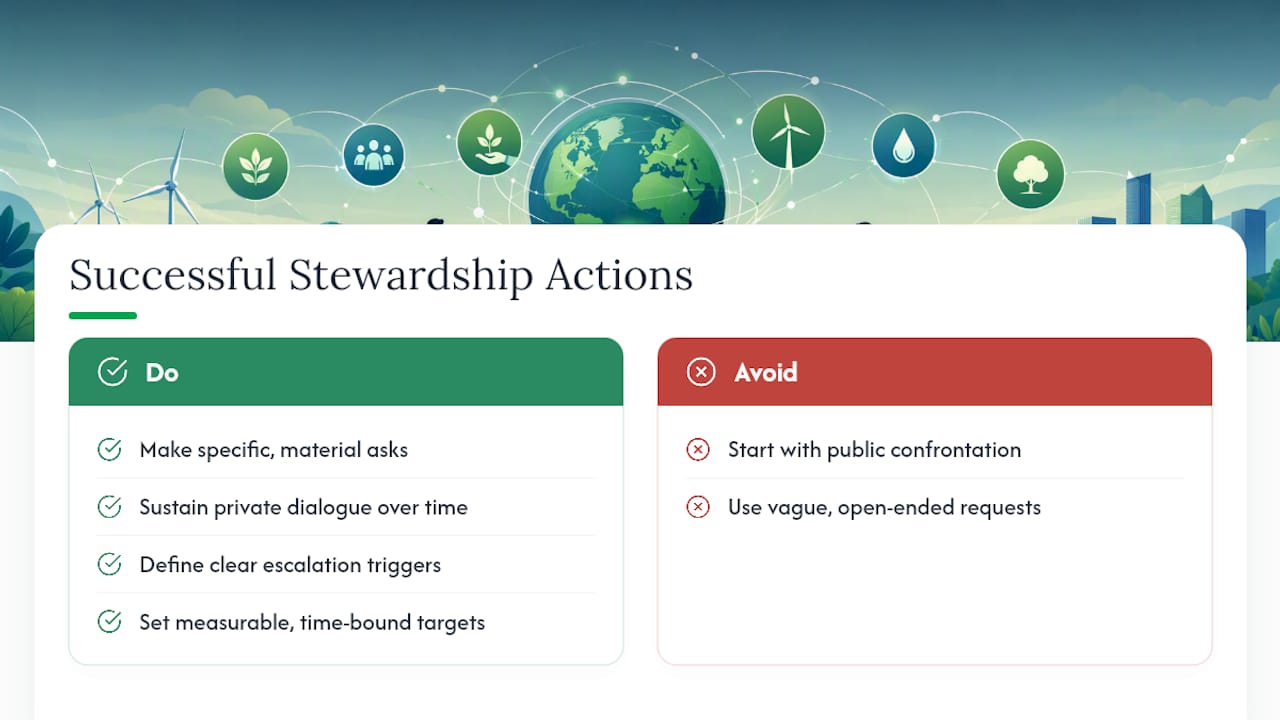
Effective interventions share a common pattern: specific, material asks, sustained dialogue, and a credible escalation path if engagement stalls. CFA Institute's analysis of stewardship impact points to focused, sustained private engagement, backed by clear escalation criteria, as the approach that produces the most consistent results. Public confrontation tends to be a last resort rather than an opening move.
Collaborative campaigns illustrate how pooled leverage changes outcomes that individual investors couldn't achieve alone. Climate Action 100+ coordinates institutional investors engaging the highest emitting companies globally on transition planning, board oversight of climate risk, and emissions disclosure. The initiative's structure, lead investors assigned to specific companies with shared research and coordinated asks, addresses the free-rider problem by making accountability visible within the coalition itself, even if it doesn't eliminate it entirely.
Governance-focused interventions often move faster than climate ones because the ask is narrower and the board has direct authority to act. A director nomination campaign targeting a board with no relevant risk oversight experience, for instance, has a clear resolution path: the company either adds qualified directors or faces a proxy fight, and shareholders vote on a defined question rather than an open-ended request for improvement.
What separates a successful case from a stalled one is usually the presence of measurable, time-bound asks. "Improve your climate disclosure" invites years of vague progress reports. "Publish Scope 3 emissions data aligned with the GHG Protocol within two reporting cycles, or we will file a shareholder proposal" gives both sides a concrete standard to work against, and gives the investor a clean trigger for escalation if the deadline passes.
How Does Stakeholder Engagement Extend Beyond Shareholders?
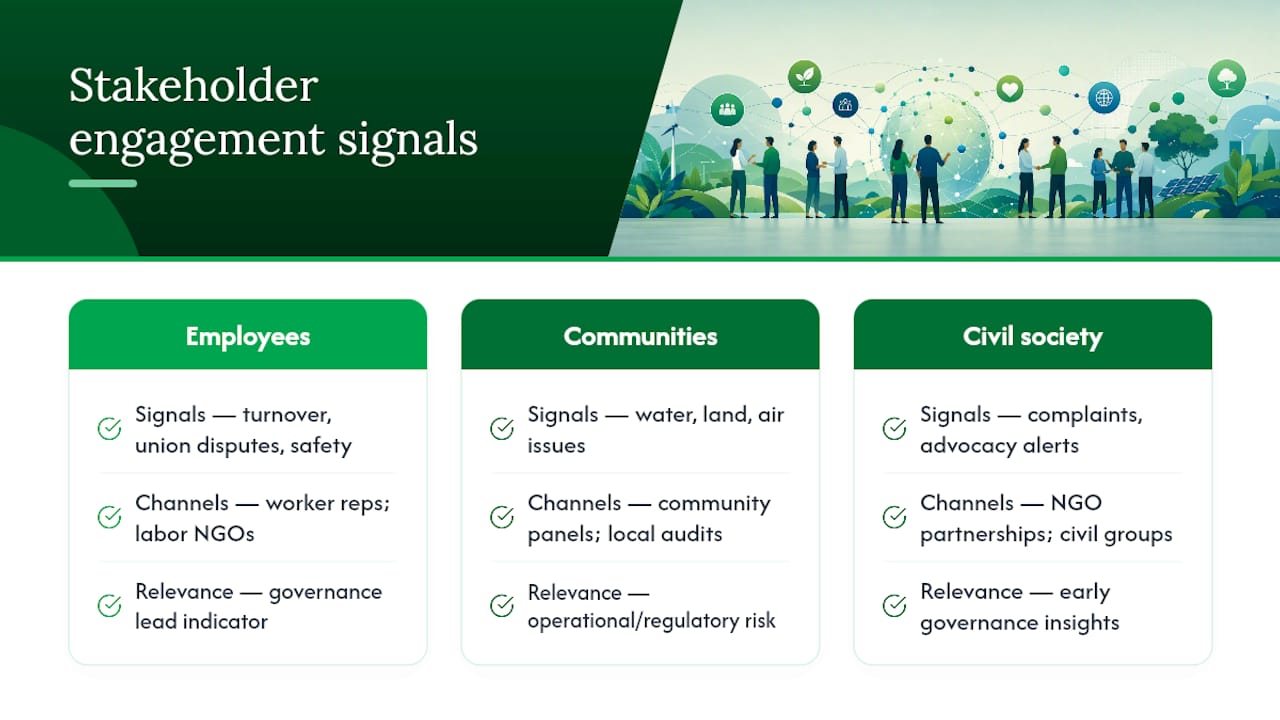
Stewardship's traditional focus on shareholder rights undersells how much of its real-world impact depends on stakeholders who never touch a proxy ballot. Employees, affected communities, and civil society organizations frequently surface the governance and operational risks that later show up in engagement priorities, often well before they appear in a company's own disclosures.
Labor practices are a clear example. Employee turnover data, unionization disputes, and workplace safety incidents rarely make it into standard ESG scorecards until they've already become a controversy, but engagement with worker representatives or labor rights organizations can flag these risks months earlier. Investors who build these channels into their research process, rather than relying solely on company-reported metrics, get an earlier and more accurate read on governance quality.
Community engagement matters most acutely around physical operations: extractive industries, infrastructure projects, and manufacturing facilities with direct environmental footprints in specific locations. A community's lived experience of water contamination, land use disputes, or air quality changes is often a leading indicator of the kind of regulatory and reputational risk that eventually hits the balance sheet, well before it appears in a quarterly filing.
The enlightened stewardship framing from ECGI's research captures why this matters structurally, not just ethically: a fiduciary duty framed narrowly around shareholder returns misses the material risks that stakeholder relationships routinely surface first. Building formal channels, whether through community advisory panels, supplier audits with worker interviews, or partnerships with labor-focused NGOs, isn't a departure from financial stewardship. It's an input to it.
What Should Practitioners Prioritize Going Into 2026?
Regulatory reporting alignment across TCFD, ISSB, and CSRD will keep converging, rewarding firms that build one clean data pipeline instead of three redundant ones. My advice: prioritize measurable engagement outcomes over engagement volume, and invest in the internal skills to interpret ESG data rather than outsourcing judgment entirely to vendor scores.
— Ransford
Build the Skills Behind Credible Stewardship
Everything covered here, escalation ladders, KPI design, ERM integration, assurance readiness, depends on people who actually know how to execute it, not just describe it in a policy document. That's the gap Esgtraininginstitute exists to close: standards-aligned certification programs covering engagement design, carbon accounting, governance analysis, and disclosure alignment with frameworks like TCFD, ISSB, and CSRD.
Course tracks range from foundation-level ESG literacy through advanced credentials for assurance practitioners and risk officers who need to defend their methodology to a board or a regulator. Some graduates carry these credentials into firms overseeing a large scale of ESG assets, reflecting how seriously boards treat verifiable stewardship capability versus self-taught familiarity. If your team's stewardship program is running on borrowed expertise or ad hoc research, review the accreditation pathways and find the credential that matches where your gaps actually are.
Sources
- About stewardship | PRI
- How investors achieve impact through stewardship | CFA Institute
- EBA Guidelines on the management of ESG risks
- Enterprise Risk Management—Integrating with strategy and performance | COSO
- The purpose of investor stewardship | ECGI
FAQ
What Is the Difference Between ESG Integration and Stewardship?
ESG integration analyzes material environmental, social, and governance factors during investment analysis and valuation. Stewardship acts on those findings through engagement, voting, and escalation with companies already held in the portfolio.
Is Investor Stewardship the Same as Impact Investing?
No. Impact investing targets specific measurable outcomes through capital allocation decisions upfront, while stewardship pursues outcomes by influencing companies already in a portfolio through ongoing engagement and voting.
How Do You Measure Stewardship Effectiveness?
Practical KPIs include engagement count, materiality-weighted engagement outcomes, voting alignment percentage against stated policy, escalation rate, and measurable changes in target companies' disclosures or targets.
Why Do Investors Use Collaborative Engagement Instead of Acting Alone?
Collaborative initiatives like Climate Action 100+ pool leverage across many institutions, letting investors influence large companies that no single mid-sized firm could move alone, while sharing research costs across participants.
What Skills Do Stewardship Practitioners Need Most?
Practitioners need fluency in ESG risk analysis, engagement strategy design, proxy voting policy, and disclosure alignment with TCFD and ISSB. Standards-aligned training programs, including those offered through Esgtraininginstitute, build these competencies directly.