

If your organization carries on business in the UK and has an annual turnover of £36 million or more, you likely must publish an annual modern slavery statement. Confirm your financial year end and check your board's approval calendar now. Your immediate next step is verifying jurisdictional thresholds against the official registry and mapping your reporting window before drafting begins.
TL;DR:
- Organizations with an annual UK turnover of £36 million or more must publish a formal modern slavery statement within six months after their fiscal year end, with board approval and a signed director's name.
- Statements should comprehensively cover supply chain structure, policies, risk assessments, due diligence, training, and measurable progress indicators, updated annually with specific evidence.
- Conducting a proper risk assessment involves cross-referencing sector and geographic risks, mapping suppliers by tier, and incorporating worker voice data and third-party audits for accuracy.
- Credible remediation emphasizes worker-centered solutions, including investigation, targeted remedy planning, monitoring, and avoiding premature supplier termination.
- Publishing must be in relevant national registries, with multi-jurisdiction statements using a core document plus annexes, and accessibility of past statements to demonstrate continuous compliance.
Table of Contents
- Who Must Publish a Modern Slavery Statement, and When?
- What Must a Modern Slavery Statement Actually Cover?
- How Do You Conduct a Modern Slavery Risk Assessment?
- What Does Credible Remediation Actually Look Like?
- Where Do You Publish, and How Does Cross-Jurisdiction Filing Work?
- A Reusable Template for Your Next Statement
- Why Training Reduces Modern Slavery Compliance Risk
- What Compliance Teams Get Wrong First Time Around
- Build the Skills Behind a Statement That Holds Up
- Sources
- FAQ
Who Must Publish a Modern Slavery Statement, and When?
Modern slavery act reporting turns on three legal tests, not one. An organization must be carrying on business in the relevant jurisdiction, must supply goods or services, and must clear a turnover threshold. In the UK, that threshold sits at £36 million in annual turnover under the Modern Slavery Act 2015. Australia's regime uses a lower AU$100 million threshold with a different filing structure, and Canada's Fighting Against Forced Labour and Child Labour in Supply Chains Act applies its own criteria. Global groups often clear the bar in one jurisdiction and not another, which is precisely why the applicability test comes first, not the drafting.
Timing follows the financial year, not the calendar year. Most guidance recommends publishing within six months of fiscal year end, though UK practice tolerates slightly longer windows if the statement clearly states the reporting period it covers. Waiting too long undercuts the transparency the whole exercise exists to demonstrate.
Governance sign-off is not optional paperwork. GOV.UK's own guidance stresses that statements should carry board approval, a named signatory (a director or equivalent), and prominent placement on the homepage or within one click of it.
Before publishing, confirm:
- Financial year end date and the resulting reporting deadline
- Board or equivalent governing body has formally approved the statement
- A named director has signed, with the signature dated
- The statement sits on the homepage or is linked prominently from it
- Prior years' statements remain accessible, not deleted or replaced
Skipping any of these five items is the single most common reason otherwise solid statements draw regulatory or media criticism. The content can be excellent and still fail on governance basics.
What Must a Modern Slavery Statement Actually Cover?
Statutory guidance from the Home Office lays out six recommended disclosure areas that anchor every credible modern slavery transparency report. Treating these as a checklist to skim past is the fastest way to produce a statement that reads as compliance theater rather than genuine disclosure.
- Organization and supply chains. Describe the business structure, sectors, geographies, and supply chain tiers. Level 1 disclosure names the sectors you operate in; level 2 maps specific supplier tiers and flags high-risk categories by product line or region.
- Policies. State the corporate slavery policies in force, including codes of conduct and supplier standards. Level 2 disclosure names the policy owner, the review cycle, and how the policy links to procurement contracts.
- Risk assessment and management. Explain how risks are identified and ranked. Strong statements name the methodology and the specific risk categories found, not just that "an assessment was conducted."
- Due diligence, including remediation. Detail the processes used to investigate concerns and the remedy provided when issues surface. This is the area where vague language does the most damage to credibility.
- Training. Specify who receives training, how often, and on what modern slavery compliance content. Attendance figures and completion rates carry more weight than a description of the curriculum.
- Monitoring and effectiveness. Report the KPIs used to judge progress year over year, such as the percentage of tier-1 suppliers audited or grievance cases resolved within a set timeframe.
Year-on-year progress is what separates a statement worth reading from one that gets filed and forgotten. Regulators and practitioner guidance consistently note that credible statements reference specific supplier samples, audit dates, and measurable outcomes rather than restating policy language unchanged from the prior year. If last year's statement said you were "developing a supplier audit program," this year's needs to say how many audits happened and what they found.
How Do You Conduct a Modern Slavery Risk Assessment?
A defensible slavery risk assessment starts with desk research, moves through supplier mapping, and ends with a tiered risk score you can defend to an auditor or a journalist. Skipping straight to supplier questionnaires without first understanding sector and geographic exposure produces assessments that miss the risks that matter most.
Start with published risk indicators. Cross-reference your sourcing countries and sectors against known risk indices and government reporting on forced labor and trafficking patterns. Layer in your own supplier data next. Map suppliers by tier, not just tier 1, since sub-tier suppliers routinely carry the highest risk and the least visibility. Some companies now pair traditional supplier questionnaires and third-party audits with AI-assisted trade-data analysis to flag sub-tier forced labor risks that manual review would miss entirely.
Useful sources and tools for this stage include:
- Supplier self-assessment questionnaires, ideally verified against independent audit findings
- Third-party social audits, weighted more heavily for high-risk sectors and geographies
- Digital traceability platforms that track goods through multiple supply chain tiers
- Sector-specific risk indices and government trafficking-in-persons reporting
- Worker surveys conducted independently of factory management, wherever feasible
Worker voice data is the piece most statements handle poorly. A supplier audit checklist can confirm a factory has a grievance poster on the wall without confirming workers trust the mechanism behind it. Genuine worker engagement means multiple accessible channels: an anonymous phone line, an app-based reporting tool, and a direct line to trade unions or local NGOs where they operate. Effective grievance mechanisms also need language accessibility and increasingly need their own effectiveness metrics reported, not just their existence.
Pro Tip: Ask your third-party auditors for anonymized grievance-line call volume and resolution times, not just pass/fail audit scores. A supplier with a working grievance channel and a handful of resolved cases is often lower risk than one with a clean audit and total worker silence.
A tool like supply-chain mapping guidance can help structure this tiering exercise before you commit resources to full-scale audits. A structured supply-chain assessment methodology from a specialist consultancy is another route worth comparing against your internal capability.
What Does Credible Remediation Actually Look Like?
Victim-centered remediation is the standard regulators and NGOs expect, and it runs directly counter to the instinct many compliance teams have to cut a supplier loose the moment a violation surfaces. Terminating the relationship without a remedy plan often just pushes the same workers into a worse, less visible situation with no back pay, no protection, and no path to a safer job. Home Office guidance is explicit that remediation must center the worker, not the reputational convenience of the buying company.
A credible remediation workflow generally follows four stages:
- Investigation. Verify the finding independently, ideally including worker interviews conducted away from management oversight.
- Remedy plan. Agree on concrete steps with the supplier, such as back pay, contract corrections, or facility changes, with named deadlines.
- Monitoring. Track whether the remedy plan is actually implemented, not just promised, through follow-up audits or worker check-ins.
- Escalation. Reserve supplier exit for cases where the supplier refuses to remediate or repeats violations, and document why lesser measures failed first.
Presenting these outcomes in your statement takes some care around confidentiality. You do not need to name a specific facility or worker to report that "three tier-2 supplier audits in 2025 identified wage discrepancies, resulting in $340,000 in aggregate back pay across affected workers, verified by follow-up audit." Aggregate figures and percentages, paired with a specific process description, satisfy the disclosure expectation without exposing anyone to retaliation.
Where Do You Publish, and How Does Cross-Jurisdiction Filing Work?
Publishing is not just posting a PDF and moving on. Three registries and templates now shape how ethical supply chain reporting gets filed and found.
- Upload to the UK registry. The Modern Slavery Statement Registry lets organizations submit statements directly, with search filters and CSV export for stakeholders and researchers. Uploading is currently voluntary but strongly encouraged, and government signals suggest it may become mandatory.
- Check Australia's equivalent. The Modern Slavery Statements Register serves the same function for entities reporting under Australian law, with comparable search and export functions.
- Use the international template for multi-jurisdiction groups. Public Safety Canada's international reporting template harmonizes reporting across UK, Australian, and Canadian requirements, cutting duplicate drafting work.
For groups reporting in more than one jurisdiction, a single global statement rarely fits every local formality. A modular approach, one core statement with country-specific annexes, preserves consistency while meeting each jurisdiction's signature and content requirements. Keep every historical statement archived and linked, not overwritten, since registries and auditors both expect a visible multi-year trail.
A Reusable Template for Your Next Statement
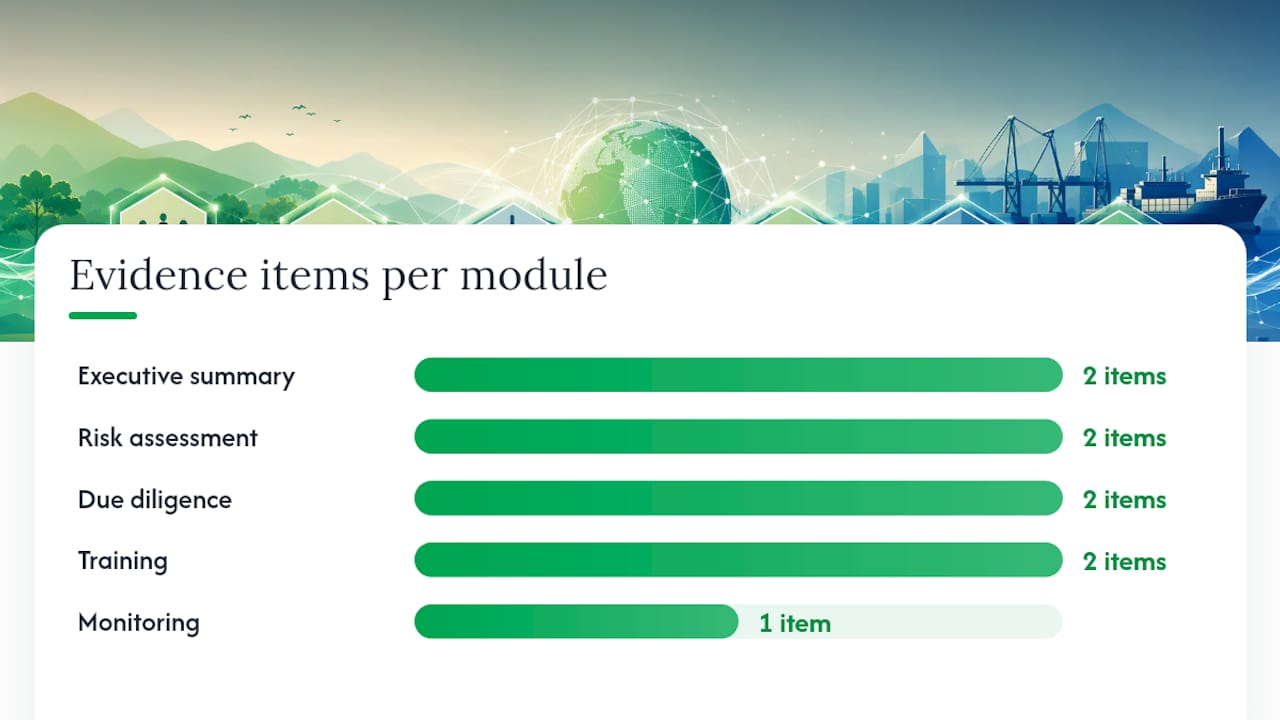
A modular structure keeps drafting fast and keeps every statutory area covered without last-minute scrambling. Build your draft around eight sections: executive summary, governance and sign-off, organization and supply chains, policies, risk assessment, due diligence and remediation, training, and monitoring with KPIs, followed by country-specific annexes where needed.
For each module, attach the evidence that backs it rather than a narrative summary alone:
- Executive summary: signed approval date and reporting period covered
- Risk assessment: supplier tier maps and risk-scoring methodology notes
- Due diligence: sample audit reports and remediation case logs (aggregated)
- Training: completion logs and role-based training matrices
- Monitoring: year-over-year KPI tables, such as percentage of audited tier-1 suppliers
| Module | Evidence to Attach | Common Gap |
|---|---|---|
| Governance | Board approval minutes, signed date | Missing named signatory |
| Risk assessment | Supplier tier map, risk scores | Tier-1 only, ignoring sub-tier |
| Due diligence | Audit samples, remediation logs | Vague "ongoing review" language |
| Training | Completion logs by role | No attendance data |
| Monitoring | Year-over-year KPI table | Same KPIs repeated with no change |
Country annexes belong at the end, each covering the local legal test, signatory, and registry filing confirmation for that jurisdiction. This keeps the core narrative reusable across markets. A resource on human rights due diligence under the CSDDD is worth reviewing if your group also faces European due diligence obligations layered on top of modern slavery act reporting.
Why Training Reduces Modern Slavery Compliance Risk
Statements built on well-documented evidence trails do not happen by accident. They happen because the people running supplier audits, writing risk assessments, and designing grievance mechanisms know exactly what regulators expect to see. Reporting teams that lack structured training in supply-chain mapping and human rights due diligence tend to produce statements heavy on policy language and light on the audit trail that actually earns credibility.
Course tracks worth prioritizing for a compliance function include:
- Supply-chain risk mapping and tiered supplier assessment methodology
- Human rights due diligence design, aligned to statutory disclosure areas
- Remediation and grievance mechanism design for cross-border supply chains
Esgtraininginstitute's corporate training and accreditation programs are built around exactly these skill gaps, drawing on standards-aligned curricula used by sustainability leads and assurance practitioners across multiple jurisdictions.
What Compliance Teams Get Wrong First Time Around
Prioritize worker-centered evidence and measurable KPIs over polished policy language. The biggest pitfall is declaring "no risks found" without documenting the investigation behind that claim. Triage matters too: start deep-dive assessments with your highest-risk product lines or sourcing geographies, then expand depth to lower-risk areas in later reporting cycles rather than spreading thin effort everywhere at once.
— Ransford
Build the Skills Behind a Statement That Holds Up
A credible modern slavery statement is only as strong as the evidence behind it, and that evidence depends on whether your team knows how to run a proper risk assessment, structure a remediation workflow, and document KPIs that survive scrutiny. This gap can be closed with training built around the same statutory disclosure areas compliance officers are already accountable for.
Corporate training packages cover supply-chain mapping, human rights due diligence, and remediation design, feeding straight into the audit samples, supplier engagement records, and grievance data your next statement needs. Certification pathways give individual compliance officers and sustainability professionals a credential that signals real competence to boards and auditors, not just attendance at a webinar. If your team is drafting its first robust statement or overhauling a weak one, review the accreditation options and find the certification track that matches your reporting responsibilities.
This article is general information, not a substitute for advice from a qualified lawyer. Consult a qualified legal professional about your own circumstances before acting on anything here.
Sources
- Gov
- Transparency in supply chains: a practical guide (Home Office)
- Modern slavery statement registry - GOV.UK
- International Reporting on Modern Slavery, Forced Labour and Child Labour Version 1 – July 2025
FAQ
What Is the Threshold for Modern Slavery Reporting?
In the UK, organizations carrying on business with an annual turnover of £36 million or more must publish a statement; other jurisdictions like Australia and Canada apply different thresholds and tests.
Who Is Required to Provide a Modern Slavery Statement?
Any commercial organization that carries on business in a covered jurisdiction, supplies goods or services, and meets the local turnover threshold must publish one, with board approval and a named signatory.
How Do I Report Suspected Modern Slavery?
Use your organization's grievance hotline or worker reporting channel first if the concern involves your supply chain, or contact local law enforcement and national trafficking hotlines for immediate safety concerns; document the report and any investigation for your next statement's due diligence section.
What Qualifies as Modern Slavery?
Modern slavery covers forced labor, human trafficking, debt bondage, and other situations where a person cannot freely leave or refuse work due to coercion, deception, or abuse of power, and it is the core risk category every slavery risk assessment is designed to identify.
Where Should I Publish My Modern Slavery Statement?
Publish it prominently on your corporate homepage or one click from it, keep prior years' statements accessible, and upload it to the relevant national registry, such as the UK's Modern Slavery Statement Registry, for maximum visibility.