

Net zero means cutting greenhouse gas emissions to the lowest feasible level and balancing whatever remains with an equivalent amount of removals, all aligned to the 1.5°C pathway science demands. That science requires a 45% cut in global emissions by 2030 against 2010 levels, then net zero by 2050. The European Union has already moved the goalposts with a legally binding 2040 target. For any organization or government, the immediate task is the same: set measurable near-term reductions across Scope 1, 2, and 3, and get them independently verified.
TL;DR:
- Many countries have pledged net-zero goals, but few have legally binding targets that include interim milestones or verified scopes, especially beyond 2030.
- The European Union's 2040 target of a 90% reduction against 1990 levels indicates regional momentum toward earlier deadlines, making 2050 benchmarks potentially outdated.
- Companies must adopt science-based, scope-comprehensive targets with clear governance and transparency, avoiding reliance on offsets that lack permanence or scope coverage.
- Building internal expertise in carbon accounting, transition planning, and assurance is crucial to develop credible targets that withstand external review.
- Achieving net zero relies heavily on technological advances in carbon removal and process innovation, especially for sectors with unavoidable residual emissions like cement and aviation.
Table of Contents
- Net Zero Targets Today: Who Has One and What They Actually Cover
- The Climate Science Behind 2030 and 2050 Targets
- SBTi, Race to Zero, and Trackers: What Each One Actually Tells You
- How to Set a Credible Corporate Net-Zero Target
- Measuring and Verifying Progress Against Net-Zero Targets
- Evaluating Target Credibility: A Practical Checklist
- Why Practitioner Skill Determines Whether Targets Hold Up
- How Net-Zero Commitments Reshape Business Strategy
- Common Barriers to Implementing Net-Zero Targets
- Technology and Carbon Removal: The Engineering Side of Net Zero
- What Successful Net-Zero Implementation Looks Like Across Sectors
- Communicating Net-Zero Commitments to Stakeholders
- What Professionals Should Prioritize Right Now
- Build the In-House Capability Net-Zero Targets Actually Require
- Where to Verify Net-Zero Data and Standards Directly
- Sources
- FAQ
Net Zero Targets Today: Who Has One and What They Actually Cover
As of June 2024, 107 countries covering roughly 82% of global greenhouse gas emissions had adopted some form of net-zero pledge. That figure sounds like near-universal consensus. It isn't, because a pledge and a plan are different things.
Coverage breaks down into three tiers of seriousness:
- Legislated targets, written into binding national law, with penalties or legal review attached (Canada and Australia are current examples).
- Policy documents, published as government strategy but without statutory force, meaning a change in administration can quietly shelve them.
- Announcements, often made at a UN summit or trade conference, with no implementation mechanism behind them at all.
Net Zero Tracker compiles targets at the country, region, city, and company level, and it filters by target type and year, which makes it the closest thing professionals have to a single reference point. Its own methodology notes matter as much as its headline numbers: the dataset counts stated ambition, not delivery. A company or country can appear on the list with a target that has no interim milestones, no defined scope boundaries, and no verification plan attached. Reading the fine print on any tracker entry, not just the headline count, is the difference between due diligence and taking a press release at face value.
The Climate Science Behind 2030 and 2050 Targets
The near halving of emissions by 2030, followed by reaching net zero by 2050, is based on carbon budget math: the atmosphere has a finite capacity to absorb additional CO2 before warming exceeds 1.5°C, and current emission rates burn through that budget fast. Front loading reductions this decade matters more than back loading them, because cumulative emissions, not just the 2050 endpoint, determine how much warming actually happens.
The 90% by 2040 benchmark: The European Union's 2040 climate target sets a legally binding 90% net emissions cut against 1990 levels, built from an 85% domestic reduction plus up to 5% from international credits. It is the clearest signal yet that regional blocs are done treating 2050 as the only date that matters.
For professionals building transition plans, the EU amendment is a preview. National governments not yet at 2040 legislation should be assumed to be heading there, and corporate targets built only around 2050 will look outdated fast. Always check the base year before comparing ambition levels.
SBTi, Race to Zero, and Trackers: What Each One Actually Tells You
Three reference points dominate credible target-setting, and each answers a different question.
- The Science Based Targets initiative (SBTi) publishes the Corporate Net-Zero Standard, now on version 2.0, which sets the criteria for what a validated corporate target looks like: full Scope 1, 2, and 3 coverage, both near-term and long-term milestones, a published transition plan, and a validation process run through SBTi itself. SBTi expects most companies to cut emissions by a very large percentage before 2050, with the remainder neutralized through high-integrity removals rather than cheap offsets.
- The UN Net Zero Coalition and Race to Zero operate at a different altitude. They aggregate commitments from states, cities, regions, and non-state actors, and they push participants toward credibility criteria rather than certifying individual targets. The UN's own analysis is candid that current national plans, taken together, still fall short of what 1.5°C requires. That gap is exactly why company-level rigor matters even when national policy lags.
- Trackers like Net Zero Tracker and the Climate Action Tracker exist to translate all of the above into comparable data. They tell you who has committed and how their target components stack up against best-practice criteria. They do not validate individual targets the way SBTi does, and treating a tracker listing as equivalent to SBTi validation is a common, avoidable mistake.
Used together, these three answer three different questions: is this target well-designed (SBTi), is this actor part of a credible global movement (Race to Zero), and how does this target compare across the field (trackers). Skipping any one of them leaves a gap in due diligence.
How to Set a Credible Corporate Net-Zero Target
Setting a target that survives scrutiny takes more than picking a year and an emissions percentage. Follow this sequence.
- Establish your inventory and base year. Choose a base year with defensible, auditable data, typically the most recent full year with complete Scope 1 and 2 records. Document data quality gaps now, since assessors and auditors will find them later regardless.
- Decide your scope boundaries. Scope 1 and 2 are usually straightforward. Scope 3 is not, and for most companies it represents the largest share of total emissions. Supplier engagement programs and standardized data-collection protocols are the practical mechanism for closing this gap, not spreadsheet estimation alone.
- Build a two-tier target architecture. Set near-term targets covering five to ten years alongside a long-term target reaching net zero by 2050 or sooner. The near-term target is what makes the long-term one credible.
- Attach governance and disclosure. Assign board or executive accountability for delivery, publish a transition plan describing the capital and operational changes required, and commit to a disclosure cadence before the first progress report is due.
Pro Tip: Treat Scope 3 as a cross-functional project from day one. Procurement, finance, and sustainability teams that co-own data collection deliver usable numbers far faster than sustainability teams working alone with supplier surveys.
Review the SBTi methodology in detail before finalizing target language. Small wording choices around scope and base year create large downstream reporting obligations.
Measuring and Verifying Progress Against Net-Zero Targets
A target is only as good as the reporting behind it. Three categories of measurement matter.
- Core KPIs: absolute emissions in tonnes of CO2 equivalent, emissions intensity per unit of revenue or output, and the volume of removals purchased, each tracked against permanence criteria (a tree planted last year is not equivalent to a tonne stored geologically for centuries).
- Disclosure routes: corporate sustainability reports, ISSB-aligned filings (the successor framework to TCFD), and, in a growing number of jurisdictions, mandatory regulator filings that carry legal weight rather than voluntary framing.
- Assurance: third-party verification that checks whether reported figures match underlying data and methodology. Credible disclosures signpost the assurance provider, the scope of what was checked, and the standard applied, rather than a vague "verified" stamp with no detail attached.
Professionals reviewing someone else's disclosure should look for these signposts explicitly. Their absence is itself useful information.
Evaluating Target Credibility: A Practical Checklist
Most net-zero claims fail on a small, predictable set of criteria. Run any target, yours or a counterparty's, through this checklist before taking it at face value.
- Is the target aligned with a recognized science-based pathway, not just an internally chosen percentage?
- Does it cover Scope 1, 2, and Scope 3, or does it quietly omit the category that usually represents the biggest share of emissions?
- Are there near-term milestones (2030 or sooner), or does the target only name a distant 2050 date with nothing in between?
- Is there transparency on removal assumptions: what type of removal, what permanence standard, what percentage of the target it covers?
The most common red flags are the mirror image of that list: heavy reliance on cheap, short-duration offsets; a total absence of Scope 3 reporting; and a transition plan with no named governance owner or timeline. When you spot these, the remedial step is straightforward: request the underlying methodology document, not a summary slide, and check it against the SBTi Corporate Net-Zero Standard criteria directly.
Why Practitioner Skill Determines Whether Targets Hold Up
Standards and trackers only work if the people applying them know how to read and use them correctly. Scope 3 accounting, transition plan design, and assurance readiness are specialist skills, not general sustainability knowledge, and the gap between a well-written target and a defensible one usually comes down to who built it.
Core competencies worth building or hiring for include:
- Carbon accounting methodology across all three scopes, including estimation techniques for supplier data gaps.
- Transition plan design that links near-term targets to capital allocation and operational change.
- Regulatory alignment across ISSB, EU, and jurisdiction-specific disclosure regimes.
- Assurance literacy: knowing what a third-party verifier actually checks and where its scope typically ends.
Certification pathways are built around exactly this gap, covering carbon accounting, climate strategy, and assurance readiness for the practitioners who carry these targets from commitment to delivery.
How Net-Zero Commitments Reshape Business Strategy
Setting a net-zero target is rarely just an environmental decision. Once a company commits, capital allocation, procurement, and product design start answering to it. A manufacturer setting a Scope 3 target effectively rewrites its supplier contracts, since supplier emissions data becomes a procurement criterion rather than a side conversation.
Operationally, three shifts show up consistently with increasing attention from green bonds and impact investing, as these financing tools play a growing role in capital allocation toward net-zero projects. First, capital expenditure planning starts weighting decarbonization projects, on-site renewables, electrified fleets, efficiency retrofits, against traditional payback periods that may no longer apply once carbon cost or regulatory risk enters the calculation. Second, product and service design begins accounting for embedded emissions, particularly in sectors like construction, apparel, and consumer electronics where material choice drives most of the footprint. Third, finance teams increasingly treat climate targets as disclosure obligations with legal exposure attached, not just voluntary commitments, which pulls the general counsel's office into what was previously a sustainability-only conversation.
The strategic risk cuts both ways. Companies that treat net zero as a marketing layer over unchanged operations face growing scrutiny and reputational exposure when Scope 3 gaps surface. Companies that integrate it into core planning, tying it to budget cycles and executive incentives, tend to hit their near-term milestones at a noticeably higher rate. The target itself doesn't change outcomes; the operational rewiring behind it does.
Common Barriers to Implementing Net-Zero Targets
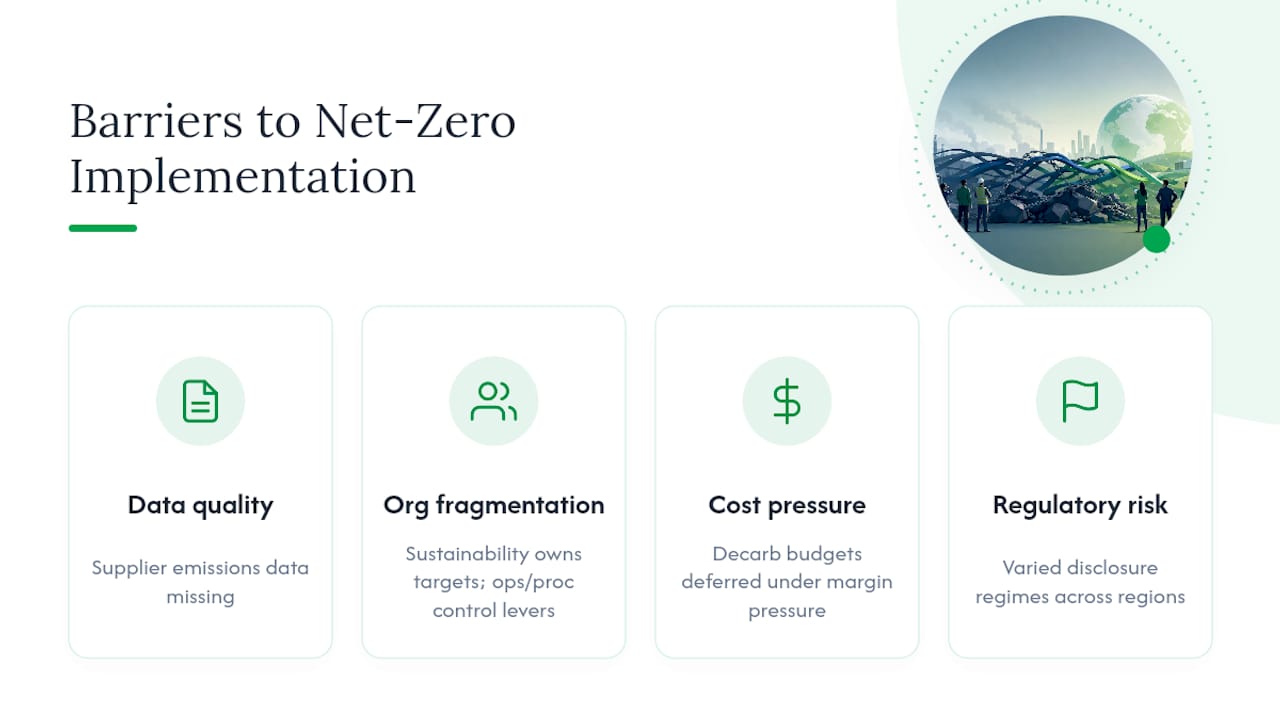
Data quality is the barrier that surfaces first and lingers longest. Most companies discover, once they attempt Scope 3 measurement, that supplier emissions data simply doesn't exist in usable form, forcing reliance on industry-average estimation methods that auditors and stakeholders increasingly question.
Organizational fragmentation compounds the problem. Sustainability teams frequently own the target while procurement, finance, and operations control the levers that actually move emissions, and without a shared governance structure, the target stalls in reporting purgatory rather than driving change.
Cost and capital competition present a harder constraint. Decarbonization investments compete against other capital priorities, and in downturns or margin-pressure periods, transition budgets are often the first line item deferred, even when the underlying target commitment remains publicly stated.
Regulatory fragmentation adds another layer. A multinational operating across the EU, North America, and Asia faces different disclosure regimes, different legal thresholds, and different levels of enforcement in each market. Building one internal reporting system that satisfies all of them, rather than parallel bespoke processes per jurisdiction, requires expertise most organizations underinvest in until a regulator forces the issue. That underinvestment in carbon accounting capability is frequently the root cause behind missed interim milestones, not lack of ambition.
Technology and Carbon Removal: The Engineering Side of Net Zero
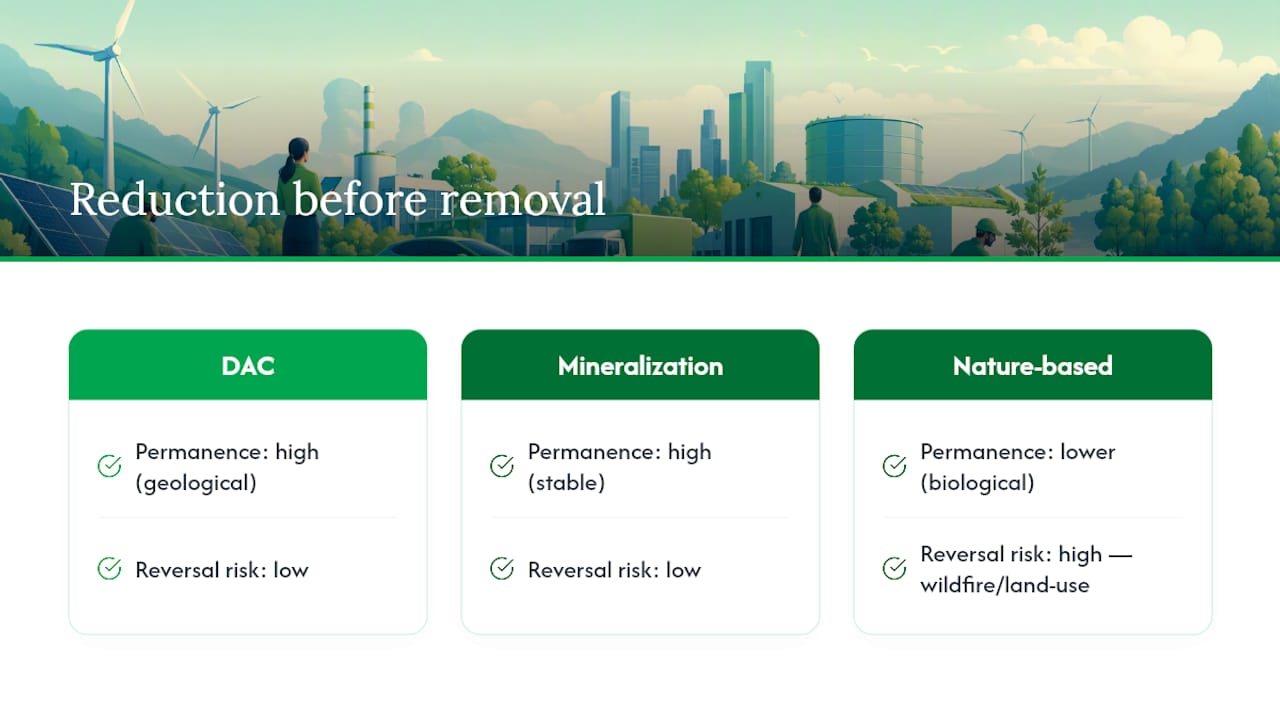
Reduction always comes before removal in a credible plan, but residual emissions, the portion that can't be eliminated with current technology, are real for almost every sector. Cement, steel, aviation, and heavy agriculture all have emissions sources with no fully mature zero-carbon substitute yet available at scale.
That residual gap is where carbon removal technology matters. Direct air capture, enhanced mineralization, and nature-based removals like reforestation each carry different permanence profiles: a tonne captured and stored geologically behaves very differently over time than a tonne stored in a forest exposed to wildfire or land-use change risk. The SBTi standard's neutralization criteria exist specifically to force this distinction, requiring high-integrity removals for the fraction of emissions that genuinely cannot be eliminated, rather than allowing low-cost offsets to substitute for real reduction work.
Innovation in industrial processes matters just as much as removal technology. Green hydrogen for steelmaking, electrified heat for industrial processes, and low-carbon cement formulations are shifting what counts as "hard to abate" faster than most transition plans account for. A target written five years ago assuming a technology gap may need revision simply because the gap has narrowed. Reviewing technology assumptions on a fixed cycle, not just at target-setting, keeps a net-zero plan from becoming quietly obsolete.
What Successful Net-Zero Implementation Looks Like Across Sectors
Sector context changes what "successful" implementation actually requires. In heavy industry, success typically means a phased capital plan tied to asset replacement cycles, since steel and cement facilities operate on multi-decade investment horizons and a net-zero target must map onto real plant retirement and rebuild schedules, not an arbitrary calendar year.
In financial services, implementation looks different again: it centers on portfolio-level emissions accounting (financed emissions) rather than direct operational footprint, meaning the target's credibility depends on the quality of data collected from the companies and projects a bank or asset manager finances, not its own office energy use.
Retail and consumer goods companies tend to succeed when they treat Scope 3 supplier engagement as a long-term partnership rather than a compliance survey, building multi-year data-sharing agreements with key suppliers instead of annual one-off requests that produce inconsistent numbers each cycle.
Across all three sector types, the pattern SBTi's own validation data points to is procurement, finance, and sustainability functions sharing ownership of target delivery rather than sustainability carrying it alone. Sector differences shape the mechanics; cross-functional ownership shapes whether the target actually gets met.
Communicating Net-Zero Commitments to Stakeholders
Investors, regulators, employees, and customers each need a different depth of detail on the same target, and treating them identically is a common communication failure. Investors and assurance practitioners want methodology: base year, scope boundaries, removal assumptions, and verification status, delivered in the disclosure itself rather than a summary claim.
Regulators increasingly want machine-comparable data formatted to ISSB or jurisdiction-specific taxonomies, which means communication strategy now has a technical formatting requirement layered on top of the narrative one. Employees and internal stakeholders need the operational translation: what the target means for their function, budget, or role, since a target announced at the top of the organization does nothing if procurement or plant managers never hear how it applies to their decisions.
External stakeholder engagement works best when it's specific rather than aspirational. Naming the near-term milestone, the current progress against it, and the named gaps still being addressed builds more credibility than a polished statement with no numbers attached. Silence on gaps, or vague language substituting for a genuine shortfall, is usually read by sophisticated stakeholders as evasion rather than confidence, and it invites exactly the scrutiny a well-documented, honestly reported gap would avoid.
What Professionals Should Prioritize Right Now
The gap between a stated target and a credible one comes down to sequencing. Near-term reductions and governance ownership have to come first; a 2050 date with nothing set for 2030 is not a plan. Scope 3 systems and supplier engagement deserve investment before the next reporting cycle forces the issue under pressure. Treat SBTi criteria and trackers like Net Zero Tracker as living references, not one-time checklists, since both standards and science keep moving.
— Ransford
Build the In-House Capability Net-Zero Targets Actually Require
Most organizations don't fail at net-zero because their ambition is wrong. They fail because the team writing the target has never been trained in SBTi methodology, Scope 3 accounting, or assurance-ready disclosure, and the gaps surface during external review instead of internal planning.

Certification pathways map directly onto that gap: courses covering SBTi methodology and validation criteria, carbon accounting across Scope 1 through 3, and assurance readiness for teams preparing disclosures that will face regulator or third-party scrutiny. Building this capability internally, rather than discovering the shortfall when a regulator or investor asks pointed questions, is what turns a stated commitment into a defensible one. Review the accreditation pathways to see which certification track matches your team's current gap, whether that's transition planning, carbon accounting, or regulatory alignment, and start the enrollment process for the next available cohort.
Where to Verify Net-Zero Data and Standards Directly
For primary verification rather than secondhand summaries, five sources cover most professional needs. The SBTi Corporate Net-Zero Standard gives the validation methodology for corporate targets. The UN Net Zero Coalition tracks state and non-state commitments globally. Net Zero Tracker provides country and company coverage statistics with filterable target data. The EU's 2040 climate target page details the legally binding regional benchmark. Canada's net-zero policy framework illustrates how legislated national targets are structured in practice.
Sources
- 2040 climate target - Climate Action - European Commission
- SBTi Corporate Net-Zero Standard V2.0
- Net Zero Coalition | United Nations
- Net Zero Tracker
- Canada's net-zero policy and plan
FAQ
What is a net-zero target?
A net-zero target is a commitment to cut greenhouse gas emissions to the lowest feasible level and balance any remaining emissions with an equivalent amount of removals, aligned to keeping warming close to 1.5°C.
Which countries have net-zero targets?
As of June 2024, 107 countries covering roughly 82% of global emissions had adopted some form of net-zero pledge, ranging from legislated targets to policy documents and announcements with varying levels of enforceability.
Which companies have net-zero targets?
Thousands of companies have set targets validated through the SBTi Corporate Net-Zero Standard, and Net Zero Tracker maintains a broader, filterable database of company-level commitments beyond SBTi validation alone.
What are the climate targets for 2030 and 2050?
Climate science calls for a near halving of global emissions by 2030 compared to 2010, followed by net zero by 2050; the European Union has additionally legislated a roughly 90% net emissions reduction by 2040 against 1990 levels.
What's the difference between net zero and carbon neutral?
Net zero requires deep emissions cuts across a company's full value chain plus high-integrity removals for what remains, while carbon neutrality claims are often built on purchased offsets without the same scope coverage or reduction thresholds, which is why credibility assessments treat the two terms very differently.