

A credible net zero transition plan is a governed, financed program of interim milestones that reduces Scope 1, 2, and 3 emissions on a science-based pathway, not a pledge for 2050. The test that separates a real plan from marketing is simple: does it carry measurable near-term targets tied to capital expenditure decisions? Standards from SBTi, ISO, and CDP now exist specifically to validate that link.
TL;DR:
- Effective transition plans link near-term emission reduction milestones directly to specific capital expenditures and allocate clear funding to all targets.
- Most credible plans include interim targets for 2025 and 2035, a comprehensive Scope 3 strategy, and detailed implementation timelines with assigned budgets and owners.
- Embedding decarbonization into CapEx processes through project tagging, shadow carbon pricing, and approval gates is crucial for actual progress beyond pledges.
- Adherence to SBTi, ISO, and CDP standards ensures plans are validated, definitions are consistent, and disclosure quality meets credible benchmarks.
- Supply chain engagement must be segmented by influence, with binding targets for high-impact suppliers and capacity-building for others to produce measurable emission reductions.
Table of Contents
- What a Net Zero Transition Plan Covers and Why It Matters
- Core Elements of a Credible Net Zero Transition Plan
- Aligning Finance and CapEx With the Transition
- Standards and Validation: SBTi, ISO, and CDP
- Scope 3 and Value-Chain Engagement That Actually Moves Numbers
- Measuring, Reporting, and Assurance Expectations
- Common Pitfalls That Undermine a Transition Plan
- A Short Checklist for What to Publish Now
- Challenges and Barriers to Implementation
- Technology and Innovation's Role in Reaching Net Zero Targets
- Stakeholder Engagement and Communication
- Sector-Specific Considerations Worth Knowing
- Regulatory and Policy Landscape Shaping Transition Plans
- Publisher Perspective: Why Training Closes the Implementation Gap
- How ESG Training Institute Can Help You Build a Credible Plan
- Key Standards and Reports Worth Consulting Directly
- Sources
What a Net Zero Transition Plan Covers and Why It Matters
A net zero transition plan is the operating document that tells a board, its investors, and its regulators exactly how a company gets from its current emissions profile to net zero, and what it spends to get there. It is broader than a target statement. It has to cover direct operational reductions, value-chain engagement across suppliers and customers, and a defined role for carbon removals once genuine abatement options are exhausted.
Ownership matters as much as content. A plan that lives only inside the sustainability function rarely survives budget season. The strongest plans sit with a cross-functional steering group that includes finance, procurement, and risk, because ISO's Net Zero Guidelines treat the plan as a management instrument that intersects strategy, capital allocation, and operations, not a communications artifact.
A transition plan earns its keep when it turns abstract targets into resourced, trackable programs. That means:
- Assigning a named executive sponsor with reporting lines to the board
- Converting each target into a funded workstream with a delivery owner
- Linking emissions milestones to enterprise risk registers so climate exposure gets the same scrutiny as credit or liquidity risk
- Setting a review cadence that forces course correction when a workstream falls behind
Investors increasingly read the absence of these features as a red flag, not a neutral gap.
Core Elements of a Credible Net Zero Transition Plan
Assessors, raters, and investors have converged on a fairly consistent checklist. Miss more than one or two of these, and a plan gets flagged as aspirational rather than actionable.
- Governance and accountability. Board-level oversight, a named executive owner, and clear escalation paths when targets slip.
- Interim targets to 2035, plus a long-term net zero date. The 2025 Net Zero Stocktake treats near-term milestones as the real test of a 1.5°C-aligned pathway, since a distant 2050 date can hide decades of inaction.
- Full scope boundary, including a substantive Scope 3 strategy. Most corporate footprints sit in the value chain, so a plan that only addresses Scopes 1 and 2 is incomplete by definition.
- Implementation actions with timelines and resourcing. Each target needs a delivery plan, a budget line, and a named team, not just a chart showing a downward curve.
- Monitoring, KPIs, and public reporting. Annual inventories, verified data, and a consistent disclosure rhythm that lets outsiders track progress against the original baseline.
Only a small share of companies assessed met the basic starting-line criteria for credible transition planning as of September 2025, according to the Net Zero Stocktake. That gap between pledge and plan is exactly what these five elements are designed to close.
Aligning Finance and CapEx With the Transition
A target disconnected from the capital budget is a wish. SBTi's Version 2.0 standard now expects companies to embed decarbonization directly into capital allocation and business decision-making, which shifts real ownership of the plan from sustainability teams toward CFOs and investment committees.
Three mechanisms make this concrete rather than aspirational:
- CapEx tagging at the project level, so every investment proposal carries a visible carbon and transition-risk footprint
- Shadow carbon pricing applied inside financial models, so high-emissions projects face a true cost comparison against lower-carbon alternatives
- Investment gates that block capital release until a project demonstrates alignment with the company's published pathway
Practitioner analysis of SBTi's V2 rollout shows organizations operationalize this by rewriting business-case templates and approval workflows so transition risk sits next to return on investment, not in a separate appendix.
Pro Tip: Ask your finance team one question: can they name the last CapEx proposal rejected or redesigned because of its carbon footprint? If the answer is no, your plan and your budget are not yet talking to each other.
Standards and Validation: SBTi, ISO, and CDP
Three frameworks now anchor most credibility assessments, and each does a different job.
- The SBTi Corporate Net-Zero Standard V2.0 requires science-based interim and long-term targets and, critically, evidence that capital allocation reflects the pathway. Target validation under V2.0 opens in the first quarter of 2027, so companies still running on legacy target-setting timelines should start preparing their submissions now, per SBTi's own guidance.
- ISO's Net Zero Guidelines, launched to give the market common definitions, reduce the risk of incomparable or misleading net zero claims by standardizing what terms like "net zero" and "carbon neutral" actually mean across sectors, detailed in ISO's framework.
- CDP's transition plan indicators assess disclosure quality against specific criteria: governance, targets, decarbonization levers, and value-chain engagement. CDP's 2025 findings show 32% of disclosers now report having a transition plan in place, up from prior years, though disclosure quality still varies widely across that group.
Treat these three as complementary rather than competing: SBTi validates the target math, ISO standardizes the vocabulary, and CDP assesses whether the disclosure itself meets a credible bar.
Scope 3 and Value-Chain Engagement That Actually Moves Numbers
Scope 3 usually holds the largest share of a company's footprint, and it is also where plans most often go soft. A credible strategy segments suppliers by both emissions contribution and how much influence the buyer actually has over them.
- High-emitting, high-influence suppliers get formal reduction targets written into contracts and procurement clauses
- Lower-impact or low-influence suppliers get capacity-building support and simplified data-collection requests rather than binding targets
- Procurement KPIs track supplier emissions performance alongside cost and delivery metrics, not as a separate sustainability scorecard
This segmented approach, outlined in CDP's transition plan analysis, lets a company focus scarce engagement resources on the suppliers who can move the needle rather than spreading effort evenly across a value chain with wildly different influence levels.
Measuring, Reporting, and Assurance Expectations
A plan is only as credible as the data behind it. Annual emissions inventories, a clearly disclosed base year, and consistent methodology across reporting periods are the baseline stakeholders now expect.
- Report Scope 1, 2, and 3 inventories annually, against a fixed and disclosed base year
- Seek independent third-party assurance on emissions data, starting with limited assurance and progressing toward reasonable assurance as reporting maturity grows
- Publish annual progress updates that show performance against original targets, including where a workstream has fallen behind and why
Credible disclosure improved across multiple plan elements between 2024 and 2025, with a growing share of companies now backing their emissions accounting with verified data, according to CDP's findings. That trend line matters more than any single year's snapshot, since assurance maturity tends to build gradually rather than arrive all at once.
Common Pitfalls That Undermine a Transition Plan
Assessors have learned to spot the same handful of weaknesses across thousands of disclosures.
- Heavy reliance on future carbon removals or vague offset purchases instead of direct abatement
- Missing or soft interim milestones between now and 2035
- No visible link between the plan and CapEx or budget decisions
- The plan stays siloed inside the sustainability function with no finance or procurement ownership
- Weak or absent Scope 3 treatment, with no supplier engagement mechanism
- Irregular reporting or no independent assurance on the underlying data
Fewer than 1% of transition plans met full credibility criteria in early CDP assessments, even though 32% of disclosers claimed to have a plan in place, per CDP's 2025 data. That gap between "has a plan" and "has a credible plan" is the single most useful filter for any board or investor reviewing a disclosure.
A Short Checklist for What to Publish Now
Teams under time pressure do not need a perfect plan. They need a defensible one.
- Publish a one-page summary naming your governance owner, your interim target years, and your Scope 1/2/3 boundary.
- Disclose your base year and current inventory, even if verification is still in progress.
- State explicitly how CapEx decisions connect to your targets, even in one sentence.
- Commit to an annual update cadence and stick to it publicly.
Pro Tip: If your team has capacity for only one improvement this year, add a 2030 or 2035 interim milestone to your existing 2050 target. That single addition does more for credibility than almost any other change.
Challenges and Barriers to Implementation
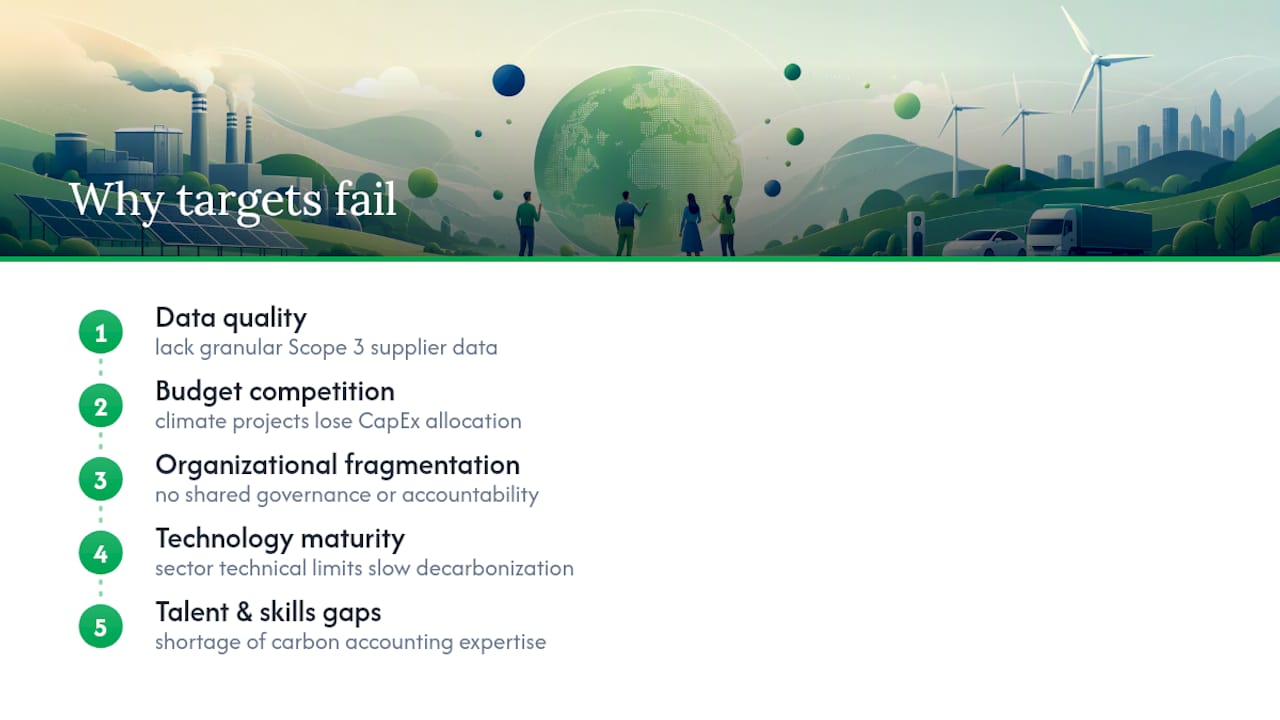
The gap between a published target and a delivered one usually comes down to four recurring obstacles. Data quality sits at the top of the list: many companies still lack granular Scope 3 data from suppliers, which forces reliance on industry averages that weaken the precision of any reduction claim.
Budget competition is the second barrier. Decarbonization projects often compete against short-term revenue priorities for the same capital pool, and without a CapEx alignment mechanism, climate projects lose that competition more often than not.
Organizational fragmentation compounds both problems. When sustainability, finance, procurement, and operations run on separate reporting lines with no shared governance body, targets get set in one department and quietly missed in another with no single point of accountability.
Technology maturity varies sharply by sector. A financial services firm can decarbonize its own operations relatively quickly through renewable power purchases and efficient offices, while a cement or steel producer faces genuine technical limits on how fast core production processes can change. Plans that ignore this asymmetry, applying the same pace of expectation across every sector, tend to lose credibility with informed reviewers immediately.
Finally, talent and skills gaps slow almost every workstream. Carbon accounting, scenario analysis, and transition finance require specific technical competence that many finance and procurement teams have not historically needed, which is why cross-functional training has become a practical bottleneck as much as a strategic one.
Technology and Innovation's Role in Reaching Net Zero Targets
Abatement technology does the heavy lifting that policy and finance alone cannot. Electrification of industrial heat, green hydrogen for hard-to-abate processes, and continued cost declines in renewable generation are shifting what counts as "achievable" in a transition plan from one year to the next.
Carbon capture and storage remains relevant primarily for genuinely hard-to-abate sectors like cement and certain chemicals processes, not as a general substitute for direct reduction elsewhere in a business. Plans that lean on it broadly, rather than in these specific applications, tend to draw the closest scrutiny from assessors.
Digital monitoring tools are changing measurement itself. Real-time energy and emissions monitoring across facilities lets companies catch inefficiencies that used to surface only in annual audits, turning emissions management into something closer to continuous operational monitoring than a once-a-year reporting exercise.
Renewable energy transition remains the most reliable lever available to most companies today. Power purchase agreements, on-site generation, and grid decarbonization commitments deliver measurable Scope 2 reductions on timelines that are far more predictable than emerging technologies still working through cost curves. A well-built plan sequences these known levers first and treats frontier technology as a complement for the emissions that direct action genuinely cannot reach yet, not as a substitute for it.
Stakeholder Engagement and Communication
Investors, employees, regulators, and customers each need a different depth of information from the same underlying plan, and treating all four the same way is a common communication failure.
Investors want the finance-facing detail: CapEx alignment, risk exposure, and how the plan affects capital structure and cost of capital over time. Employees, especially those in operations and procurement, need practical guidance on how the plan changes their day-to-day decisions, not high-level ambition statements. Regulators expect standardized disclosure that maps cleanly onto whatever reporting framework applies in their jurisdiction. Customers and civil society groups tend to focus on outcomes and credibility signals like third-party assurance, since they generally lack the technical background to assess methodology directly.
The companies that communicate best build one core data set and then translate it into different formats for each audience, rather than maintaining separate, inconsistent narratives that eventually contradict each other under scrutiny. Nearly half of transition plans now integrate at least one environmental issue beyond climate, such as water or biodiversity, according to CDP's 2025 analysis, which shows stakeholders are increasingly reading plans for breadth, not just carbon math alone.
Sector-Specific Considerations Worth Knowing
A financial institution's transition plan looks almost nothing like a manufacturer's, and treating them identically is a design mistake. For banks and asset managers, the plan centers on financed emissions across loan books and investment portfolios, where data availability from borrowers and investees is often the binding constraint rather than internal operations.
Heavy industry, steel, cement, and chemicals, faces genuine technical ceilings on near-term reduction rates because core production processes have decades-long asset lifecycles. Their credible plans tend to show a slower early curve paired with explicit technology deployment milestones for the 2030s, rather than an aggressive near-term slope that ignores physical plant realities.
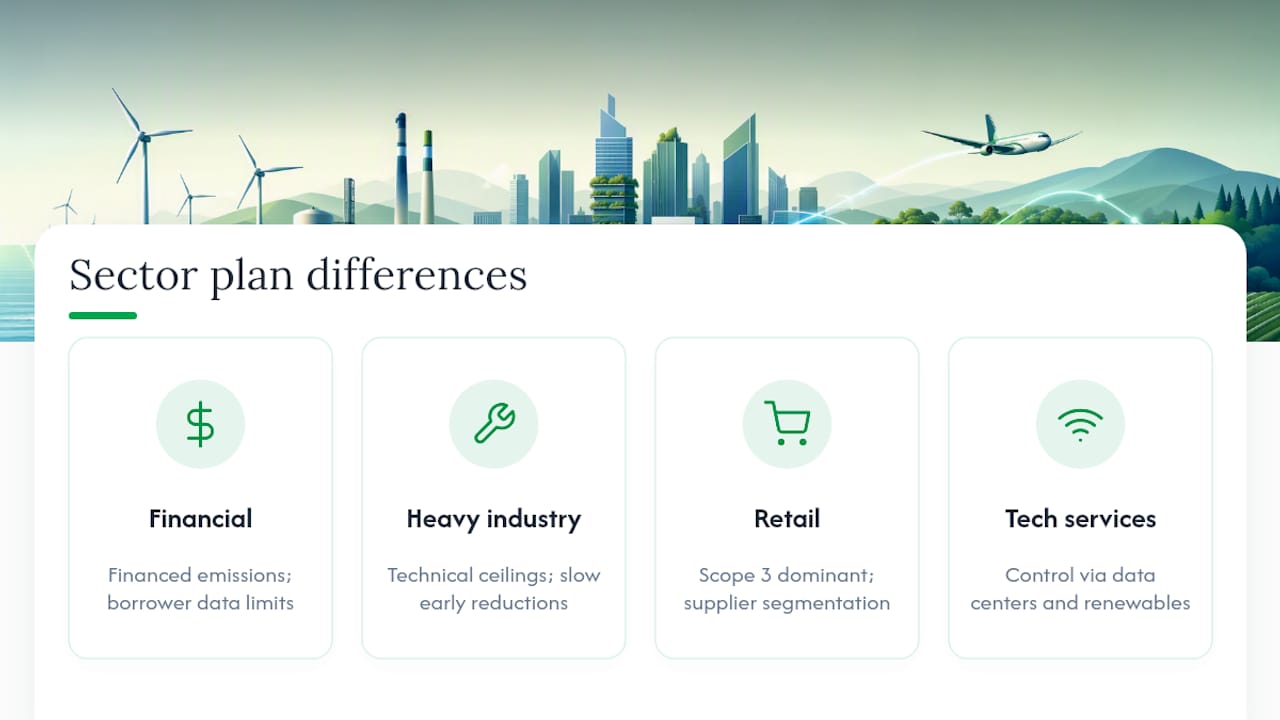
Retail and consumer goods companies usually carry their largest footprint in Scope 3, spread across manufacturing suppliers and product use. Their strongest plans lean heavily on the supplier segmentation approach covered earlier, rather than operational efficiency alone. Technology and services companies, by contrast, often have the most control over their own footprint through data center efficiency and renewable procurement, which is why their plans face scrutiny less on feasibility and more on ambition and pace.
Regulatory and Policy Landscape Shaping Transition Plans
Disclosure requirements are tightening across major markets, and the direction of travel is consistent even where specific rules diverge by jurisdiction. Mandatory climate disclosure regimes increasingly ask for transition plan detail specifically, not just historical emissions data, which pushes companies that previously treated planning as voluntary toward formal governance and assurance processes.
Regulators are also converging on the same core elements this article has already covered: interim targets, governance structure, and Scope 3 treatment. That convergence matters practically, because it means a plan built to the SBTi and ISO standards already satisfies most of what emerging disclosure regulation asks for, reducing the compliance burden of building parallel reporting tracks.
Policy incentives are shifting in the same direction. Carbon pricing mechanisms, sector-specific emissions trading schemes, and border carbon adjustments are changing the financial calculus behind CapEx decisions in ways that make early transition planning a genuine cost advantage rather than a purely reputational exercise. Companies that align their internal shadow carbon price with the direction those policies are heading tend to avoid expensive retrofits later.
Publisher Perspective: Why Training Closes the Implementation Gap
Most transition plans fail on delivery, not design. Cross-functional teams simply lack shared fluency in carbon accounting, transition finance, and governance, which is why plans stall between the strategy deck and the budget meeting. Building that competence across finance, procurement, and risk functions, not just within sustainability teams, is what actually closes the gap between pledge and performance.
— Ransford
How ESG Training Institute Can Help You Build a Credible Plan
Most gaps in a transition plan trace back to a skills gap, not a strategy gap. Esgtraininginstitute exists to close that gap directly, with certification programs built around the same standards this article has covered: carbon accounting, sustainable finance, and transition planning aligned to frameworks like SBTi and ISO.
Cross-functional teams that complete structured training tend to produce plans with tighter governance, clearer CapEx linkage, and more consistent annual reporting, because the people writing the plan and the people approving the budget are finally speaking the same technical language. Esgtraininginstitute's accreditation programs are built for exactly this: sustainability leads, risk officers, finance professionals, and assurance practitioners who need standards-aligned credentials, not generic sustainability awareness training. Explore the current course catalog and certification tracks on the ESG Training Institute site and identify the credential that matches your team's next capability gap, whether that's carbon accounting, transition finance, or disclosure assurance.
Key Standards and Reports Worth Consulting Directly
Four sources anchor most credible plan design work today. The SBTi Corporate Net-Zero Standard V2.0 sets the target-validation methodology and CapEx alignment expectation. The ISO Net Zero Guidelines standardize definitions so claims stay comparable across sectors. CDP's transition plan indicators benchmark disclosure quality against real-world submissions. The Net Zero Stocktake 2025 tracks how few companies actually meet starting-line criteria. Reviewing all four before finalizing a plan catches gaps a single framework misses.
Sources
Public and private funding for decarbonization has expanded well beyond grants and tax credits, though availability still varies sharply by jurisdiction and sector. Government programs in many markets now offer targeted incentives for renewable energy installation, industrial electrification, and energy efficiency retrofits, and these should factor directly into a company's CapEx business case rather than sit as a separate, disconnected opportunity.
Green bonds and sustainability-linked loans have matured into a standard financing tool for companies with credible transition plans, since lenders increasingly price the loan against progress on disclosed targets. That link between borrowing costs and target performance is itself a strong argument for building a rigorous, well-governed plan rather than a loosely worded ambition statement, since the financial terms now depend directly on it.
Internal funding mechanisms matter just as much as external capital. Ring-fenced decarbonization budgets, internal carbon fees that fund abatement projects, and dedicated innovation funds for pilot technologies all give a transition plan the resourcing it needs to survive annual budget cycles rather than compete from scratch against unrelated priorities every year.
- Climate Transition Plans: 2025 Findings and Trends (CDP)
- Net Zero Stocktake 2025
- Corporate Net-Zero Standard (SBTi)
- ISO Net Zero Guidelines