
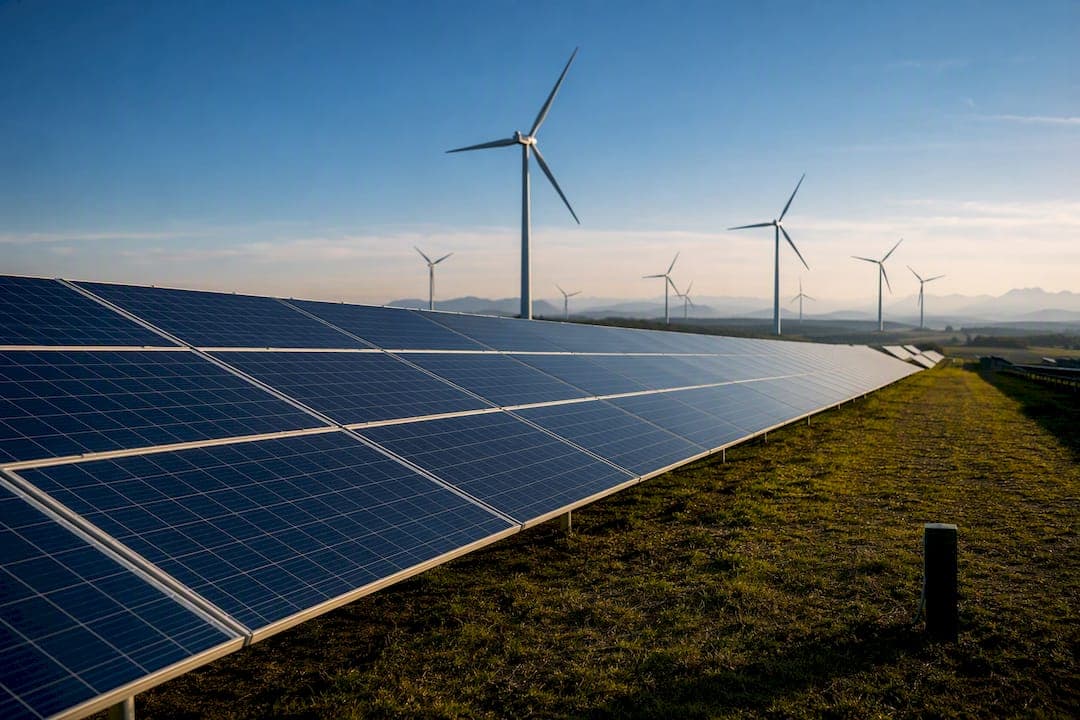
Adopt a portfolio procurement strategy that layers onsite generation, long-term power purchase agreements where feasible, and energy attribute certificates for the shortfall. Establish targets, timeline, and governance first. RE100 members already secure 249 terawatt-hours of clean power collectively, and the GHG Protocol sets the accounting rules that make any of these instruments count toward your disclosures.
TL;DR:
- Rely on a layered portfolio approach combining onsite generation, long-term PPAs, and unbundled certificates to balance impact, cost, and market availability.
- Focus procurement on projects with strong additionality, matching generation profiles to load, and optimal location to maximize emissions reductions.
- Prioritize hourly or 24/7 matching and consider storage once renewable targets exceed roughly 20%, to improve demand alignment and reduce grid emissions.
- Engage stakeholders early, set clear milestones, and run pilot deals to ensure smooth execution and alignment with Scope 2 accounting standards.
- Invest in training teams on carbon accounting, contract negotiation, and disclosure requirements to reduce procurement risks and ensure audit-ready documentation.
Table of Contents
- Why a Renewable Energy Procurement Strategy Matters Now
- What Are the Core Renewable Energy Procurement Methods?
- How Do You Combine These Methods Into a Portfolio?
- What Criteria Should You Use to Select a Supplier?
- When Should You Consider Hourly Matching or Storage?
- What Does an Implementation Checklist Look Like?
- How Does Training Reduce Procurement Execution Risk?
- A Practitioner's View on Procurement Trade-Offs
- Build Procurement Capability Before You Negotiate
- Sources
Why a Renewable Energy Procurement Strategy Matters Now
Corporate buyers no longer treat renewable energy procurement as a side project for the sustainability team. It has become a hedge against price volatility, a supply resilience play, and, for regulated companies, a disclosure requirement tied directly to Scope 2 accounting under the GHG Protocol.
The market has scaled accordingly. Corporate sourcing through PPAs and onsite installations has delivered more than 160 gigawatts of capacity, and the private sector accounted for over 75% of global renewable investment between 2013 and 2020, according to the Global Renewables Alliance. That is not incremental change. That is corporate buyers becoming the primary engine of new renewable build.
The Gap Ahead: RE100 members currently secure 249 TWh of clean power but project a shortfall of roughly 290 TWh by 2030, according to CDP. That gap is the demand signal driving competition for well-structured PPAs today.
A structured approach trades some flexibility for cost certainty and audit-ready documentation. An unstructured one, buying whatever certificates are cheapest each year, leaves you exposed to price spikes and to auditors asking why your claims don't map to a coherent sourcing plan.
What Are the Core Renewable Energy Procurement Methods?
Every renewable energy procurement strategy eventually gets built from five basic building blocks. Understanding the mechanics of each one determines whether your portfolio actually reduces emissions or just moves paperwork.
- Onsite or self-generation: You install solar, wind, or other generation on your own site. Highest upfront capital, longest payback, but strongest additionality and no counterparty risk once built.
- Physical PPAs: You contract to receive actual electricity from a specific project, typically in the same market or grid. Delivery and settlement are physical, which suits companies with retail load obligations.
- Virtual PPAs (VPPAs): These function as financial contracts for difference. You never take physical delivery, but you lock in a fixed price against market volatility and receive the associated energy attribute certificates.
- Green tariffs: Utility-offered products that let you buy renewable power without negotiating a bespoke contract, per the EPA's green tariff guidance. Fast to access but weaker on additionality since you're often buying into an existing utility program.
- Unbundled EACs/RECs: Certificates purchased separately from any power contract. Cheapest, fastest, but the thinnest additionality claim of the five.
Contract tenors vary sharply: onsite deals and physical PPAs often run 10 to 20 years, VPPAs commonly run 7 to 15, and unbundled EACs can be bought annually or even spot. The EPA's Guide to Purchasing Green Power, produced jointly with the DOE, WRI, and NREL, walks through the contracting mechanics of each in more depth than most internal teams have time to build alone.
How Do You Combine These Methods Into a Portfolio?
No single instrument covers every goal. A renewable energy procurement strategy that relies solely on unbundled EACs is cheap and fast but weak on additionality. One that relies solely on physical PPAs is strong on impact but slow to scale and hard to match against fluctuating load. The fix is a portfolio that balances four axes: availability in your markets, scale relative to your total load, additionality strength, and cost against your budget cycle.
A workable sizing approach looks like this:
- Anchor with onsite generation wherever site economics work, even if it only covers 10 to 20% of load. It's your strongest additionality claim and it's immune to counterparty risk.
- Layer long-term PPAs (physical where you have retail obligations, virtual where you don't) to cover the bulk of remaining load, prioritizing new-build projects for genuine additionality.
- Fill the residual gap with EACs, ideally matched by vintage and geography to your actual consumption, not just the cheapest certificates available.
Legal analysis of corporate PPA structures consistently points to this layered approach as the way to avoid single-point failure, per DLA Piper's review of corporate power purchase agreements.
Pro Tip: Reserve your long-term, project-specific contracts for markets where your load is largest and most predictable. Use shorter EAC purchases to absorb volatility in smaller or newer facilities where load forecasts are still shaky.
What Criteria Should You Use to Select a Supplier?
Vetting a PPA or EAC offer takes more than comparing price per megawatt-hour. Weak due diligence here is how companies end up with certificates that don't survive an audit or contracts that lock in exposure they didn't model.
- Additionality: Is this a new project enabled by your contract, or an existing asset simply reselling its output?
- Vintage and commissioning date: Older certificates from long-operating plants carry a weaker claim than certificates tied to a facility commissioned around your contract signing.
- Location and grid match: Certificates from a distant, disconnected grid do less for your local emissions profile than those from your consumption region.
- Shape and volume match: Does the generation profile match your load curve, or will you be over-procured at midday and short at night?
- Counterparty and price risk: What's the developer's balance sheet, and does the contract include a price collar or credit support if the counterparty defaults?
Model RFP questions worth including: What's the project's commissioning date and expected online date? What curtailment risk exists in this market? What credit support backs the contract if the seller experiences financial distress?
When Should You Consider Hourly Matching or Storage?
Annual matching, buying enough clean energy certificates over a year to offset your annual load, has been the default for a decade. It's also increasingly seen as insufficient. OECD analysis found that hourly, or 24/7, matching delivers materially more robust emissions reductions in grids with high renewable penetration, because it forces your procurement to align with actual demand timing rather than an annual average.
- Hourly/24/7 matching requires certificates or contracts tied to specific hours, not just annual totals.
- Time-based EACs (T-EACs) are the emerging trading instrument built to support this, though liquid markets for them remain limited in most regions.
- Energy storage systems (ESS) become the bridge for temporal mismatch once your renewable target climbs high enough that solar and wind alone can't cover every hour.
Research on integrated procurement strategies found that direct PPA approaches can become structurally infeasible without storage beyond roughly 20% renewable targets, and that ESS requirements grow nonlinearly above 80% penetration. If your target sits above that threshold, storage stops being optional and starts being load-bearing infrastructure in your procurement math.
What Does an Implementation Checklist Look Like?
A renewable energy procurement strategy fails most often at handoff, not at design. The plan looks sound on paper; then finance, legal, and sustainability teams never actually align on execution.
- Map stakeholders early: sustainability sets targets, finance models cost and risk, legal negotiates contract terms, and procurement runs the RFP. The Cisco Clean Energy Playbook documents this cross-functional structure in practice, including the value of bringing in external advisors for first deals.
- Set milestones: target-setting, market screening, RFP issuance, contract negotiation, and signing typically span 12 to 18 months for a PPA.
- Run a pilot deal before committing to your largest facility, to stress-test internal governance without full-scale exposure.
- Align procurement documentation with Scope 2 accounting from day one, so certificates and contracts map cleanly to the GHG Protocol's market-based method when disclosure season arrives.
How Does Training Reduce Procurement Execution Risk?
Most procurement failures trace back to a governance or accounting gap, not a bad contract. Teams that understand Scope 2 market-based accounting, PPA negotiation mechanics, and carbon disclosure requirements close deals faster and defend them more easily under audit.
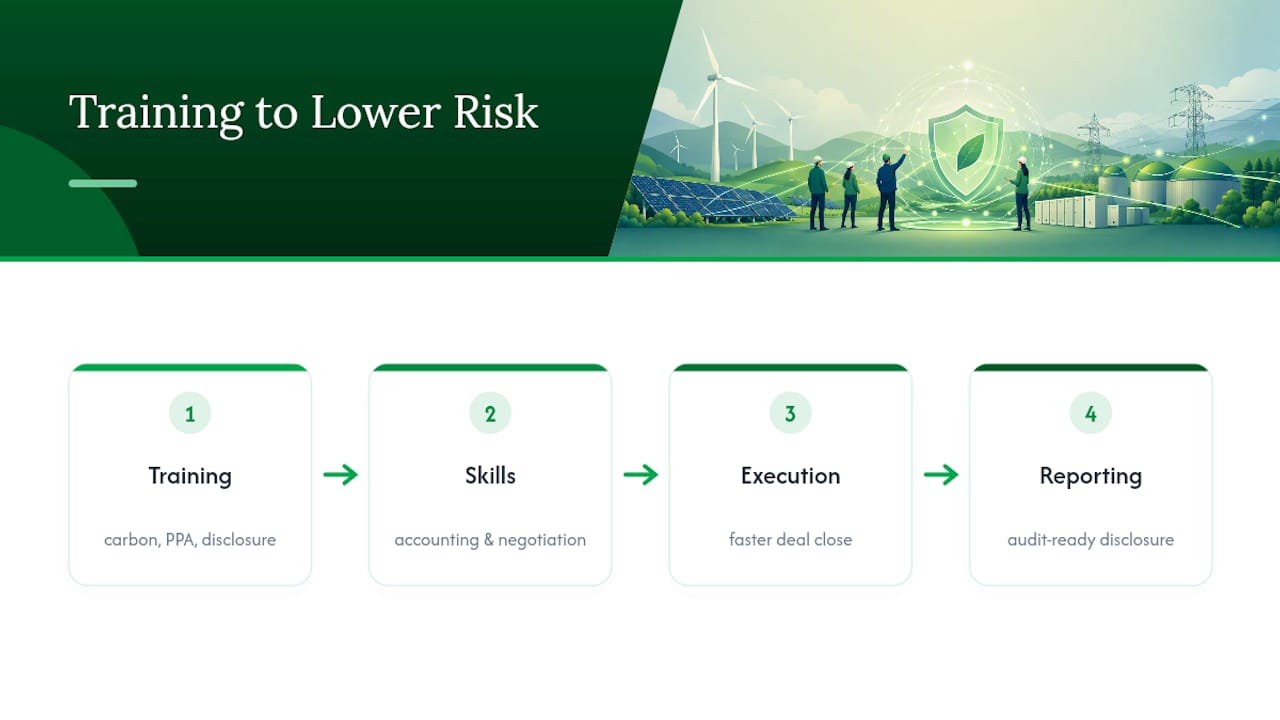
Courses covering carbon accounting, climate strategy, and sustainable finance map directly onto these procurement tasks. Esgtraininginstitute publishes practical examples showing how capability-building shortens the distance between a signed contract and an audit-ready disclosure.
A Practitioner's View on Procurement Trade-Offs
The tension in this work is speed versus systemic impact. Unbundled EACs let you claim progress fast; new-build PPAs move markets slowly but actually add renewable capacity that wouldn't otherwise exist. I'd rather see a company start with a modest pilot PPA and scale deliberately than announce a large EAC-only claim that unravels under scrutiny. Buyer coalitions, several companies backing one project together, often unlock deals no single buyer could justify alone.
— Ransford
Build Procurement Capability Before You Negotiate
Contracts like VPPAs and physical PPAs carry real negotiation and accounting complexity, and getting the Scope 2 treatment wrong can undo months of procurement work. There are courses that build the carbon accounting, governance, and negotiation literacy that procurement and sustainability teams need before they sit across from a developer.
Course topics map directly onto the procurement tasks covered here, from Scope 2 market-based accounting to contract governance frameworks, so teams walk into an RFP process already fluent in the standards a counterparty will expect them to know. For readers evaluating financing structures behind onsite or developer-backed projects, the mechanics of green bonds and impact investing are worth a parallel look.
Explore accreditation pathways built around real procurement and disclosure requirements, and get your team certified before your next RFP goes out the door.
Sources
- Renewable Energy Procurement Trends and Strategies (CDP)
- Advancing decarbonisation through clean electricity procurement (OECD)