

Scope 3 comprises 15 categories defined by the GHG Protocol's Corporate Value Chain (Scope 3) Standard, split into eight upstream categories (1 through 8) and seven downstream categories (9 through 15). Upstream covers emissions tied to purchased goods, capital assets, and business operations before your product ships. Downstream covers what happens after, from product use to end-of-life to financed activities. Materiality determines which categories deserve full calculation rigor versus a documented exclusion.
TL;DR:
- Most companies should focus on high-spend categories like purchased goods and product use, especially Category 11, due to their large emissions impact.
- Using a hybrid approach for supplier data, combining primary emissions reports with spend-based estimates, offers a practical way to improve inventory accuracy gradually.
- Materiality assessment should prioritize categories with the greatest emissions or reduction potential, rather than attempting complete coverage immediately.
- Quantitative estimates in difficult categories like use-phase and financed emissions require sound assumptions and transparent documentation to withstand scrutiny.
- Building supply-chain and stakeholder engagement skills through targeted training enhances inventory quality and helps manage audit risks.
Table of Contents
- Scope 3 Categories Explained: A Quick Reference List
- Upstream Categories (1–8): Scope, Data, and Calculation Highlights
- Downstream Categories (9–15): Use-Phase, End-of-Life, and Investments
- Materiality and Boundaries: Choosing What to Measure First
- Calculation Methods: Which Approach Fits Which Category
- Category 15 and Financed Emissions: Where PCAF Takes Over
- Building Your Scope 3 Inventory: A Starter Roadmap
- Why Standards-Aligned Training Reduces Scope 3 Reporting Risk
- How Esgtraininginstitute Helps You Build Scope 3 Competence
- What Practitioners Get Wrong About Scope 3 Precision
- Primary Standards to Consult Before You Start
- Sources
Scope 3 Categories Explained: A Quick Reference List
Each category has a minimum boundary set by the GHG Protocol, and several allow optional activities beyond that floor when they're material to your business.
Upstream (1–8):
- Category 1: Purchased goods and services — cradle-to-gate emissions from everything you buy
- Category 2: Capital goods — emissions embedded in equipment, buildings, and machinery
- Category 3: Fuel and energy-related activities — upstream emissions not already counted in Scope 1 or 2
- Category 4: Upstream transportation and distribution — inbound freight and logistics
- Category 5: Waste generated in operations — treatment and disposal of operational waste
- Category 6: Business travel — flights, hotels, and rental cars for employees
- Category 7: Employee commuting — including remote work energy use
- Category 8: Upstream leased assets — assets you lease but don't own
Downstream (9–15):
- Category 9: Downstream transportation and distribution
- Category 10: Processing of sold products
- Category 11: Use of sold products — typically the largest category for durable goods makers
- Category 12: End-of-life treatment of sold products
- Category 13: Downstream leased assets
- Category 14: Franchises
- Category 15: Investments — dominant for banks, insurers, and asset managers
Upstream Categories (1–8): Scope, Data, and Calculation Highlights
Upstream categories trace emissions from cradle to your gate, meaning everything that happens to a material, component, or service before it enters your operations. This is where most companies find their largest inventory gaps, simply because supplier data is incomplete or nonexistent for most vendor relationships.
Category 1 (purchased goods and services) usually carries a significant share of a company's Scope 3 footprint outside financial services. The Scope 3 Calculation Guidance recommends a hybrid method for this category: combine supplier-specific emission factors where you have them with spend-based estimates for the rest of your supplier base. This matters because supplier data coverage is almost always patchy in year one. A company might get primary data from their top suppliers by spend and fall back to industry-average factors for the long tail. That's not a weakness in your inventory, it's how the guidance expects Category 1 to work in practice.
For Category 2 (capital goods), treat major equipment purchases the same way you'd treat Category 1, using supplier environmental product declarations when available and defaulting to spend-based factors from databases like Ecoinvent otherwise.
Category 7 (employee commuting) has become more complicated since hybrid and remote work became common. Teleworking emissions, meaning the electricity and heating a home office consumes, now fall inside this category's boundary for many companies, and estimating them requires assumptions about home energy mix and hours worked that most teams haven't built yet.
Category 8 (upstream leased assets) trips up companies that don't realize leased office space, vehicles, or equipment count here rather than under Scope 1 or 2, depending on the lease structure and consolidation approach chosen.
Common upstream data sources include:
- Supplier-submitted primary data through CDP supply chain questionnaires
- Spend-based estimates using economic input-output factors
- Life-cycle assessment databases such as Ecoinvent for material-level factors
- Industry association benchmarks for sector-specific processes
Pro Tip: Don't chase perfect supplier data across your entire vendor list in year one. Start with the hybrid method on your top-spend suppliers, document the assumptions behind your spend-based estimates for everyone else, and improve coverage year over year. Auditors care more about a transparent, defensible methodology than an inventory that looks complete but hides shaky assumptions.
Waste and recycling create their own data-quality trade-offs inside Category 5. The calculation guidance gives expanded detail here, specifying when to include full treatment-chain emissions for recycling and waste-to-energy versus reporting only the direct emissions from the waste-treatment facility. Getting this wrong in either direction either overstates your footprint or hides a real reduction opportunity.
Downstream Categories (9–15): Use-Phase, End-of-Life, and Investments
Downstream categories track what happens to your product, and your capital, after it leaves your control. This is where assumptions do most of the work, because you rarely have direct visibility into how customers actually use what you sell.
Category 11 (use of sold products) is where the modeling gets challenging. Estimating emissions requires considering factors such as expected product lifetime, use intensity, and the energy or fuel source the product utilizes. A washing machine manufacturer has to assume how many cycles a typical unit runs per year and for how many years, then multiply by expected energy consumption per cycle. Get any one of those wrong and your Category 11 number swings by an order of magnitude. This is consistently the category practitioners underestimate on effort, since realistic use-phase modeling for durable goods can dominate an entire company's Scope 3 total once assumptions are stress-tested.
Category 12 (end-of-life treatment) forces a choice about allocation. Do you count the emissions from landfilling, incineration, or recycling your product at the end of its useful life, and if a customer recycles it, whose emissions are those, yours or the recycler's? The GHG Protocol's framework resolves this through defined allocation rules tied to who controls the end-of-life decision, which is why documenting your allocation approach matters as much as the number itself.
Downstream data approaches generally include:
- Product-use surveys or smart-device telemetry for use-phase intensity
- Industry lifetime assumptions from trade associations or regulatory studies
- Waste-composition studies for end-of-life allocation
- Sector-specific guidance when a category's standard method doesn't fit your business model
Category 13 (downstream leased assets) and Category 14 (franchises) apply narrowly, mostly to companies that lease out equipment or property, or that operate a franchise model. Most companies will find these immaterial and can document the exclusion rather than build a full calculation.
Category 15 (investments) is different in kind from every other downstream category. It doesn't map to a physical product or service. It maps to capital, and it requires an entirely separate methodology to calculate credibly, which is where financed-emissions standards take over from the generic GHG Protocol approach.
Materiality and Boundaries: Choosing What to Measure First
Not every company needs to calculate all 15 categories with equal rigor. The GHG Protocol's materiality principle, echoed in EPA's Scope 3 inventory guidance, says prioritize categories that are large, that offer real reduction potential, or that stakeholders expect you to report on, rather than attempting flawless coverage everywhere at once.
A practical screening method looks like this:
- Spend or volume screen — rank categories by rough scale using procurement spend or activity volume as a proxy for emissions
- Supplier mapping — identify which vendors, product lines, or asset classes sit behind your highest-spend categories
- Hotspot analysis — apply industry-average emission factors to your top categories to find where the actual tons are concentrated
- Feasibility check — weigh data availability and collection cost against each category's likely materiality before committing calculation resources
Categories you exclude still need documentation. The Scope 3 Standard's detailed FAQ expects companies to disclose excluded activities and justify the exclusion, not simply omit them silently.
Pro Tip: Speed and accuracy pull in opposite directions in year one. Resolve that tension by publishing a first inventory built on reasonable, disclosed assumptions rather than delaying disclosure for a year while chasing precision you won't fully achieve anyway. Refine the estimate in year two once you know which categories actually matter.
Calculation Methods: Which Approach Fits Which Category
The Scope 3 Calculation Guidance lays out five core methods, and choosing the right one for each category is largely a data-availability question, not a preference question.
- Spend-based method — multiplies purchase cost by an economic emission factor; fastest to deploy, least precise
- Average-data method — applies industry-average activity factors, such as per-unit emissions for a material type
- Supplier-specific method — uses actual emissions data reported by a vendor, the gold standard where available
- Hybrid method — blends supplier-specific and spend-based or average-data approaches within the same category
- Average LCA-based method — draws factors from life-cycle assessment databases when neither spend nor supplier data covers the activity well
Supplier-specific data wins whenever a vendor can provide primary, verified figures, particularly for high-spend or high-materiality relationships. Spend-based estimates remain the practical default for the long tail of smaller suppliers where engagement cost outweighs the accuracy gain.
Authoritative data sources worth building into your process include the GHG Protocol's calculation guidance itself, Ecoinvent for material and process-level factors, national greenhouse gas inventories for country-specific grid and fuel factors, and utility-published transmission and distribution loss factors for Category 3.
Whichever method you choose, document the underlying assumptions and assign a data-quality score to each figure. That practice, more than any single calculation choice, is what separates an audit-ready inventory from one that collapses under assurance scrutiny.
Category 15 and Financed Emissions: Where PCAF Takes Over
Investments often dominate the Scope 3 inventory of banks, insurers, and asset managers, accounting for a large portion of their total footprint once loan books and equity holdings are included. The generic GHG Protocol calculation methods weren't built for capital flows, which is why the Partnership for Carbon Accounting Financials exists as the operational standard for this category.
PCAF provides:
- Asset-class-specific attribution formulas covering listed equity, corporate bonds, business loans, project finance, mortgages, and commercial real estate
- A data-quality scoring system that grades each financed-emissions figure from verified reported data down to proxy estimates
- Explicit rules requiring inclusion of a counterparty's own Scope 3 emissions in sectors like oil and gas, cement, and automotive, where omitting them would understate financed emissions substantially
Adopt PCAF as soon as investments represent a material share of your footprint, and document which asset classes rely on reported data versus proxy factors from the outset.
Building Your Scope 3 Inventory: A Starter Roadmap
Running a defensible first inventory follows a fairly consistent sequence across organizations, regardless of sector.
- Set governance and boundaries — confirm your organizational and operational boundary approach before touching category data
- Screen for materiality — apply the four-step method above to rank categories
- Map suppliers and data sources — identify who holds the primary data behind each material category
- Engage suppliers early — request CDP-aligned disclosures or direct emissions data from top-spend vendors
- Select calculation methods per category — match method to data availability, not the other way around
- Run pilot calculations — test your approach on one or two categories before scaling to all material ones
- Assess uncertainty and document assumptions — assign data-quality scores category by category
- Disclose exclusions and limitations — state clearly what you didn't calculate and why
- Set improvement targets — build a supplier-engagement plan to upgrade data quality year over year
Pro Tip: Treat your first inventory as a baseline you'll revise, not a finished product. Auditors and frameworks like SBTi expect year-over-year improvement in data quality far more than they expect a perfect number on day one.
Why Standards-Aligned Training Reduces Scope 3 Reporting Risk
Methodological errors in Scope 3 inventories rarely come from bad intentions. They come from teams applying calculation methods inconsistently across categories, or missing a boundary rule that leads to double counting. Structured training closes that gap and improves supplier engagement quality at the same time, since practitioners who understand PCAF attribution formulas or the Category 1 hybrid method ask suppliers sharper, more specific questions.
Esgtraininginstitute has built its carbon accounting curriculum around this exact need, with programs aligned to GHG Protocol and PCAF methodology and a graduate base whose organizations collectively oversee a substantial amount of ESG assets.
How Esgtraininginstitute Helps You Build Scope 3 Competence
Reading the GHG Protocol's decision trees is one thing. Applying the Category 1 hybrid method to your own supplier base, or defending a PCAF attribution figure in front of an assurance provider, is another skill entirely, and it's the gap Esgtraininginstitute's certification programs are built to close.

The institute offers carbon accounting and financed-emissions coursework alongside supplier-engagement and assurance-preparation modules, available as self-paced online courses, instructor-led virtual sessions, or corporate training packages for teams building inventory capability together. Certification pathways map directly to the standards covered in this guide, from GHG Protocol category boundaries to PCAF asset-class methodology, so the credential reflects skills you'll actually use during your next audit cycle. If your team is preparing a Scope 3 inventory for the first time, or tightening one that's already drawn assurance questions, explore accredited certification paths built around exactly this material.
What Practitioners Get Wrong About Scope 3 Precision
The biggest misconception in Scope 3 accounting isn't about methodology. It's about what "good" looks like. That's backwards. A hybrid inventory with disclosed assumptions and honest data-quality scores is more defensible in front of an assurance provider than a falsely precise one built on undocumented shortcuts.
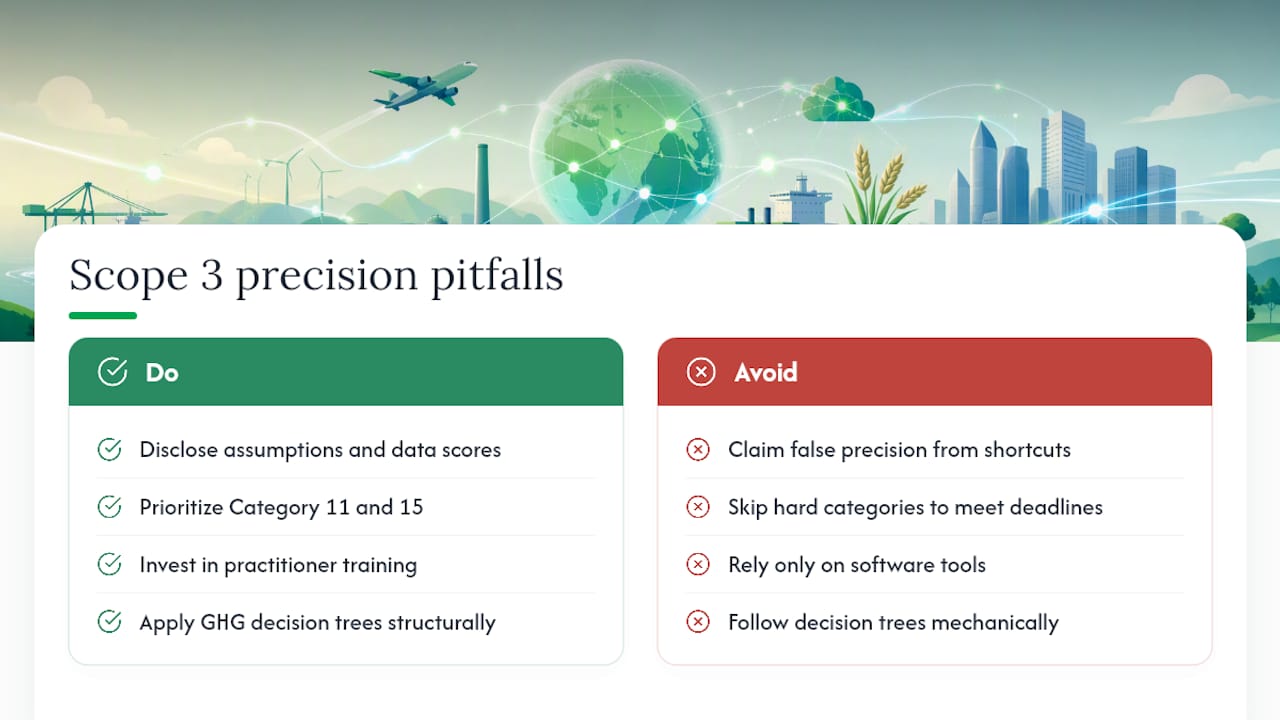
The second mistake is treating Category 11 use-phase modeling and Category 15 financed-emissions attribution as afterthoughts because they're hard. They're hard precisely because they tend to be the largest numbers in the inventory. Skipping the difficult categories to hit a reporting deadline produces a Scope 3 total that technically exists but doesn't reflect where your actual climate risk sits.
Training changes this dynamic more than any software purchase does, because the decisions that matter, which method to apply, how to allocate end-of-life emissions, when a category crosses the materiality threshold, are judgment calls no tool makes for you. A practitioner who understands the GHG Protocol's decision trees at a structural level, rather than following them mechanically, produces an inventory that survives scrutiny from CDP reviewers, SBTi validators, and financial auditors alike.
— Ransford
Primary Standards to Consult Before You Start
Build your inventory on primary sources, not secondary summaries. The Corporate Value Chain (Scope 3) Standard defines the 15 categories and their minimum boundaries. The Scope 3 Calculation Guidance supplies decision trees and category-specific methods, including hybrid-method detail for Category 1. PCAF Part A operationalizes Category 15 for financial institutions. EPA's Scope 3 inventory guidance corroborates the materiality-first approach that should guide where you spend your calculation effort first. For supplier data collection specifically, Esgtraininginstitute's guidance on supply-chain mapping and partner resources on sustainable packaging design offer practical detail on the purchased goods and materials side of Category 1.
Sources
- Corporate Value Chain (Scope 3) Standard — GHG Protocol
- Scope 3 Inventory Guidance — US EPA (snapshot)
- PCAF Part A — Global GHG Accounting & Reporting Standard (2025) — PCAF