

A stakeholder engagement plan is a documented strategy that identifies who has a stake in a project, maps their influence and interest, and defines how the project team will communicate, consult, and collaborate with them throughout its life cycle. The first action, before drafting a single message or scheduling a meeting, is to build a stakeholder register and plot each entry on an influence versus interest grid.
That register becomes the backbone of everything else in this article. Ready-to-use templates and two worked examples sit in the sections ahead, so you can copy the structure directly into your own project files rather than building one from a blank page.
Before you write anything else, confirm you have these three inputs on hand:
- A list of every group or individual affected by, or able to affect, the project's outcome
- Access to sponsors, prior project documentation, or org charts to fill in gaps in that list
- A shared document or system where the register and communications plan will live and get updated
TL;DR:
- Regularly update the stakeholder register and influence-interest map to reflect changes in stakeholder roles, contact information, and engagement levels.
- Use the influence versus interest grid alongside IAP2 levels to allocate engagement efforts appropriately, focusing on high-influence, high-interest stakeholders.
- Address structural participation barriers such as language, timing, and accessibility from the start to improve stakeholder inclusion and trust.
- Revisit and revise the engagement plan whenever scope, stakeholder roles, or milestones change, rather than relying on a fixed schedule.
- Closely monitor stakeholder responsiveness over time and escalate direct contact when previously engaged stakeholders turn unresponsive for two consecutive touchpoints.
Table of Contents
- What Is a Stakeholder Engagement Plan and Why Does It Matter?
- What Should Every Stakeholder Engagement Plan Include?
- How Do You Build a Stakeholder Engagement Plan Step by Step?
- How Do You Map Stakeholders by Influence and Interest?
- How Do You Design a Communication Plan Stakeholders Actually Read?
- How Do You Monitor and Revise a Stakeholder Engagement Plan?
- What Mistakes Undermine Most Stakeholder Engagement Plans?
- Templates and Worked Examples You Can Use Today
- Why Trust This Guidance on Stakeholder Engagement Planning
- Where Should You Go to Build ESG Stakeholder Engagement Skills Next?
- What Actually Determines Whether a Stakeholder Engagement Plan Works
- Key Takeaways
- Sources
What Is a Stakeholder Engagement Plan and Why Does It Matter?
A stakeholder engagement plan functions as a living subsidiary document inside the broader project management plan, not a one-time deliverable you file away after kickoff. It sits alongside the risk register and the communications plan, and it gets revisited every time the project's scope, timeline, or stakeholder roster shifts. Treating it as static is one of the fastest ways to lose the trust it's supposed to protect.
Project sponsors rely on the SEP to understand who needs to sign off on major decisions and when. Project managers use it to sequence outreach so no one learns about a change secondhand. Communications leads pull directly from it to plan newsletters, briefings, and public notices. Affected communities, regulators, and supply-chain partners use it, whether they realize it or not, as the mechanism through which their concerns actually reach decision-makers. Each of these groups needs something slightly different from the same document, which is exactly why a generic, one-page stakeholder list rarely holds up under real project pressure.
The benefits show up in concrete ways. Projects with a working SEP tend to catch opposition early, while it's still a conversation rather than a formal objection. Decisions move faster because the people who need to weigh in have already been mapped and looped in at the right level. Approvals from boards, funders, or regulatory bodies go smoother when there's a documented trail showing who was consulted and how their feedback shaped the outcome.
Three frameworks anchor most credible SEPs in use today. The IAP2 Spectrum of Public Participation defines five engagement levels, inform, consult, involve, collaborate, and empower, that let you calibrate effort to actual need instead of over-engaging low-priority groups. The Project Management Body of Knowledge treats stakeholder management as an integrated project activity requiring regular review as part of project controls, not a communications afterthought. And UN guidance on the 2030 Agenda lays out five principles, purposeful, inclusive, transparent, proactive, and well-planned engagement that apply just as well to a corporate ESG rollout as to a public infrastructure project.
For teams building ESG-specific engagement work, the same discipline applies to supply-chain stakeholder identification, where mapping upstream and downstream partners follows a similar structured approach to sustainability reporting.
What Should Every Stakeholder Engagement Plan Include?
A defensible SEP has four structural pillars: a stakeholder register, defined objectives, a communications plan, and a process for handling escalation and records. Skip any one of them and the plan becomes either incomplete or unenforceable when someone challenges a decision months later.
Stakeholder register fields
Your register needs to answer, at a glance, who someone is and what they need from you. Build it with these fields:
- Name and organization — the individual or group, plus their affiliation
- Role or interest — what stake they hold (regulatory, financial, operational, community)
- Influence level — high, medium, or low ability to affect project outcomes
- Interest level — high, medium, or low degree to which the project affects them
- Preferred contact method — email, phone, in-person, translated materials, accessible formats
- Engagement level assigned — inform, consult, involve, collaborate, or empower, per IAP2
- Owner — the team member responsible for maintaining that relationship
- Last contact date and next scheduled touchpoint
The PMC "Ten simple rules" guidance on SEP development treats this kind of systematic data collection as a foundational rule, not an optional add-on, precisely because gaps in the register are where projects lose track of who was supposed to be consulted.
Objectives and success indicators
Set two or three objectives per stakeholder tier rather than one blanket goal for the whole project.
Communications plan fields
Your communications plan should track, per stakeholder or stakeholder group: channel, frequency, content type, message owner, and the date of the last and next scheduled contact. This table lives right next to the register so the two documents update together instead of drifting apart.
Escalation, grievance handling, and record-keeping
Every SEP needs a documented path for what happens when a stakeholder raises a serious objection. Define who receives the complaint, the response timeline, and where the resolution gets logged. For projects with significant community or environmental impact, this escalation path often needs to align with a formal grievance redress mechanism, a requirement built directly into funder-level SEP templates used across development finance projects.
How Do You Build a Stakeholder Engagement Plan Step by Step?
Building an SEP follows a repeatable seven-step sequence: identify, analyze, prioritize, design, implement, monitor, and update. Each step produces a specific artifact you carry into the next one.
-
Identify stakeholders. Start with a structured sponsor interview, asking directly who benefits, who bears risk, and who has stopped similar projects before. Review historical project documentation, meeting minutes, and org charts for names that surface repeatedly. Then run a mind-mapping session with your core project team, sometimes called a CPIG exercise (core project interest group), to surface secondary and tertiary stakeholders no single person would think of alone. Budget half a day for this across a mid-size project.
-
Analyze each stakeholder. For every name on the register, assess influence (their power to help or block the project), interest (how much the outcome affects them), sentiment (supportive, neutral, or opposed), specific needs, and any accessibility barriers, language, disability, geography, or technology, that could block their participation. This step is where the UN's guidance on removing structural barriers becomes practical rather than theoretical.
-
Prioritize using the IAP2 spectrum and the influence/interest grid. Cross-reference each stakeholder's grid position against the five IAP2 levels to decide how much engagement effort they warrant. A high-influence, high-interest regulator likely sits at "collaborate." A low-influence, low-interest vendor might only need occasional updates.
-
Design engagement activities and communications. For each priority tier, assign specific activities, briefings, workshops, surveys, town halls, and name an owner for each. This is where the communications plan fields from the previous section get populated with real dates and names, not placeholders.
-
Implement and log every interaction. Run the activities as scheduled, and record what happened: who attended, what was said, what commitments were made. A five-step method built around identify, map, communicate, collect feedback, and document works well here because it keeps the logging step from becoming an afterthought.
-
Collect feedback continuously, not just at project close. Short surveys after major briefings, informal check-ins with key contacts, and open comment channels all feed back into the register.
-
Evaluate and update the SEP at defined triggers. Revisit the plan whenever scope changes, a key stakeholder role turns over, or a milestone gets missed. Treating the SEP as a living document, rather than a static kickoff artifact, is one of the clearest markers separating projects that sustain stakeholder trust from those that lose it midway through.
Pro Tip: Set a recurring 15-minute calendar block every two weeks specifically to review the register for stale "last contact" dates. Stakeholders who haven't heard from you in over a month are the ones most likely to form opinions about your project without you.
How Do You Map Stakeholders by Influence and Interest?
The influence versus interest grid remains the fastest way to translate a long stakeholder list into a clear action plan. Draw a two-by-two matrix: influence on the vertical axis, interest on the horizontal axis, and plot every name from your register into one of the four quadrants.
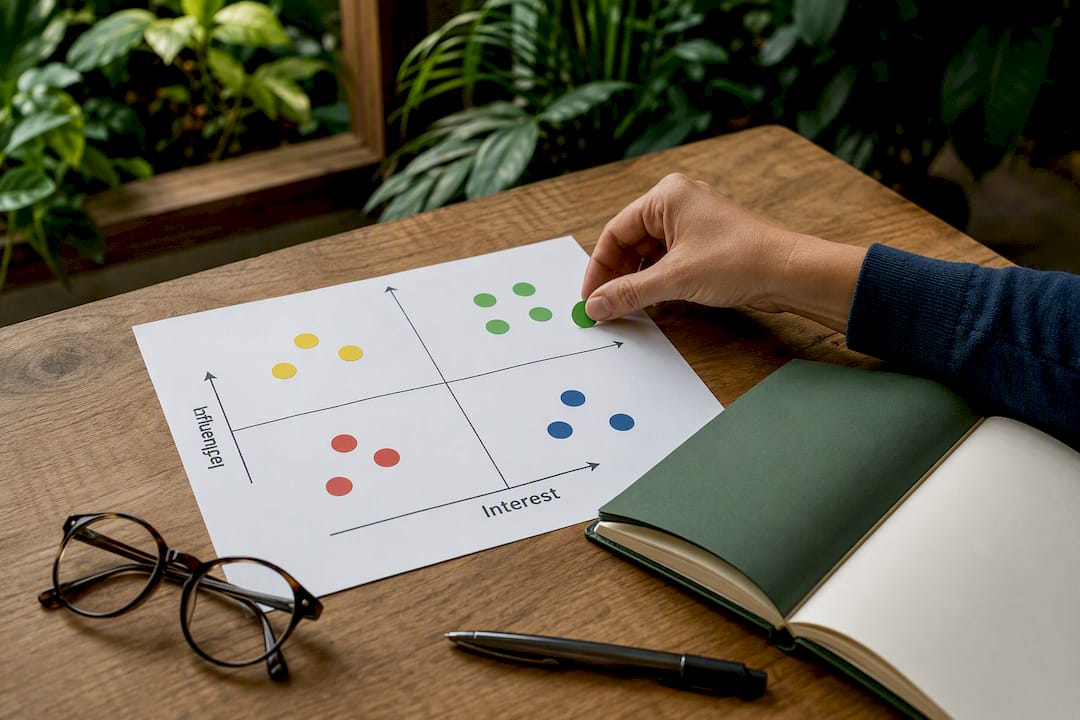
Stakeholders with high influence and high interest, senior sponsors, key regulators, major funders, belong in the top-right quadrant and need active collaboration: regular briefings, direct input into decisions, and fast response times when they raise concerns. High-influence, low-interest stakeholders, a board member who cares about outcomes but not process, sit top-left and typically need periodic, high-level updates rather than constant contact. Low-influence, high-interest stakeholders, often community members or frontline staff, sit bottom-right; they don't need to approve decisions, but ignoring them creates reputational risk disproportionate to their formal power. Low-influence, low-interest stakeholders need minimal, efficient contact, usually a newsletter or occasional update.
For projects with interdependent stakeholder ecosystems, a supply chain, a coalition of community organizations, a network of subcontractors, a simple grid understates the real dynamics. Build a network map instead, showing which stakeholders influence each other, not just the project. A community leader who sits on three neighboring boards carries more real leverage than the grid alone would suggest.
Maps go stale fast. Refresh them using lightweight signals rather than a full quarterly redraw:
- Meeting attendance trends (declining attendance often precedes disengagement)
- Response rates to surveys or requests for input
- Shifts in sentiment during check-ins, even informal ones
- Turnover in key contact roles at partner organizations
This lighter-touch refresh approach, drawn from best-practice guidance on iterative SEP development, keeps your map current without turning maintenance into its own project.
Watch for stakeholders who show up on paper but never engage. Silence isn't neutrality. A stakeholder who stops responding to emails, skips meetings, or gives clipped answers in check-ins is often signaling quiet opposition rather than indifference, a pattern that shows up repeatedly in stakeholder management training focused on hidden influence.
Pro Tip: If a historically responsive stakeholder goes quiet for two consecutive touchpoints, escalate to a direct phone call rather than another email. Silent resistance rarely resolves itself through the same channel that triggered it.
How Do You Design a Communication Plan Stakeholders Actually Read?
Channel and cadence should follow directly from each stakeholder's grid position, not from what's convenient for the project team. High-priority stakeholders get direct, personal channels, phone calls, one-on-one meetings, tailored briefings, on a frequency that matches the pace of decisions affecting them. Lower-priority stakeholders get efficient, one-to-many channels: newsletters, bulletin boards, project websites, updated on a fixed schedule they can rely on.
Message content needs to be calibrated by purpose, not copy-pasted across every audience:
- Decision content goes to stakeholders whose sign-off or input actually shapes an outcome, and should state clearly what's being decided and by when
- Status content goes to stakeholders who need to stay informed but aren't voting on anything, and should be shorter and less technical
- Consultation content goes out when you genuinely want input before a decision is finalized, and must specify how feedback will be used, not just collected
Confusing these three categories is one of the fastest ways to erode trust. Sending "status" language to a stakeholder who expected a real say in the outcome reads as dismissive, even when that wasn't the intent.
Accessibility has to be designed in from the start, not patched on when someone complains. The UN's Practical Guide for the 2030 Agenda names language, distance, culture, and power imbalances as structural barriers that block participation unless project teams remove them proactively. Run through this checklist for every major engagement activity:
- Language: Are materials translated for non-native speakers in the affected community?
- Timing: Do meeting times accommodate shift workers, caregivers, or different time zones?
- Format: Are documents available in accessible formats for people with visual or hearing impairments?
- Anonymity: Is there a way to give honest feedback without attaching a name, for stakeholders who fear retaliation?
- Technology barriers: Does participation require internet access or a smartphone that some stakeholders may not have?
For common scenarios, keep a short bank of message templates ready: a project-update email for quarterly stakeholders, a decision-request memo for high-influence sign-offs, and a consultation invitation that clearly states the decision window and how input will be used. Having these drafted in advance cuts response time dramatically when a real deadline hits.
How Do You Monitor and Revise a Stakeholder Engagement Plan?
Monitoring an SEP means tracking a small set of indicators consistently, not generating a large report no one reads. Three metrics do most of the work: response rate to outreach (emails answered, surveys completed), meeting or briefing attendance over time, and sentiment shift, whether measured formally through surveys or informally through check-in notes.
Collect this data through methods that don't burden stakeholders. Short, two-minute surveys after major briefings work better than long annual assessments. Informal check-ins with key contacts, five minutes on the phone, often surface more honest feedback than a written form. Simple dashboards, even a shared spreadsheet updated weekly, let the project team spot declining engagement before it becomes a crisis.
Document every substantive interaction: date, participants, topics raised, and commitments made. Version control matters here. When the SEP itself changes, note what changed and why, so a stakeholder who asks "didn't you tell us something different in March?" can be answered accurately.
Set clear triggers for when the plan itself needs revision rather than waiting for a scheduled review cycle:
- Project scope or timeline changes materially
- A key stakeholder role turns over (new department head, new community representative)
- A planned milestone gets missed or delayed
- Sentiment data shows a sustained negative shift across two or more touchpoints
The PMC guidance on SEP best practices frames this kind of iterative revision, rather than a fixed annual update, as one of the core rules separating plans that stay useful from ones that quietly go out of date. A plan built in month one and never touched again is, functionally, no longer a plan by month twelve.
What Mistakes Undermine Most Stakeholder Engagement Plans?
Most SEP failures trace back to a handful of repeatable mistakes, and each one has a fast fix once you spot it.
-
One-size-fits-all messaging. Sending the same email to a regulator and a community volunteer signals that neither was really considered individually. Fix it by segmenting your communications plan by engagement tier before the next send, even if that means splitting one email into three versions.
-
Neglecting low-influence stakeholders until they become high-influence problems. Groups dismissed early sometimes organize, gain media attention, or form coalitions that suddenly shift their grid position. Re-evaluate the full register quarterly, not just the top-priority names, and watch for signs of coalition-building among previously quiet groups.
-
Failing to remove participation barriers. Assuming stakeholders will "reach out if they have concerns" ignores language gaps, scheduling conflicts, and power imbalances that silently exclude people. Add a standing line item to every engagement activity plan: has this been checked against the accessibility criteria covered earlier?
-
Letting the plan go stale. A register with contact dates from eight months ago is a liability, not an asset, the moment someone challenges a decision.
If you're facing an active crisis, run this remediation checklist immediately: pull the register, flag every stakeholder untouched in 60 days, identify which of them sit in high-influence or high-interest quadrants, and schedule direct contact with those first. Everything else can wait a week.
Templates and Worked Examples You Can Use Today
A usable stakeholder register needs, at minimum, these columns: name and organization, role or interest, influence level, interest level, preferred contact method, assigned engagement level, owner, and last/next contact dates, covered in full in the components section above. Pair that register with a communications schedule that tracks channel, frequency, content type, message owner, and status per stakeholder group.
| Stakeholder Group | Engagement Level | Channel | Cadence |
|---|---|---|---|
| Executive sponsor | Collaborate | One-on-one briefing | Bi-weekly |
| End-user department leads | Involve | Workshop and email survey | Monthly |
| IT security team | Consult | Review meeting | Per milestone |
| General staff | Inform | Company newsletter | Monthly |
Worked example A: internal IT system rollout. The executive sponsor sits at "collaborate," with bi-weekly one-on-ones covering budget and timeline decisions. Department leads sit at "involve," receiving monthly workshops where they help shape rollout sequencing. General staff sit at "inform," receiving a monthly newsletter update with no expectation of formal input. Message types shift accordingly: decision content for the sponsor, consultation content for department leads, and status content for staff.
Worked example B: community-facing sustainability program. Here the register expands to include affected community members, local environmental groups, and, where relevant, indigenous stakeholders whose land or resources intersect with the project. Because impacts may be significant, the plan builds in informed consultation and participation steps, and in some cases free, prior, and informed consent processes, following the kind of structured template funders require for projects affecting vulnerable groups. Translated materials, evening meeting times, and anonymous feedback channels are built in from the start, not added after a complaint.
Pro Tip: Keep both templates in the same shared file as separate tabs. When a new project starts, duplicate the tab that most resembles it rather than rebuilding the structure from scratch.
Why Trust This Guidance on Stakeholder Engagement Planning
This article was written by Ransford, drawing on established frameworks including IAP2, PMBOK, and UN guidance on stakeholder engagement, alongside practitioner rules published in peer-reviewed and institutional sources.
Esgtraininginstitute builds on this same foundation. The institute equips sustainability leads, risk officers, and assurance practitioners with the competence needed for the sustainability transition, through certifications covering climate strategy, carbon accounting, and sustainable finance. Its programs stay aligned with current regulatory expectations, a requirement for any organization producing credible ESG disclosures or transition plans. Graduates of Esgtraininginstitute programs now manage over $30 trillion in ESG assets across jurisdictions worldwide, a scale that reflects the practical rigor built into the training itself. For teams working through assurance-specific stakeholder engagement, the institute's ISAE 3000 versus ISAE 3410 comparison offers a deeper look at how engagement type shapes assurance scope.

Where Should You Go to Build ESG Stakeholder Engagement Skills Next?
A stakeholder register and an influence/interest grid will get a project manager through most projects, but ESG-specific engagement, community consultation tied to environmental disclosures, supply-chain stakeholder mapping for sustainability reporting, or assurance-linked engagement work, often demands training that goes beyond a template. That's where a structured stakeholder engagement course or certification pays off: it builds the judgment to know when a standard IAP2 approach is enough and when a project needs the fuller consultation rigor that regulators and assurance providers expect.
Esgtraininginstitute's accreditation programs are built around exactly that gap, pairing standards-aligned coursework with the kind of applied, template-driven skill-building this article has walked through. For project managers who need their stakeholder management techniques to hold up under regulatory or assurance scrutiny, that credential carries weight a generic project management certificate doesn't.
What Actually Determines Whether a Stakeholder Engagement Plan Works
Most SEP advice fixates on the template, register fields, grid quadrants, communication cadences, and treats those as the whole job. They're not. The real determinant of whether a plan succeeds is whether someone actually revisits it after week one, and most don't. The evidence throughout this guide points the same direction: plans fail less from bad initial mapping and more from staleness, a register frozen at kickoff while the actual stakeholder landscape keeps moving underneath it.
Conventional guidance also underweights silence. Teams chase the stakeholders who show up loudly and assume the quiet ones are simply satisfied. That assumption is often wrong, and it's usually wrong at the worst possible moment, right before a decision gets challenged.
If you take one thing from this guide, prioritize the revision trigger list over the initial mapping exercise. A mediocre first map that gets updated every month will outperform a perfect first map that never gets touched again.
— Ransford
Key Takeaways
A stakeholder engagement plan succeeds when the register stays current, engagement levels match the IAP2 spectrum accurately, and revision happens at defined triggers rather than on a fixed calendar.
| Point | Details |
|---|---|
| Start with the register | Build a stakeholder register with influence, interest, and contact fields before drafting any messaging. |
| Match effort to the grid | Use the influence/interest grid and IAP2 levels to decide who gets collaboration versus a simple update. |
| Remove participation barriers | Address language, timing, format, and technology gaps before stakeholders are expected to self-advocate. |
| Treat the plan as living | Revisit the SEP at defined triggers: scope changes, stakeholder turnover, or missed milestones. |
| Watch for silence | Escalate to direct contact when a previously responsive stakeholder goes quiet for two touchpoints in a row. |
Where to Go Deeper on Stakeholder Engagement Planning
For compliance-heavy or publicly funded projects, the TFCA FF project-level SEP template offers the annexes and grievance-mechanism structure regulators expect. The UN's Practical Guide for the 2030 Agenda is the strongest reference for inclusive engagement principles across any sector.
- Use PMC's "Ten simple rules" for academically grounded process rules
- Use Asana's five-step template for a quick internal project without heavy compliance requirements
- Reference PMI/PMBOK language when your organization already runs on that governance framework
Sources
- Stakeholder Engagement: Practical Guide for the 2030 Agenda
- Ten simple rules on how to develop a stakeholder engagement plan
- 5 Steps to Create a Stakeholder Engagement Plan + Template
- TFCA FF Project-level Stakeholder Engagement Plan Guidance