

A sustainability-linked loan (SLL) ties a borrower's cost of capital to measurable ESG performance, using KPIs and sustainability performance targets (SPTs) to trigger margin adjustments. Unlike green or social loans, an SLL carries no restriction on use of proceeds. Professionals should choose this instrument when the goal is linking financing cost to enterprise-wide ESG progress rather than financing a specific eligible project.
TL;DR:
- Credible SLLs require KPIs tied to material sustainability risks, with targets set beyond business-as-usual and benchmarked against external standards.
- Transparency in methodology and post-signing verification are critical to prevent greenwashing and ensure ESG improvements after issuance.
- Smaller borrowers often struggle with data readiness and the high fixed costs of verification infrastructure, limiting SLL adoption at smaller scales.
- Contract language must specify verification standards, baseline restatement procedures, and clear consequences for missed targets to avoid disputes.
- Staff trained in sustainability finance and assurance practices are essential to build reliable KPI data and effectively manage the verification process.
Table of Contents
- What Is a Sustainability-Linked Loan and How Does It Work?
- The Five SLLP Components: What Each One Demands in Practice
- What the Data Says About SLL Pricing and Credit Outcomes
- Greenwashing Risks in SLLs and How to Close Them
- A Checklist for Structuring or Assessing an SLL
- Why Trained Assurance Capacity Determines SLL Credibility
- Market Trends and Growth Projections for SLLs
- How Global Regulation Shapes SLL Structuring
- Real-World Examples of Companies Structuring SLLs
- SLLs Versus Green Bonds and Other Sustainable Instruments
- Where Businesses Struggle With SLL Adoption
- Common Pitfalls in SLL Contracts and How to Avoid Them
- An Editorial Take on Where SLL Practice Needs to Improve
- Prepare Your Team to Structure and Verify Credible SLLs
- Sources
- FAQ
What Is a Sustainability-Linked Loan and How Does It Work?
An SLL is a general-purpose credit facility, structured so its pricing moves with the borrower's performance against pre-agreed sustainability metrics. The Sustainability Linked Loan Principles (SLLP) published by the LMA, LSTA, and APLMA define it as a loan instrument that links terms to predetermined sustainability objectives, with use of proceeds playing no role in the label. That single distinction separates SLLs from green loans and social loans, both of which require ring-fenced spending on eligible projects.
Several facility types can carry the SLL label:
- Revolving credit facilities, the most common structure, since covenant testing aligns naturally with annual KPI reporting cycles.
- Term loans, often used where the borrower wants a longer runway to hit ambitious SPTs.
- Contingent facilities such as letters of credit or guarantee lines, increasingly labeled as lenders extend the framework.
Pricing mechanics typically use a margin ratchet: a step-down in interest margin when the borrower meets its SPT, and a step-up when it misses. The LMA's principles call for at least annual independent verification of performance against these targets. Four parties typically drive the transaction: the borrower, the lead arranger or sustainability coordinator who structures the KPI framework, the syndicate of lenders, and an external verifier who checks reported results against the agreed methodology.
The Five SLLP Components: What Each One Demands in Practice
The SLLP framework rests on five components, and skipping any one of them is usually what turns a credible SLL into a target for greenwashing criticism.
- Selection of KPIs. Each KPI must pass a materiality test: does it reflect a core sustainability risk or opportunity tied to the borrower's actual business model? A logistics company might select fleet emissions intensity; a bank might select the share of financed assets aligned with a low-carbon pathway. Common categories span greenhouse gas emissions, energy intensity, water use, board diversity, and supply-chain labor standards.
- Calibration of SPTs. Targets need ambition beyond business-as-usual trajectories, a defined baseline year, and a benchmark against sector peers or science-based pathways. A target the borrower would hit anyway defeats the entire mechanism.
- Loan characteristics. The margin ratchet, the SPT testing dates, and the consequences of missing a target all need precise legal drafting, not vague aspirational language.
- Reporting. Borrowers should disclose KPI performance at least annually, alongside the methodology used to calculate it, ideally in a location accessible to lenders and, where feasible, the public.
- Verification. SLLP guidance distinguishes a pre-signing review of KPI selection from mandatory post-signing assurance, which confirms actual performance against the SPT each testing period.
Pro Tip: Negotiate the verification scope into the loan agreement itself, not as a side letter. Vague assurance language is one of the fastest ways a well-designed SLL turns into a disputed one at year three.
What the Data Says About SLL Pricing and Credit Outcomes
The pricing case for SLLs is not theoretical anymore. University of Edinburgh research found that a one-standard-deviation increase in borrower ESG performance was associated with roughly a 10.64 basis-point reduction in loan spreads, alongside a greater likelihood of credit rating upgrades and stronger post-borrowing equity returns for SLL borrowers versus conventional loan takers.
Separate academic work on SLL financial performance traces much of this benefit to the financing-cost channel itself, the mechanical effect of a lower coupon, rather than to signaling value from investor demand. That matters for how professionals should model these deals: the coupon discount generally needs to be sufficient, and the SPT achievable, to justify the monitoring, reporting, and verification (MRV) infrastructure the loan requires. Transparency mediates the outcome too. Borrowers who disclose granular methodology tend to sustain ESG improvement after signing; those with less transparency may carry higher greenwashing risk.
Greenwashing Risks in SLLs and How to Close Them
The typical warning signs are easy to spot once you know where to look. Immaterial KPIs that have nothing to do with core operations, SPTs already achieved before signing, and reporting so opaque that lenders cannot verify the underlying calculation all point to a facility built for marketing rather than performance.
World Bank analysis of SLL transparency found that low-disclosure SLLs were associated with deteriorating ESG performance after issuance, while high-disclosure deals tended to certify commitments the borrower was already on track to meet. Transparency, in other words, is a workable proxy for credibility.
Concrete safeguards include:
- Requiring KPIs tied to a documented materiality assessment, not a metric chosen for optics.
- Independent benchmarking against sector peers or recognized pathways before the SPT is finalized.
- Mandatory post-signing assurance written into the credit agreement, with a named verification standard.
- A public or at minimum lender-accessible disclosure policy covering methodology, not just headline results.
Pro Tip: Push for a re-opener clause covering baseline restatements. Mergers, divestitures, and accounting changes routinely distort a baseline year, and without a re-opener the SPT can become meaningless within 18 months.
Negotiation should also cover who pays for verification and how disputes over baseline adjustments get resolved. The FCA's review of the SLL market notes the product has matured, but regulators still flag incentive rigor and credibility of underlying targets as unresolved.
A Checklist for Structuring or Assessing an SLL
Before signing, run through diagnostics, deal terms, and post-signing process separately. Treating these as one negotiation usually means MRV costs get discovered too late.
- Pre-deal diagnostics. Confirm data systems can produce auditable KPI figures, governance assigns clear ownership of sustainability reporting, and the proposed KPI passes a documented materiality test against a validated baseline.
- Deal terms. Agree the SPT calibration method (internal trajectory versus external benchmark), the size and direction of the pricing ratchet, the scope of required verification, and who bears the cost of MRV infrastructure.
- Post-signing process. Set the reporting calendar, lock in assurance timing relative to each testing date, define the public or lender-facing disclosure plan, and agree a contingency process for missed targets or restated baselines.
| Checklist stage | Primary risk if skipped | Who typically owns it |
|---|---|---|
| KPI materiality test | Greenwashing accusation, reputational cost | Sustainability lead |
| SPT calibration | Target too weak or unachievable | Borrower and sustainability coordinator |
| Verification scope | Disputed compliance at testing date | External verifier, legal counsel |
| MRV cost allocation | Coupon benefit erased by compliance spend | Finance and treasury |
| Disclosure plan | Investor or lender distrust | Sustainability lead and legal counsel |
Practical Law guidance on SLL operational costs is blunt about the last row: MRV costs, from data systems to assurance fees to internal staff time, can offset a meaningful share of the margin benefit if nobody budgets for them upfront.
Why Trained Assurance Capacity Determines SLL Credibility
An SLL's credibility rests on the people running the MRV process as much as the contract language. Borrowers with trained sustainability and finance staff produce cleaner baseline data, catch calibration errors earlier, and give verifiers less to dispute. Targeted training in sustainable finance, carbon accounting, and assurance practice narrows the gap between a KPI that looks good on paper and one that survives independent review. Building internal capability, not just outsourcing verification, is what separates borrowers who sustain their SPT trajectory from those flagged in later disclosure analysis as high greenwashing risk. Assurance practitioners who understand the operational side of building an assurance function tend to spot weak KPI framing before a deal ever reaches signing.

Market Trends and Growth Projections for SLLs
SLL issuance has grown unevenly since the SLLP framework launched in 2019, with volumes concentrated among investment-grade corporates and, increasingly, private equity sponsors using the structure in fund finance facilities. Regulators describe the market as maturing rather than accelerating in a straight line. The FCA's two-year review of the SLL market found lenders and borrowers had absorbed the SLLP framework into standard documentation, while flagging that incentive design still varies widely in rigor across deals. Sector concentration remains notable: energy, real estate, and heavy industry borrowers dominate volumes, partly because their emissions KPIs are easier to measure and benchmark than diffuse categories like supply-chain labor standards. Smaller and mid-market borrowers have been slower to adopt SLLs, largely because the fixed cost of building MRV infrastructure is harder to absorb relative to loan size. Expect continued growth in fund finance applications, where sponsors use SLLs to link fund-level facilities to portfolio-wide ESG metrics, a structure the LMA has published specific guidance on given its distinct calibration challenges.
How Global Regulation Shapes SLL Structuring
No single regulator governs SLLs worldwide, which makes voluntary principles the de facto rulebook. The SLLP, jointly maintained by the LMA, LSTA, and APLMA, function as the closest thing to a global standard, and most institutional lenders now reference them directly in credit agreements. Beyond the SLLP itself, national regulators have started applying general disclosure and conduct rules to SLL marketing. The FCA has published commentary specifically on the SLL market's credibility gap, effectively signaling that mislabeled or weakly calibrated deals could draw conduct scrutiny even without SLL-specific rules on the books. In the European Union, broader sustainable finance disclosure requirements create indirect pressure on SLL borrowers that also report under corporate sustainability reporting rules, since inconsistency between SLL KPI disclosure and mandatory ESG reporting is an obvious red flag for auditors and investors alike. Professionals structuring cross-border facilities should treat the SLLP as the baseline and layer in whatever disclosure regime applies to the borrower's home jurisdiction, rather than assuming one framework covers both obligations.
Real-World Examples of Companies Structuring SLLs
Utility and industrial borrowers were early and consistent users of SLLs, largely because emissions-intensity KPIs map cleanly onto existing regulatory reporting they already produced. Shipping and logistics companies followed a similar path, linking margin ratchets to fleet-wide carbon intensity metrics that regulators in that sector already required them to track under separate rules. Private equity sponsors have used the fund-finance version of the structure to tie subscription-line or NAV facility pricing to portfolio-wide ESG metrics, an application detailed in LMA guidance on SLLs in fund finance. What separates the credible examples from the criticized ones is not sector or size. It is whether the borrower picked a KPI core to its operations and disclosed enough methodology detail for outsiders to check the math. Borrowers who picked a single material metric, benchmarked it against a recognized external pathway, and published their methodology tended to avoid the credibility disputes that hit peers who selected vague, easily satisfied targets.
SLLs Versus Green Bonds and Other Sustainable Instruments
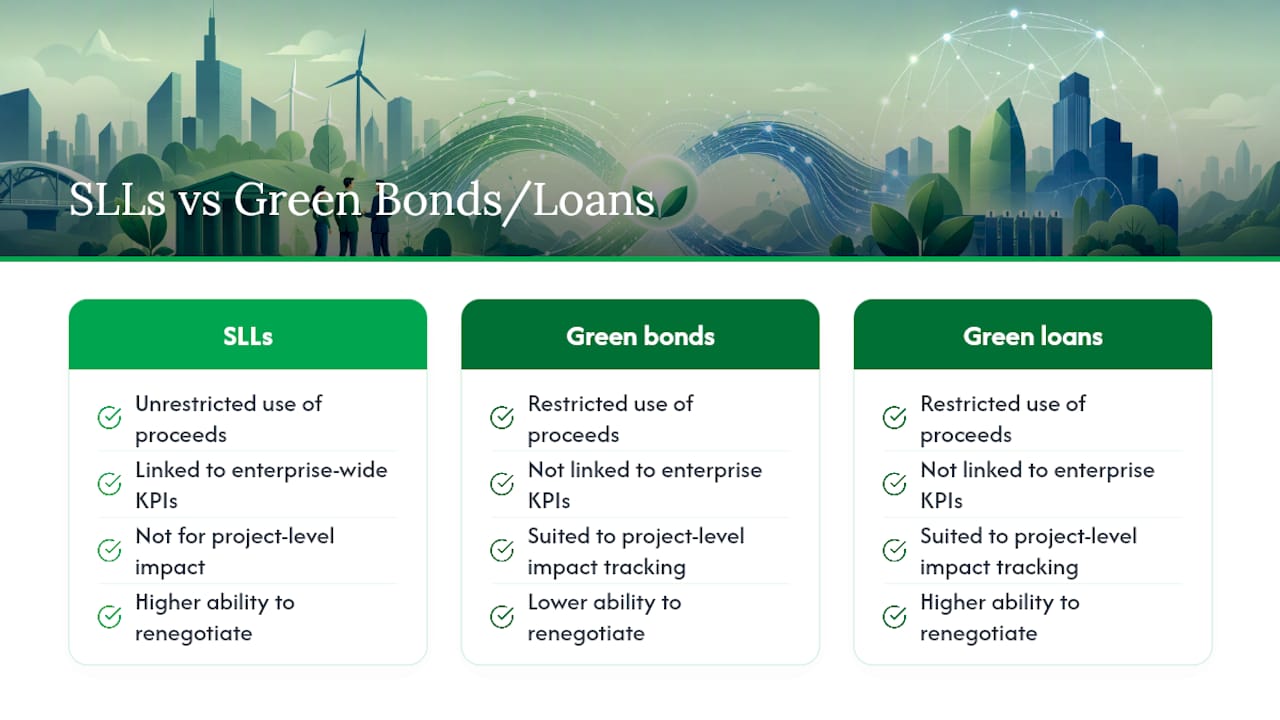
SLLs occupy a distinct niche among sustainable financing tools, and confusing them with adjacent instruments is a common structuring mistake. Green and social loans restrict use of proceeds to eligible projects, which suits a borrower financing a specific solar installation or affordable housing development, but that structure cannot flex to reward company-wide performance improvement. SLLs solve the opposite problem: they leave proceeds unrestricted but tie pricing to enterprise-wide KPI achievement, which fits a borrower whose sustainability strategy touches operations broadly rather than one discrete project.
Sustainability-linked bonds mirror the SLL mechanism in capital markets, though bond investors generally have less ability to renegotiate covenants mid-term than a bank syndicate does. Green bonds, like green loans, carry the use-of-proceeds restriction. For impact investing strategies focused on measurable outcome tracking rather than balance-sheet financing, instruments like green bonds or dedicated impact funds often fit better than an SLL, since SLLs measure corporate-level KPI achievement rather than project-level impact metrics. Professionals choosing between environmentally sustainable loans structured as use-of-proceeds facilities and SLLs should ask a simple question: is the financing need project-specific, or is it a general working-capital or term facility where the borrower wants financing costs to track overall ESG progress?
Where Businesses Struggle With SLL Adoption
Data readiness is the most common barrier. Many borrowers discover mid-negotiation that they cannot produce auditable, consistently calculated KPI data going back far enough to establish a credible baseline. Smaller borrowers face a second, related problem: the fixed cost of building MRV infrastructure, from data systems to assurance fees, does not scale down proportionally with loan size, which makes SLLs economically marginal for smaller facilities even when the coupon discount looks attractive on paper.
Governance gaps compound both problems. When no single function owns sustainability data collection, KPI figures arrive late, inconsistently calculated, or without the audit trail a verifier needs. Ambition-setting creates its own friction: sustainability teams want stretch targets that demonstrate real progress, while treasury teams want SPTs the company can reliably hit to avoid a margin step-up. That tension, if unresolved before term sheet negotiations, tends to produce exactly the watered-down KPIs that draw greenwashing criticism later. Cross-border borrowers face an added layer, since a KPI benchmarked against one jurisdiction's sector average may not translate cleanly to another market where the same industry operates under different baseline emissions intensity.
Common Pitfalls in SLL Contracts and How to Avoid Them
Contract drafting is where many SLLs quietly go wrong, often in clauses that look fine until a testing date exposes the gap. A few recurring pitfalls:
- Vague verification language. Contracts that reference "independent verification" without naming a standard or specifying scope leave room for dispute exactly when a borrower is close to missing an SPT.
- No baseline restatement mechanism. Mergers, acquisitions, or accounting method changes routinely shift the baseline year's figures, and a contract silent on how to handle that leaves lenders and borrowers arguing over apples-to-oranges comparisons.
- Asymmetric consequences. Some deals build in a margin step-up for missing a target but no corresponding step-down for outperformance, which undermines the incentive logic the SLLP framework is built around.
- Undefined "material amendment" triggers. Contracts should specify what changes to the business (divestitures, major KPI-relevant asset sales) trigger a mandatory SPT recalibration rather than leaving it to informal renegotiation.
Legal counsel should treat each of these as a negotiation checkpoint rather than boilerplate, since the LMA's fund finance guidance makes clear that KPI materiality and SPT ambition function as genuine pricing levers, not just disclosure exercises. A contract that leaves these levers vague hands both sides a dispute waiting to happen.
An Editorial Take on Where SLL Practice Needs to Improve
An SLL earns its label when the KPI is material and the SPT is genuinely stretching. A green loan still wins when financing is project-specific and proceeds need ring-fencing. Market practice needs more ambitious targets and routine independent assurance, not just pre-signing reviews. Run a KPI materiality test before the term sheet, not after.
— Ransford
Prepare Your Team to Structure and Verify Credible SLLs
Structuring an SLL that survives scrutiny takes more than a term sheet. It takes staff who can build a defensible KPI baseline, calibrate an SPT against a real benchmark, and produce the audit trail an external verifier will actually accept. Certifications exist to address this gap, designed for sustainability leads, finance teams, and assurance practitioners who need to get MRV right the first time, not after a lender flags a weak target.
Programs like the Certificate in Sustainable Finance cover KPI and SPT design directly, while the Certified Sustainability Assurance Professional (CSAP) credential builds the verification skills lenders increasingly expect on the other side of the table. Teams needing carbon accounting depth for emissions-based KPIs can turn to the Certificate in Carbon Accounting, and professionals who want ongoing, modular access can use the All-Access CPD Pass at $599 per year for courses including Carbon Accounting and GHG Measurement and ESG Reporting for Accountants. Check current course details and enroll directly on the Esgtraininginstitute site to get your team ready for the next SLL negotiation.
Sources
- How do borrower ESG performance and risks matter to banks? — University of Edinburgh research
- World Bank analysis on SLL transparency and market practices
FAQ
What Is a Sustainability-Linked Loan?
A sustainability-linked loan ties a borrower's loan pricing to predetermined KPIs and SPTs, with no restriction on how proceeds are used, unlike a green or social loan.
How Is an SLL Different From a Green Loan?
A green loan restricts proceeds to eligible environmental projects, while an SLL leaves proceeds unrestricted and instead adjusts pricing based on enterprise-wide ESG performance against agreed targets.
Do SLLs Actually Lower Borrowing Costs?
Research on borrower ESG performance found a one-standard-deviation improvement associated with roughly a 10.64 basis-point reduction in loan spreads, along with a higher likelihood of credit rating upgrades for SLL borrowers.
What Makes an SLL Vulnerable to Greenwashing Criticism?
Immaterial KPIs, targets already achieved before signing, and opaque reporting methodology are the main warning signs; transparency levels correlate strongly with whether ESG performance improves or deteriorates after issuance.
How Can Training Reduce SLL Structuring Risk?
Staff trained in sustainable finance, carbon accounting, and assurance practice are better equipped to build auditable KPI baselines and calibrate credible SPTs, which reduces disputes at verification. Esgtraininginstitute's Certificate in Sustainable Finance and Certified Sustainability Assurance Professional (CSAP) programs are built directly for this gap.