

Sustainability reporting assurance is an independent evaluation of an organization's sustainability disclosures, performed to confirm they are complete, accurate, and prepared in line with recognized criteria. It matters because regulators and investors increasingly treat unassured ESG data as unreliable. The core distinction professionals need first: limited assurance offers a "nothing has come to our attention" conclusion, while reasonable assurance offers a positive, audit-grade opinion, and both are shaped by the new ISSA 5000 standard.
TL;DR:
- Limited assurance relies mainly on inquiries and provides a negative conclusion, while reasonable assurance requires substantive testing and offers a positive, audit-like opinion.
- The new ISSA 5000 standard, effective from December 15, 2026, will unify and replace older frameworks, applying across all sustainability topics and reporting regimes.
- Organizations should focus on strengthening data lineage, controls, and documentation before engaging assurance providers to avoid scope delays and higher fees.
- Expect mandatory assurance to begin with limited scope, gradually moving to reasonable assurance as internal controls and data maturity improve.
- Combining internal training with external assurance reduces engagement timelines, making the process faster, cheaper, and less prone to scope and documentation issues.
Table of Contents
- What Sustainability Reporting Assurance Covers
- Which Standards Govern Sustainability Assurance Practice?
- Limited vs Reasonable Assurance: What Actually Changes
- How Does a Sustainability Assurance Engagement Actually Work?
- Who Provides Sustainability Assurance and How Should You Choose One?
- What Should Reporting Teams Fix Before Engaging Assurance?
- Building Internal Capability for Assurance Readiness
- Integrating Sustainability Assurance With Financial Audit Processes
- What's Changing in Sustainability Assurance Practice?
- Sustainability Assurance in Practice: What the Evidence Shows
- Practical Priorities as ISSA 5000 Takes Effect
- Build the Internal Capability Assurance Engagements Demand
- Sources
What Sustainability Reporting Assurance Covers
Sustainability information spans greenhouse gas emissions, workforce and safety metrics, board oversight structures, and supply chain due diligence data. None of it carries the same weight as financial statements unless someone independent checks it. That's the gap assurance closes.
Investors want assurance because unverified ESG claims have a track record of overstatement. Regulators want it because disclosure regimes only work if the numbers behind them hold up under scrutiny. Organizations that pursue assurance typically see:
- Higher credibility with lenders, rating agencies, and institutional investors
- Reduced exposure to greenwashing allegations and reputational fallout
- Smoother alignment with disclosure regimes like the EU's Corporate Sustainability Reporting Directive
- Better internal data governance, since assurance forces teams to document how numbers are actually produced
Assurance turns a sustainability report from a communications document into something closer to a financial statement. That shift is why finance teams, not just sustainability teams, now have a stake in getting it right.
Which Standards Govern Sustainability Assurance Practice?
Three reference points define the current landscape. ISSA 5000, issued by the IAASB, is a stand-alone, principles-based standard covering both limited and reasonable assurance across any sustainability topic or reporting framework. It is effective for periods beginning on or after December 15, 2026, with earlier adoption permitted, which gives reporting teams a defined runway rather than an open-ended deadline.
ISSA 5000 was built to sit alongside, and eventually largely supersede, the older ISAE 3000 framework that many practitioners used for ad hoc sustainability engagements before a dedicated standard existed. The IAASB designed it to be profession-agnostic, meaning it applies across sustainability topics and frameworks rather than being tied to one disclosure regime.
Independence rules matter just as much as technical scope. IESBA ethics requirements now extend to sustainability engagements, so practitioners face the same conflict-of-interest scrutiny that governs financial audits.
On the regulatory side, the EU's Corporate Sustainability Reporting Directive is the primary force pushing assurance from optional to mandatory in Europe, starting with limited assurance requirements. The CEAOB's non-binding guidance, published in March and September 2024, clarifies how practitioners should interpret those limited-assurance expectations in the absence of finalized detailed rules.
What this means in practice: before any testing begins, practitioners must confirm the criteria applied to sustainability data are suitable and available, and agree whether the engagement covers the full sustainability report or a narrower slice, like climate disclosures alone.
Limited vs Reasonable Assurance: What Actually Changes
The difference between limited and reasonable assurance is not a matter of degree. It changes the conclusion's wording, the procedures behind it, and the internal controls a company needs.
Limited assurance produces a negative-form conclusion: "nothing has come to our attention that causes us to believe the information is materially misstated." Reasonable assurance produces a positive-form opinion, stating the information "presents fairly" or "is prepared, in all material respects," in accordance with the criteria. That is a stronger claim, and it demands stronger evidence.
Procedurally, limited assurance relies mainly on inquiries and analytical procedures, while reasonable assurance requires substantive testing and control testing similar to a financial audit. That gap explains why:
- Reasonable assurance engagements take considerably longer and cost more
- Reasonable assurance demands a mature control environment with documented evidence trails
- Limited assurance can still be meaningful, not a lesser exercise, particularly for entities early in their reporting journey
A common misunderstanding is treating the two levels as roughly interchangeable with different price tags. They are not. Moving from limited to reasonable assurance typically requires real investment in control design and operating effectiveness, not simply a bigger sample size on the same underlying data.
Pro Tip: Ask a prospective practitioner to walk through exactly which procedures change between limited and reasonable assurance for your specific KPIs. If they can't name specific control tests, they haven't scoped the engagement properly.
How Does a Sustainability Assurance Engagement Actually Work?
An engagement moves through a defined sequence, and skipping steps is how scope disputes happen later.
- Agree the reporting boundary. Decide what's in and out, whether that's the entire sustainability report, a subset like Scope 1 and 2 emissions, or a single framework's disclosures.
- Select suitable criteria. The practitioner must confirm the criteria used, whether ESRS, GRI, or a sector framework, are suitable and available to users of the report.
- Set materiality. Materiality thresholds for sustainability data are often qualitative as well as quantitative, since a small percentage error in emissions data can carry outsized reputational weight.
- Gather evidence. Inquiries and analytics for limited assurance; substantive testing, sampling, and control walkthroughs for reasonable assurance.
- Draft the conclusion. The report states the level of assurance obtained, the criteria applied, and any scope limitations encountered.
Timelines vary widely depending on data maturity, but a first-year limited assurance engagement for a mid-sized reporter commonly runs several weeks once evidence requests go out. The final report always specifies:
- The assurance level obtained (limited or reasonable)
- The criteria and framework applied
- Any restrictions on scope or access to information
- The practitioner's conclusion, stated in negative or positive form
Vague scoping at the outset is the single biggest cause of engagement delays and fee disputes later.
Who Provides Sustainability Assurance and How Should You Choose One?
Assurance providers fall into two broad camps: professional accountancy firms operating under IAASB and IESBA standards, and specialized sustainability consultancies that may follow different, less standardized methodologies. Both can be competent. Only the former is bound by the same independence and quality-control regime that governs financial statement audits.
When vetting a provider, look for:
- Demonstrated familiarity with ISSA 5000 and ISAE 3000, not just general ESG consulting experience
- Documented independence policies consistent with IESBA requirements
- Sector-specific experience relevant to your KPIs, since emissions assurance and social-metric assurance call for different testing approaches
- A written methodology you can review before signing, not a verbal assurance that "we've done this before"
Before contracting, pin down scope boundaries, sample sizes, the exact reporting language to be used, fee structure, deliverables, and timeline in writing. Red flags include vague sample-size commitments, reluctance to name the specific standard being applied, and pricing that seems disconnected from the stated scope.
What Should Reporting Teams Fix Before Engaging Assurance?
Most engagement delays trace back to the same handful of gaps, and fixing them before the assurance practitioner arrives saves both time and fees.
- Data lineage. Know exactly where each KPI originates, who owns the source system, and how it flows into the final report.
- Controls and governance. Build reconciliation processes and assign clear ownership for every disclosed metric, the same way finance teams handle general ledger accounts.
- Traceability. Keep documentation that lets a sample transaction be traced back to its source record without a scramble.
- Quick wins. Standardize units and definitions across business units first; inconsistent measurement is the most common cause of scope expansion mid-engagement.
Pro Tip: Run an internal mock assurance exercise on your top five KPIs before the real engagement starts. Most gaps surface in the first sample request, and finding them yourself is far cheaper than a practitioner finding them for you.
Building Internal Capability for Assurance Readiness
Closing the gaps above takes trained people, not just better software. Esgtraininginstitute offers standards-aligned certification pathways covering carbon accounting, ESG reporting frameworks, and assurance-adjacent risk and governance topics, built for sustainability leads, internal auditors, and risk officers preparing for expanded disclosure obligations.

Its programs are designed against current regulatory expectations, and its graduate network now manages more than $30 trillion in ESG assets globally. For a deeper walkthrough of the standard reshaping this field, see ISSA 5000: The New Global Sustainability Assurance Standard, and for a practical build-out sequence, the Building a Sustainability Assurance Practice series maps directly onto the readiness gaps most teams face.
Integrating Sustainability Assurance With Financial Audit Processes
Sustainability assurance and financial audit are converging, not merging, and the distinction matters for how teams plan their year. Both processes increasingly draw on the same underlying data systems, especially where emissions or workforce metrics feed into financial disclosures like climate-related liabilities or impairment assessments.
Many organizations now schedule sustainability assurance fieldwork to overlap with financial audit cycles, since both require similar evidence: source documentation, control testimonies, and management representations. Financial auditors and sustainability assurance practitioners increasingly need to coordinate directly, particularly where a company's external financial auditor and sustainability assurance provider are the same firm, which is common given existing audit relationships.
The IESBA independence rules that now apply to sustainability engagements mirror financial audit independence requirements, which reduces the risk of a firm being disqualified from one engagement because of conflicts created by the other. But coordination isn't automatic. Finance teams that treat sustainability data as separate from financial reporting infrastructure tend to duplicate evidence-gathering effort and frustrate both audit teams.
The more effective model treats sustainability KPIs as extensions of the general ledger control environment, subject to the same reconciliation discipline as revenue or inventory figures. Companies that already run integrated assurance planning, where the audit committee oversees both financial and sustainability assurance scopes in the same calendar, report fewer scheduling conflicts and lower total assurance fees, since practitioners can share some evidence-gathering infrastructure across both engagements. This integration trend is likely to accelerate as ISSA 5000 adoption spreads and sustainability data becomes formally embedded in financial statement notes under frameworks like ESRS.
What's Changing in Sustainability Assurance Practice?
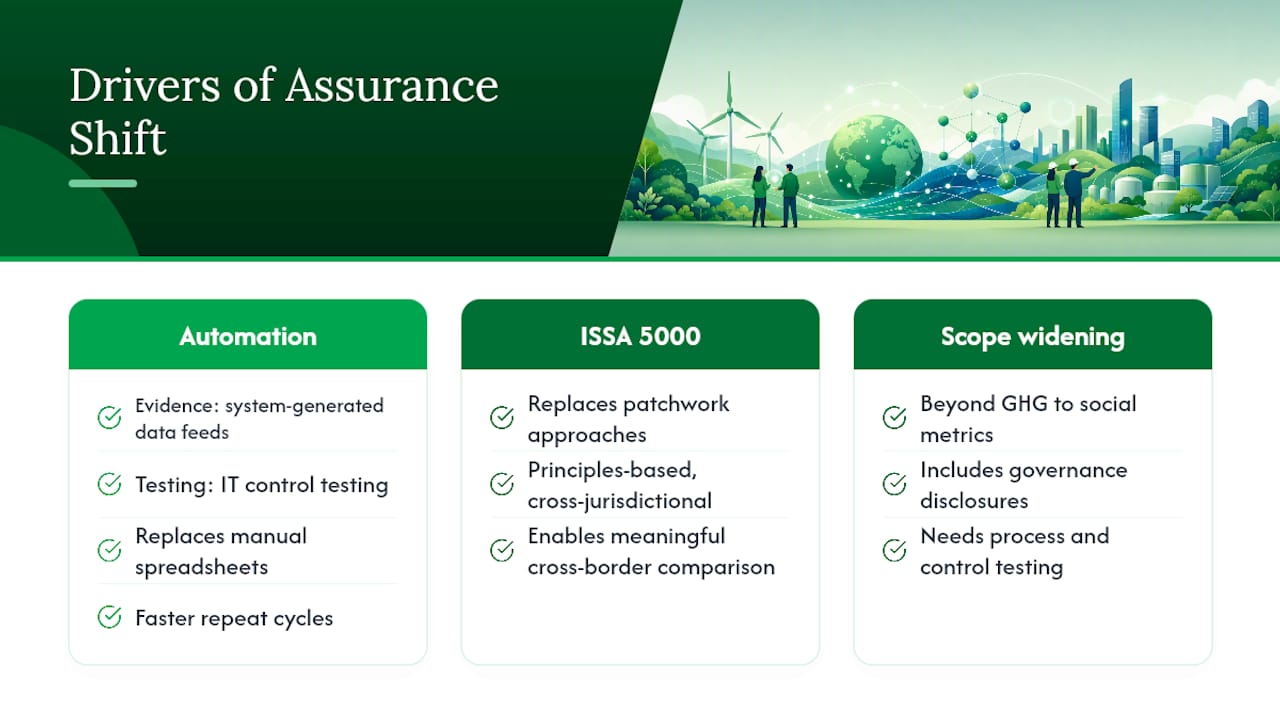
Assurance practice is shifting from a check-the-box compliance exercise toward something closer to continuous monitoring, and three developments are driving that shift.
First, data automation is changing what "evidence" means. Practitioners increasingly test system-generated data feeds, such as automated emissions calculations from metered energy use, rather than relying solely on manually compiled spreadsheets. That shifts assurance procedures toward IT control testing, a skill set traditionally associated with financial statement audits of complex systems rather than sustainability reporting.
Second, the profession is consolidating around fewer, more rigorous standards. ISSA 5000's arrival replaces a patchwork of national and framework-specific assurance approaches with one principles-based standard usable across topics and jurisdictions. That consistency should make cross-border comparisons of assurance quality more meaningful, something investors have struggled with when providers used varying, incompatible methodologies.
Third, assurance scope is widening beyond emissions. Early sustainability assurance engagements concentrated almost entirely on greenhouse gas data because it was quantifiable and comparably mature. Newer engagements increasingly cover social metrics, like workforce composition and safety incidents, and governance disclosures, like board diversity and executive pay ratios tied to sustainability targets. These qualitative and semi-quantitative metrics demand different evidence types than emissions data, often relying more on process and control testing than on recalculation.
Practitioners should also expect assurance timelines to compress as data systems mature. Once a company has run one or two assurance cycles, subsequent engagements typically move faster because the evidence trail is already documented and reusable, a pattern strongly reminiscent of how financial audits stabilize after the first year of a new auditor relationship.
Sustainability Assurance in Practice: What the Evidence Shows
The clearest signal on why assurance matters comes from research rather than anecdote. Academic analysis of sustainability reporting assurance across leading global companies finds that firms obtaining assurance reduce information asymmetry with investors and improve the quality of decisions those investors make. That is the mechanism behind assurance's market value: it's not a compliance stamp, it's a signal that measurably changes how capital providers interpret a company's disclosures.
The same research examines assurance lag, meaning the gap between when a reporting period ends and when the assurance opinion is issued, along with variation in assurance levels and provider types chosen across jurisdictions. Companies in markets with mandatory assurance requirements, unsurprisingly, show shorter lags and more consistent provider selection than those where assurance remains voluntary.
A useful illustration of the limited assurance step in action: a company adopting CSRD-aligned reporting for the first time typically starts with limited assurance across its full sustainability statement, then narrows reasonable assurance to a subset of high-priority metrics, often emissions data, in later cycles as controls mature. This staged approach lets a reporting team build the control infrastructure reasonable assurance demands without attempting a full-scope reasonable assurance engagement on day one, which ICAEW guidance notes is rarely realistic for first-time reporters.
Sector patterns are emerging too. Heavy industry and extractives, where emissions data has long been subject to environmental permitting scrutiny, tend to reach reasonable assurance on carbon metrics faster than sectors like financial services, where sustainability data systems are newer and less integrated with existing regulatory reporting infrastructure.
Practical Priorities as ISSA 5000 Takes Effect
Expect limited-assurance mandates to arrive first across most jurisdictions, with reasonable assurance following as control environments mature. Cross-functional coordination between finance, HR, and operations is non-negotiable once assurance touches data those teams generate. The realistic sequence: define scope tightly, shore up controls, pilot limited assurance, then scale toward reasonable assurance once your evidence trail can withstand substantive testing.
— Ransford
Build the Internal Capability Assurance Engagements Demand
Training your own team is not a substitute for independent assurance. It is the groundwork that makes assurance engagements faster, cheaper, and less likely to stall on documentation gaps. Esgtraininginstitute's certification pathways are built specifically for that groundwork: courses covering control testing, materiality assessment, and standards-aligned reporting give sustainability leads and internal auditors the vocabulary and technical grounding to work productively with external practitioners rather than translating for them mid-engagement.
Organizations that combine internal training with external assurance consistently report shorter engagement timelines, since practitioners spend less time explaining basic concepts and more time testing evidence. Esgtraininginstitute's accreditation pathways map directly onto the skills ISSA 5000 engagements require, from criteria selection to evidence documentation. Review the current certification tracks and enroll your reporting team before your next assurance cycle begins.
Sources
- EUR-Lex: Corporate Sustainability Reporting Directive (CSRD)
- Limited assurance vs reasonable assurance | ICAEW
- Limited vs reasonable assurance | KPMG UK
- Sustainability reporting assurance: Knowledge, lags, levels, and providers in leading global companies