

TNFD disclosures are voluntary, standardized reports on nature-related dependencies, impacts, risks, and opportunities, built on four pillars and 14 recommended disclosures. The practical starting point is a LEAP assessment (Locate, Evaluate, Assess, Prepare), which identifies where an organization depends on or affects nature before any disclosure line is drafted. Professionals scoping this work should treat LEAP as the engine and the 14 disclosures as the output.
TL;DR:
- Companies should prioritize gathering spatial and ecosystem data early in the Locate phase, using existing maps and supplier questionnaires to overcome data gaps.
- Disclosing specific priority locations and targets with clear timelines enhances credibility and investor trust, even if data quality is limited in the initial stages.
- A cross-functional team with finance, procurement, legal, operations, and biodiversity expertise is essential for scoping and executing a credible TNFD disclosure project.
- Assurance readiness relies on transparent documentation of methodologies, primary data sources, and defensible location and target choices from the outset.
- Incorporating nature dependencies and impacts into financial language requires mapping ecological facts to financial risks like revenue loss, capital costs, or regulatory liabilities.
Table of Contents
- What TNFD Disclosures Cover and Who Should Report Them
- Four Pillars and the 14 Recommended Disclosures Explained
- The LEAP Approach: Turning Assessment Into Disclosure
- How to Scope and Resource a TNFD Disclosure Project
- Metrics and Targets: Building a Measurement Architecture That Holds Up
- Mapping TNFD to TCFD, ISSB, GRI, and CSRD
- Building Internal Capability for TNFD Readiness
- Case Studies: What Early TNFD Adopters Got Right
- Common Roadblocks in the TNFD Disclosure Process
- Integrating Nature Dependencies Into Financial Disclosures
- Verifying and Assuring TNFD Disclosures
- Why Investors Are Paying Closer Attention to Nature Risk
- Where to Go Deeper on TNFD
- The Real Bottleneck Isn't the Framework, It's the Data Culture
- Sources
What TNFD Disclosures Cover and Who Should Report Them
TNFD disclosures give capital providers, insurers, and regulators decision-useful information on how a company depends on nature and how its operations affect ecosystems. The Taskforce on Nature-related Financial Disclosures built the framework to be science-based and market-led rather than imposed by statute, and its disclosure recommendations sit alongside other reporting baselines rather than replacing them.
Reporting stays voluntary under a comply-or-explain model, but the framework tracks closely with global policy commitments, including the Kunming-Montreal Global Biodiversity Framework, which pushes governments and financial markets toward nature-positive outcomes by 2030. That alignment matters for anyone wondering whether TNFD is optional in practice. It is optional in the letter of the law, but increasingly expected in the spirit of investor due diligence.
TNFD disclosures suit a wide range of organizations, not just extractive or agricultural companies:
- Financial institutions with lending or investment exposure to nature-dependent sectors
- Manufacturers with supply chains tied to agriculture, forestry, or fisheries
- Companies operating near protected areas, wetlands, or water-stressed regions
- Insurers pricing physical and transition risk tied to ecosystem degradation
Four Pillars and the 14 Recommended Disclosures Explained
TNFD's structure mirrors the TCFD architecture that finance professionals already know, but each pillar carries nature-specific expectations that go beyond climate.
Governance asks how the board and management oversee nature-related issues, including who owns the LEAP process internally. Strategy covers how nature-related dependencies and impacts shape business strategy, including transition plans and locations facing material risk. Risk & impact management documents how the organization identifies, assesses, and responds to nature-related risks across operations and value chains. Metrics & targets covers the quantitative backbone: what gets measured, what targets get set, and how progress gets tracked.
Those four pillars break into 14 recommended disclosures. A minimal but credible disclosure set typically includes:
- Board oversight of nature-related issues and management's role in assessing them
- A description of nature-related dependencies, impacts, risks, and opportunities across short, medium, and long time horizons
- Priority locations disclosed with enough specificity to identify ecological sensitivity
- Risk management processes, including how nature risks integrate into existing enterprise risk frameworks
- Metrics used to assess and manage material nature-related issues
- Targets set to manage nature-related dependencies and impacts, with progress reported over time
TNFD also layers on six general disclosure requirements beyond what ISSB's IFRS S1 requires, largely to enforce a consistent materiality approach across sectors and geographies. Getting that materiality approach right early saves a rework later, since every subsequent disclosure decision traces back to it.
The LEAP Approach: Turning Assessment Into Disclosure
LEAP stands for Locate, Evaluate, Assess, and Prepare, and it is TNFD's integrated method for generating the evidence base behind every disclosure claim. Each phase produces a specific, usable output.
- Locate maps where the organization operates relative to sensitive ecosystems, producing a list of priority locations for deeper assessment.
- Evaluate identifies the dependencies and impacts at those locations, drawing on ecosystem services and pressure data.
- Assess translates those dependencies and impacts into financial and reputational risks and opportunities.
- Prepare turns the assessment into decisions: what to disclose, what targets to set, and how to respond strategically.
Each phase feeds directly into the disclosures above. Locate outputs support the priority-location disclosure; Assess outputs support risk-management and materiality statements. One caution worth repeating: a published LEAP assessment on its own does not constitute a TNFD-aligned disclosure. You still need to map findings against at least one of the 14 recommendations before you can claim alignment.
Pilot testers consistently report the same friction points: gathering spatial data on asset locations, engaging suppliers who hold data you don't, and consulting Indigenous Peoples and local communities near priority sites.
Pro Tip: Start your Locate phase with whatever geospatial data you already hold in procurement or facilities systems before commissioning new mapping. Most organizations already know more about their footprint than their sustainability team assumes.
How to Scope and Resource a TNFD Disclosure Project
Scoping decisions made in week one shape everything that follows, so treat this phase with the same rigor as the assessment itself.
- Set disclosure objectives first. Decide whether you're targeting a full 14-disclosure statement in year one or a phased rollout starting with governance and priority locations.
- Choose time horizons deliberately. Short, medium, and long horizons should reflect your industry's actual planning cycles and capital cycles, not a generic template, since the horizon choice materially changes which nature-related issues you must cover.
- Assemble a cross-functional team. A LEAP assessment needs finance for materiality framing, procurement for supply chain data, legal for disclosure risk, operations for site-level detail, and a biodiversity specialist to interpret ecological data.
- Name an executive sponsor. Nature-related risk crosses departments in ways climate risk often doesn't, and sponsorship above the sustainability function prevents the project from stalling at data requests.
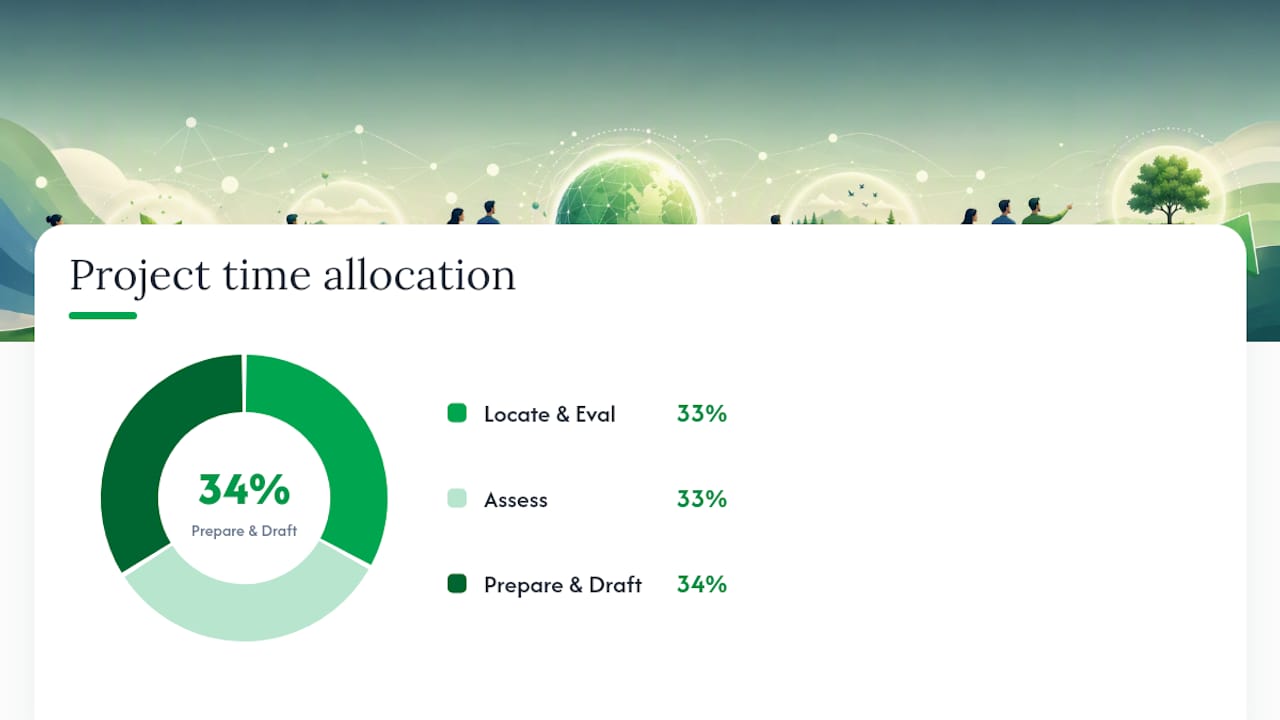
- Sequence the work in phases. A common pattern: months one through three for Locate and Evaluate, months four through six for Assess, and months seven through nine for Prepare and disclosure drafting.
Data gaps are the norm, not the exception, in year one. Use proxy data from sector-level ecosystem databases, third-party spatial datasets, and supplier questionnaires to fill early gaps, and disclose those limitations transparently rather than delaying publication indefinitely.
Pro Tip: Publish a staged disclosure that names your data gaps explicitly. Investors read a transparent "we don't have this yet, here's our plan" statement as more credible than a polished report that quietly omits weak spots.
Metrics and Targets: Building a Measurement Architecture That Holds Up
TNFD's metrics architecture splits into core global metrics, which every organization is expected to disclose against, and core sector metrics, which apply to specific high-risk sectors like agriculture, mining, and energy. Both operate on the same comply-or-explain logic as the rest of the framework: disclose the metric or explain why it doesn't apply.
Target setting is where many teams stall, because nature lacks a single unit of measurement equivalent to a ton of carbon. TNFD points organizations toward methods from the Science Based Targets Network and toward the Global Biodiversity Framework's 2030 targets as reference points, rather than prescribing a single metric.
For data-limited contexts, a few pragmatic moves keep the disclosure moving without waiting for perfect data:
- Report leading indicators (supplier engagement rates, percentage of priority sites assessed) alongside lagging outcome metrics
- Use sector-average proxies where site-specific data isn't yet available, labeled clearly as estimates
- Layer in supplier questionnaires to close specific dependency gaps over successive reporting cycles
TNFD has worked with partners including SBTN, GRI, ISO, and the UN Statistics Division to push toward standardization, though measurement challenges across ecosystems remain real, which is precisely why the framework leans on a leading-indicators architecture rather than demanding finished outcome data from day one.
Mapping TNFD to TCFD, ISSB, GRI, and CSRD
The fastest way to reduce reporting burden is to reuse work you've already done for climate disclosures, since TNFD shares its four-pillar architecture with TCFD and ISSB.
- Governance, strategy, and risk-management narratives written for ISSB or CSRD's ESRS often transfer directly into TNFD's equivalent pillars with nature-specific additions layered on top.
- GRI standards remain the stronger fit for broad impact disclosure on biodiversity and ecosystems, since GRI was built around stakeholder impact rather than investor materiality.
- Reserve TNFD-specific work for what genuinely requires it: LEAP-derived priority location disclosures, nature-specific metrics, and dependency mapping that climate frameworks don't capture.
UNDP's guidance on TNFD frames this interoperability as intentional design, not coincidence, and provides mapping documents specifically to help teams avoid duplicating narrative work across frameworks. Teams building out this crosswalk may also find it useful to review how the TCFD to ISSB transition reshaped climate reporting, as the same convergence logic applies to nature.
Building Internal Capability for TNFD Readiness
LEAP assessments demand skills most sustainability teams don't have sitting idle: spatial data analysis, ecosystem dependency mapping, and financial materiality judgment applied to biodiversity data. Formal training closes that gap faster than learning by trial and error on a live disclosure deadline.
Some organizations design certification pathways specifically around this kind of applied capability, covering LEAP-style assessment methods, nature-related metrics selection, and the assurance practices investors expect behind a credible disclosure. Graduates of such programs now manage substantial ESG assets across global jurisdictions, reflecting how central structured training has become to credible nature-related reporting.
For sustainability leads scoping their first TNFD disclosure, the practical next step is straightforward: build the internal skill base before the assessment deadline arrives, not during it.
Case Studies: What Early TNFD Adopters Got Right
Early TNFD adopters share a pattern worth studying: they didn't wait for perfect data before publishing. Financial institutions with agricultural lending exposure have led on priority-location disclosure, using existing loan-book geography data to identify where borrowers operate near water-stressed or biodiversity-sensitive areas, then layering LEAP-style dependency analysis on top of data they already held.
Consumer goods companies with palm oil, cocoa, or timber in their supply chains have moved fastest on the Evaluate phase, largely because certification schemes in those commodities already required some supplier-level environmental data. That existing data pipeline shortened their Locate and Evaluate timelines considerably compared to sectors starting from zero.
Insurers, meanwhile, have concentrated early disclosure effort on the Risk & Impact Management pillar, treating nature-related physical risk as an extension of catastrophe modeling work they already run for climate. That reuse of existing risk infrastructure illustrates a broader lesson: the organizations moving fastest on TNFD are rarely starting from scratch. They're redirecting data and modeling capacity built for adjacent purposes.
What separates a strong early disclosure from a thin one isn't polish. It's specificity: naming actual priority locations rather than describing risk in the abstract, and disclosing targets with a timeline rather than a general commitment to "reduce impact." Investors reading these reports for the first time tend to reward candor about limitations over confident vagueness.
Common Roadblocks in the TNFD Disclosure Process
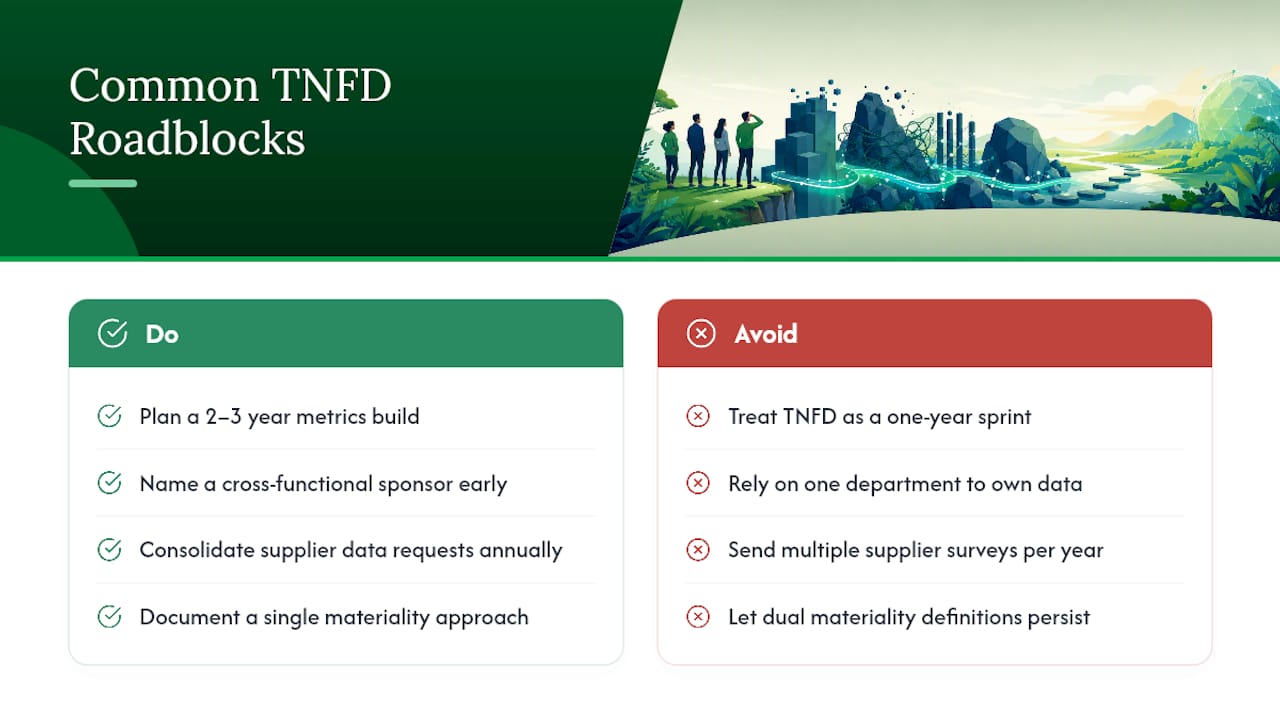
Data availability is the roadblock every team hits first. Spatial data on exact asset locations, supplier-level environmental performance, and ecosystem condition at specific sites simply doesn't exist in most corporate systems yet. Teams that treat this as a one-year sprint tend to burn out; teams that plan a two-to-three-year build toward full metrics coverage tend to publish something credible in year one and improve steadily.
Internal ownership is the second common snag. Nature-related risk doesn't sit neatly inside any one department. Sustainability teams often hold the disclosure mandate without the authority to compel data from procurement or the technical grounding to interpret ecosystem data on their own. Naming a cross-functional sponsor at the outset, as covered in the scoping section above, heads off a lot of this friction before it stalls the project.
Materiality disagreement is the third. Finance and sustainability teams frequently define "material" differently, one thinking in balance-sheet terms, the other in ecological terms, and TNFD's general disclosure requirements exist partly to force a single, documented materiality approach rather than let two definitions coexist unresolved.
Supplier engagement fatigue is real for any company that has already run climate, labor, and now nature-related supplier questionnaires in the same year. Consolidating data requests into a single annual supplier survey, rather than three separate ones, tends to raise response rates meaningfully.
None of these roadblocks are unique to TNFD. They're the same organizational friction points that slowed early TCFD adoption, which suggests they resolve with time and repetition rather than a clever one-time fix.
Integrating Nature Dependencies Into Financial Disclosures
The technical challenge underneath every TNFD disclosure is translating ecological facts into financial language a CFO or investor can actually act on. A wetland providing flood buffering isn't naturally expressed in financial terms, but the cost of losing that buffering, higher insurance premiums, disrupted operations, capital expenditure on artificial flood defenses, is.
Start by distinguishing dependencies from impacts, since TNFD tracks both directions of the relationship. A dependency is something your business relies on nature to provide, like pollination, water filtration, or raw material supply. An impact is something your business does to nature, like water extraction, land conversion, or emissions affecting a local ecosystem. Reporting only one direction gives investors half the picture, since a company can have low dependency but high impact, or the reverse, and the financial exposure looks completely different depending on which applies.
Once dependencies and impacts are mapped through the LEAP process, translate them into financial line items wherever possible: revenue at risk from a disrupted input, capital expenditure required for mitigation, or contingent liability from regulatory exposure at a specific site. Where a clean financial translation isn't yet possible, disclose the qualitative exposure and flag it as a metric under development rather than omitting it. Assurance providers and investors increasingly expect that qualitative bridge to be explicit, not implied.
Verifying and Assuring TNFD Disclosures
Assurance is what turns a TNFD disclosure from a marketing document into something an investor can rely on. Unlike financial audits, nature-related assurance is still a developing practice, but the underlying principle is familiar: an independent third party checks that the data behind your disclosure supports the claims you're making.
Start assurance readiness during the LEAP process itself, not after the disclosure is drafted. Document your data sources, methodology for identifying priority locations, and the basis for every metric as you go, since reconstructing that trail after publication is far harder than capturing it in real time. A sustainability assurance practice built around this kind of ongoing documentation tends to produce audit-ready disclosures with far less scramble at year-end.
Assurance providers will typically test three things: whether your priority-location methodology is defensible and consistently applied, whether your metrics trace back to verifiable primary or proxy data, and whether your targets are specific enough to be measured against in future reporting cycles. Vague targets or undocumented location selection are the two most common reasons a first assurance engagement flags a disclosure for rework.
Investor confidence tracks assurance maturity closely. A disclosure with third-party assurance, even limited assurance rather than full reasonable assurance, signals a level of internal control that unaudited nature disclosures simply can't match.
Why Investors Are Paying Closer Attention to Nature Risk
Investors read TNFD disclosures the way they read TCFD disclosures a few years ago: as an early signal of which companies understand a risk category before it hits the balance sheet. A company that can name its priority locations, quantify its dependencies, and show a credible target trajectory looks materially different from a competitor offering vague sustainability language.
The financial logic is straightforward. Nature-related risk shows up as supply disruption, regulatory exposure, insurance cost increases, and reputational damage, all of which affect valuation whether or not a company discloses them. Investors increasingly treat the absence of nature disclosure itself as a data point, reading silence as either unmanaged risk or an unwillingness to quantify it.
Beyond risk pricing, credible TNFD disclosures increasingly factor into capital allocation decisions, particularly among lenders and institutional investors with biodiversity-related mandates tied to the Global Biodiversity Framework. Companies that disclose early and specifically position themselves ahead of that capital shift rather than reacting to it once it becomes standard due diligence practice.
The benefit compounds over time. A company publishing its second or third year of TNFD disclosures with improving data quality and narrowing target gaps builds a credibility track record that a first-year disclosure, however polished, simply cannot match.
Where to Go Deeper on TNFD
Start with the TNFD Recommendations for the full 14-disclosure detail and the LEAP guidance for assessment methodology. For metrics and target-setting context, review SBTN's methods and the Global Biodiversity Framework directly.
The Real Bottleneck Isn't the Framework, It's the Data Culture
The conventional advice on TNFD treats it as a documentation exercise: read the 14 disclosures, fill in the template, publish. That framing undersells what actually separates strong disclosures from thin ones. The real bottleneck is whether an organization has a data culture that already tracks supplier-level environmental information, site-level ecological context, and cross-functional risk data before the disclosure deadline arrives.
Companies treating TNFD as a one-off compliance sprint tend to publish generic, low-specificity reports that read as defensive. Companies treating it as a multi-year capability build, starting with LEAP, investing in spatial and supplier data infrastructure, and training the people who have to interpret it, tend to publish disclosures that actually move investor perception.
If there's one place to prioritize limited resources, it's the Locate and Evaluate phases of LEAP, not the final disclosure drafting. Weak location and dependency data produces a polished but hollow disclosure. Strong data, even reported with acknowledged gaps, produces something investors trust more than a document with no visible seams at all. Build the data foundation first. The disclosure writes itself once that foundation holds.
— Ransford