
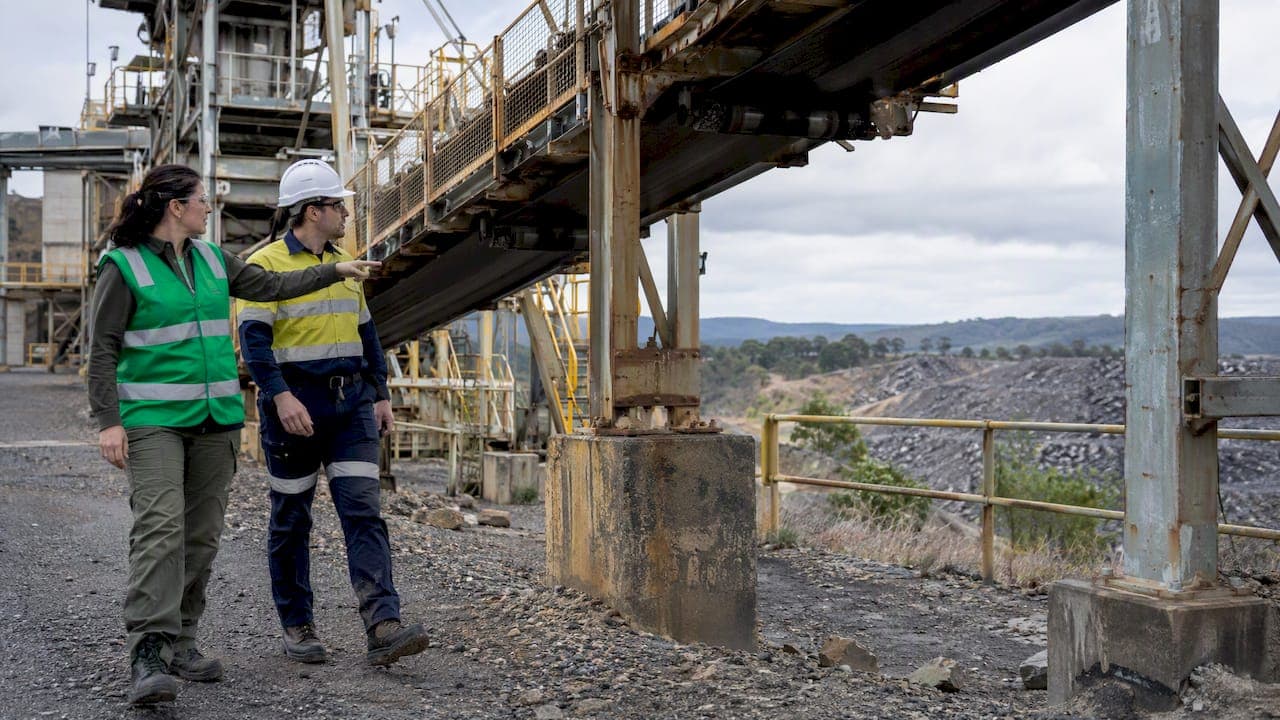
Just transition planning embeds distributional, procedural, restorative and recognition justice into decarbonization decisions. It works through early diagnostics, inclusive governance, worker-centered policies, asset repurposing, targeted finance and ongoing monitoring. The World Bank, the ILO and the UNFCCC each supply parts of the toolkit. We translate them into a phased, measurable plan.
TL;DR:
- Start diagnostics before closure dates are fixed: map facility and supply chain jobs, household dependence, community vulnerability, and reusable land, grid connections, and skills.
- Anchor justice principles in enforceable law; give the commission authority, fund worker and community participation, and provide an accessible grievance channel.
- Schedule income support and retraining before layoffs, tie training to actual vacancies, and coordinate wage subsidies and local investment with regional diversification.
- Track worker placement and earnings, local hiring, household energy costs, and grievances; scale pilots only after agreed placement, cost, and community acceptance thresholds.
- Fund diagnostics and pilots with grants or concessional capital, then bring in private lenders when projects have visible pipelines and measurable social safeguards.
Table of Contents
- What are the core principles of a just transition?
- How does the World Bank 3x3 framework structure a plan?
- Which governance bodies and forms of social dialogue make a plan credible?
- How do workforce measures, social protection and local investment fit together?
- How can finance and asset repurposing support a fair transition?
- What should monitoring and legal frameworks look like?
- What does a practical diagnostic, pilot and scale checklist look like?
- How should planners engage Indigenous peoples and local communities beyond social dialogue?
- How do gender considerations and equity shape a just transition plan?
- Which risks are specific to just transition, and how do you manage them?
- What role can emerging technologies and innovation play?
- Why does upstream planning matter more than any single policy?
- How can ESG Training Institute help you build just transition capacity?
- FAQ
- Sources
What are the core principles of a just transition?
A just transition rests on four tenets of justice. The World Bank and UNDP legal primer names them: distributional, procedural, restorative and recognition. Each one points to a different kind of policy decision.
- Distributional justice asks who gets the benefits and who carries the costs. In practice, this means directing investment toward the regions and workers who lose the most from fossil fuel decline.
- Procedural justice asks who has a seat at the table. Legal rights to participate, consult and appeal turn good intentions into safeguards.
- Restorative justice addresses past and ongoing harm. Land remediation, health programs and compensation for affected communities fall here.
- Recognition justice acknowledges the identities, knowledge and rights of groups that have been overlooked, including Indigenous peoples and informal workers.
Principles alone do not change outcomes. The same source argues that these tenets must be anchored in enforceable legal frameworks at national, regional and enterprise levels. That is where a commitment becomes a durable obligation, whether it sits in climate law, labor law, mining regulation or procurement rules.
The framework operates across national, regional and enterprise levels, and its tenets must be anchored in enforceable legal frameworks to move commitments into actionable, durable policies. For planners, that means drafting the legal hook early, not after the plan is published.
How does the World Bank 3x3 framework structure a plan?
The World Bank describes effective planning as a process built on three pillars: governance and strategic planning, people and communities, and repurposing land and assets. These pillars run across three phases: pre-closure, closure and transformation. That grid of nine cells is the "3x3."

The framework earns its place because it forces sequencing. Practitioner guidance on coal regions is explicit that diagnostic and analytical work, such as mapping job losses and community vulnerabilities, should begin well before any physical closure. Waiting until a plant shuts means designing support in a crisis.
A workable phased approach looks like this:
- Map the exposure. Build a job inventory by facility, supply chain and household dependence, then overlay community vulnerability indicators.
- Inventory assets. List land, grid connections, buildings and skills that could serve a second life.
- Set up governance. Assign a mandate, a budget and a reporting line before announcing any closure date.
- Pilot targeted interventions. Test retraining, placement or local enterprise support on a small cohort and record what works.
- Scale what performs. Expand only when pilots meet agreed criteria for placement rates, cost and community acceptance.
- Review and adapt. Revisit assumptions at each phase gate, using monitoring data rather than anniversaries.
Pro Tip: Write phase-gate criteria into the plan itself, such as minimum pilot placement results and completed stakeholder consultation, so moving from pilot to scale is a documented decision and not a political one.
Which governance bodies and forms of social dialogue make a plan credible?
Governance is where many plans quietly fail. The most common arrangements are a high-level commission, an interdepartmental committee and a technical secretariat. They do different jobs, and strong plans usually combine them.
- A commission carries political authority and public legitimacy, and often includes worker, employer, community and Indigenous representatives.
- An interdepartmental committee aligns energy, labor, education, finance and regional development ministries so that policies do not contradict one another.
- A technical secretariat does the daily work: data, drafting, tracking and coordination with local governments.
Review of national practice shows that governments are beginning to fold just transition into NDCs and long-term strategies, but details on social dialogue and diversification are often thin. Good practice includes naming an overseeing body and attaching concrete planning measures.
Social dialogue is the backbone of legitimacy. The ILO's guidelines call for formal tripartite mechanisms involving governments, employers and workers at every stage of policymaking. Meaningful participation needs more than a meeting: it needs advance access to documents, time to respond, funded capacity for worker and community representatives, and a written record showing how input changed the outcome.
Further requirements separate working bodies from decorative ones:
- A mandate and budget that match the scope of the transition
- Clear reporting lines to a head of government or equivalent
- A grievance and redress channel that affected people can use without legal representation
Pro Tip: Publish a short "what we heard and what changed" note after each consultation round. It builds trust faster than any communications campaign.
For readers building the reporting side of this, our guide to what a credible climate transition plan includes covers disclosure expectations that complement these governance arrangements.
How do workforce measures, social protection and local investment fit together?
People-centered measures are the heart of the plan, and they work best when coordinated. ILO and World Bank experts stress policy coherence: when reskilling, wage subsidies and safety nets are coordinated with regional diversification, the risk of long-term economic dislocation shrinks. Without coordination, social resistance can threaten the climate goals themselves.
A practical package combines:
- Active labor market policies. Retraining tied to real vacancies, placement services, wage subsidies for employers who hire displaced workers, and certification pathways that recognize existing skills.
- Social protection timed to risk. Unemployment insurance, bridging income and early retirement options scheduled before closures, not after layoffs begin.
- Community investment. Funding for local enterprise, infrastructure and services, led by the communities that will live with the results.
Integration with education and labor policy matters just as much. The European Environment Agency stresses that just transition is cross-cutting, not a one-off project, and that new green jobs must be accessible to people leaving carbon-intensive sectors. A solar factory that hires only new graduates does little for a laid-off miner.
Employment outcomes also depend on private firms. World Bank analysis puts the private sector at about 90 percent of employment in many developing countries.
The private sector accounts for about 90 percent of employment in many developing countries, so the creation, protection and enhancement of quality jobs depends on partnerships and place-based economic strategies, not public programs alone.
Locally led diversification is where co-benefits are won or lost. Communities that design their own economic strategies keep more of the value, and capacity-building matters as much as capital. Programs such as the RELA curriculum on digital leadership and economic empowerment show how skills and network coordination can support community-level ventures.
How can finance and asset repurposing support a fair transition?
Money follows clarity. A taxonomy tells investors which activities count as supporting a just transition, and the World Bank's Just Transition Taxonomy is built around the same three pillars described above. When planners define eligible activities, such as retraining, site remediation and local enterprise development, they give lenders something concrete to underwrite.
Practitioners also use specialized instruments to tie private capital to social outcomes. The World Bank and UNDP primer describes transition credits and sustainability-linked lending as ways to connect capital to social safeguards and measurable community development results.
To make these tools work, attach the following:
- Social safeguards written into loan or credit terms, such as consultation requirements and local hiring commitments
- Metrics that track community outcomes, not just emissions, with defined baselines
- Verification by a party independent of the borrower
- Consequences such as pricing step-ups when social targets are missed
Repurposing assets is the physical side of the same strategy. Coal sites often hold grid connections, water access, industrial land and skilled operators. Solar, storage, manufacturing, data hosting or remediation-led land reuse can all draw on those advantages. The point is to decide the reuse pathway during the pre-closure phase, so workers and landowners know what comes next.
Sequencing finance reduces risk. Start with grants or concessional funds for diagnostics and pilots. Use public guarantees or blended structures to bring in private lenders once a pipeline is visible. Reserve commercial finance for projects with a demonstrated revenue model.
Pro Tip: Bundle small local projects into a single investable program. Lenders rarely finance many tiny deals, but they may consider a portfolio with shared safeguards and reporting.
What should monitoring and legal frameworks look like?
A plan that is not measured will drift. Track social and economic outcomes alongside emissions, and review them on a schedule. The IEA, drawing on UNFCCC experts, calls for moving beyond high-level principles to evidence-based policy that is iterative, monitored for impact and tailored to vulnerable groups.
Useful indicators include:
- Placement rate and earnings of displaced workers after displacement
- Share of new jobs filled by residents of affected regions
- Household energy cost burden for low-income families
- Local government revenue stability after facility closures
- Participation rates by gender, age and Indigenous status in consultation and training
- Number and resolution time of grievances
Legal frameworks turn these indicators into obligations. The World Bank and UNDP legal primer argues that enforceable provisions give plans durability across political cycles and give investors confidence. A national example, New York's Chapter 7 on Just Transition, shows concrete tie-ins: workforce studies, identification of at-risk facilities and stakeholder working groups aligned with state goals.
Treating environmental and social objectives as separate is a common pitfall. Integrating equity and governance metrics into decarbonization roadmaps is necessary to avoid the social resistance that can stall or reverse policy.
Independent review closes the loop. Assign an audit body, a statistics office or an academic partner to assess progress, publish findings and trigger plan revisions. Our breakdown of what CFOs and auditors check on transition plans under ESRS E1 shows how assurance expectations are moving in this direction, and our piece on proving a net zero transition plan covers the evidence trail.
What does a practical diagnostic, pilot and scale checklist look like?
Use this ordered checklist to sequence action and build early political support. It follows the upstream logic of the World Bank coal transition guidance: diagnostics first, then pilots, then scale.
- Complete the diagnostic outputs. Before any major policy decision, produce a stakeholder map, a job impact analysis by facility and community, and a financial gap assessment.
- Rank priorities. Score regions and groups on vulnerability, feasibility, co-benefits and political traction. High vulnerability with high feasibility goes first.
- Design pilots with a control. Define the target group, the intervention, the budget and the success measure before launch. Compare against a similar group not yet served where possible.
- Publish pilot results. Share what worked and what did not. Honest reporting earns credibility with workers and unions.
- Set scale-up criteria. Expand when placement, cost per participant and community acceptance meet pre-agreed thresholds.
- Lock in legal and budget commitments. Secure funding lines and legal hooks before political attention shifts.
- Review at each gate. Use monitoring data to adjust or stop interventions that underperform.
Early wins matter. A visible retraining program that places workers into real jobs, or a remediated site that opens to new tenants, builds the political support that carries a plan through harder phases.
How should planners engage Indigenous peoples and local communities beyond social dialogue?
Tripartite dialogue covers workers, employers and government. It does not automatically cover Indigenous peoples, farmers, informal workers, women's groups or residents who never held a formal job at the affected facility. Recognition justice, one of the four tenets in the World Bank and UNDP legal primer, demands that these groups be engaged on their own terms.
Practical steps include:
- Early, good-faith consultation that begins before sites are selected, with enough time and resources for communities to deliberate and respond
- Respect for land and resource rights, including free, prior and informed consent where national or international law requires it
- Co-design of benefits, such as community ownership stakes in renewable projects, local procurement and revenue-sharing
- Use of local and traditional knowledge in land restoration and economic planning
- Culturally appropriate formats: local languages, in-person meetings and trusted intermediaries
Engagement is also a risk tool. The World Bank notes that treating social and environmental goals separately invites social resistance that can stall or reverse policy. Communities that shape a project are far more likely to defend it.
How do gender considerations and equity shape a just transition plan?
Energy and extractive sectors have often been male-dominated, which means a plan that counts only formal jobs at the facility can miss much of the impact. Women may lose indirect income from catering, retail or services around a closing site, and they often carry unpaid care work that grows when household income falls.
Gender-responsive planning starts in the diagnostic phase. Disaggregate job mapping by gender, age and employment type, and include informal and household-level effects. Then build the response:
- Set targets for women's participation in retraining and in new clean energy roles, with childcare, transport and safety support so those targets are reachable
- Review certification and hiring rules for hidden barriers
- Ensure consultation formats and schedules allow women, young people and workers with disabilities to take part
- Track outcomes by gender in the monitoring framework, using the same indicators described above
The European Environment Agency stresses that new green jobs must be accessible to people leaving carbon-intensive sectors. Accessibility is an equity question: it covers who hears about openings, who can afford to retrain and who is hired. Equity reaches beyond gender too, covering older workers, migrants, ethnic minorities and low-income households facing higher energy costs. Each group needs to appear in the diagnostic, the budget and the indicators.
Which risks are specific to just transition, and how do you manage them?
Just transition planning carries its own risk register, separate from technical or financial risk. The main categories and responses are:
- Social opposition. When people feel excluded, resistance can stall policy. Mitigate with early engagement, transparent data and working grievance channels.
- Policy incoherence. Labor, education, energy and regional policies pulling in different directions waste money. The ILO's emphasis on policy coherence points to a coordinating body with real authority.
- Timing mismatch. Closures that outrun retraining, or new jobs that appear in the wrong region, leave workers stranded. Align closure schedules with support milestones.
- Fiscal exposure. Local governments that rely on a single facility's taxes face budget shocks. Plan revenue transition measures alongside worker measures.
- Capture and weak delivery. Funds can be diverted or poorly used. Independent audit, public reporting and clear eligibility rules reduce the risk.
- Finance risk. Projects may fail to attract capital. Use the sequencing logic described earlier: concessional funds first, private capital as pipelines mature.
The IEA stresses that localized impacts on workers and vulnerable communities can be acute, and that policy must be iterative. Treat the risk register as a living document, reviewed at each phase gate, with named owners and trigger points for escalation.
What role can emerging technologies and innovation play?
Technology can widen access or widen gaps, depending on how it is deployed. Used well, it supports every stage of planning.
- Diagnostics. Geospatial data, satellite imagery and labor market analytics can speed up job and asset mapping, helping planners see where exposure is concentrated.
- Skills delivery. Digital learning platforms and virtual training can extend retraining to remote communities, provided connectivity and devices are addressed.
- Matching and placement. Skills-based job matching tools can link displaced workers to vacancies across sectors.
- Transparency. Open dashboards and mapping tools let communities see how funds are spent and what outcomes are achieved.
- Clean energy deployment. Distributed solar, storage and microgrids can give communities local ownership and local jobs.
Some cautions apply. First, technology does not replace the human work of consultation, and a dashboard nobody trusts does not build legitimacy. Second, new industries must be connected to the people leaving old ones. The World Bank's emphasis on place-based economic strategies applies here: innovation succeeds for a region when its workers, firms and institutions can take part. Build digital access and basic skills into the plan so that innovation reaches the people the plan is meant to protect.
Why does upstream planning matter more than any single policy?
Too many governments treat just transition as an add-on, a fund or a committee created after the decarbonization targets are set. I think that sequencing is backwards. Once emission pathways, closure dates and investment priorities are fixed, the room to protect workers narrows to compensation. Upstream planning keeps real options open: which sites close first, where new industry locates, how long workers have to prepare.
The harder demand is integration. Labor ministries, education systems, finance agencies and local governments each hold a piece, and a plan fails at the seams between them. The UNFCCC's Katowice Committee report highlights gaps in existing frameworks for this reason. Skills are the connective tissue: when people can move from declining sectors into growing ones, almost every other policy gets easier. That is why we train practitioners on exactly these competencies at ESG Training Institute.
— Ransford
How can ESG Training Institute help you build just transition capacity?
We built our certifications so that practitioners can turn frameworks like the ones above into working plans, with programs aligned to current international standards and verifiable CPD. Our programs help practitioners build just transition capacity. Related programs cover the reporting and risk skills a transition plan depends on, and the full range is on our certification catalog.
Our learning outcomes map to the work described in this guide:
- Designing governance arrangements and stakeholder engagement processes
- Selecting indicators and building monitoring and reporting systems
- Attaching social safeguards and metrics to finance and credits
- Quantifying and reporting transition-related metrics, as covered in our Certified Sustainability Reporting Professional (CSRP) program
For teams, our All-Access CPD Pass is $599 per year and supports continuous professional development. Browse the programs and enroll at Esgtraininginstitute.
FAQ
What are the key principles of a just transition?
A just transition rests on four tenets of justice: distributional, procedural, restorative and recognition. Together they ask who benefits, who participates, how past harm is repaired and whose identities and rights are respected. The World Bank and UNDP legal primer recommends anchoring them in enforceable law.
What are the key components of transition planning?
Effective plans combine governance and strategic planning, support for people and communities, and the repurposing of land and assets. The World Bank frames these as three pillars across pre-closure, closure and transformation phases. Monitoring and finance run through all of them.
What is clean energy transition?
A clean energy transition is the shift from fossil fuel-based energy systems to low-carbon sources, along with the changes in jobs, infrastructure and finance that shift requires. The IEA's work focuses on making these transitions affordable and fair for households and workers.
What does transition to net zero mean?
Moving to net zero means cutting greenhouse gas emissions as far as possible and balancing any remainder with removals. A credible path includes a plan for the people and regions affected, which is why net zero and just transition planning are increasingly treated together. Our guide to proving a net zero transition plan explains what evidence is expected.
Sources
- LEGAL FOUNDATIONS FOR JUST TRANSITIONS:
- LAYING THE FOUNDATION FOR A SOCIALLY SUSTAINABLE COAL TRANSITION