
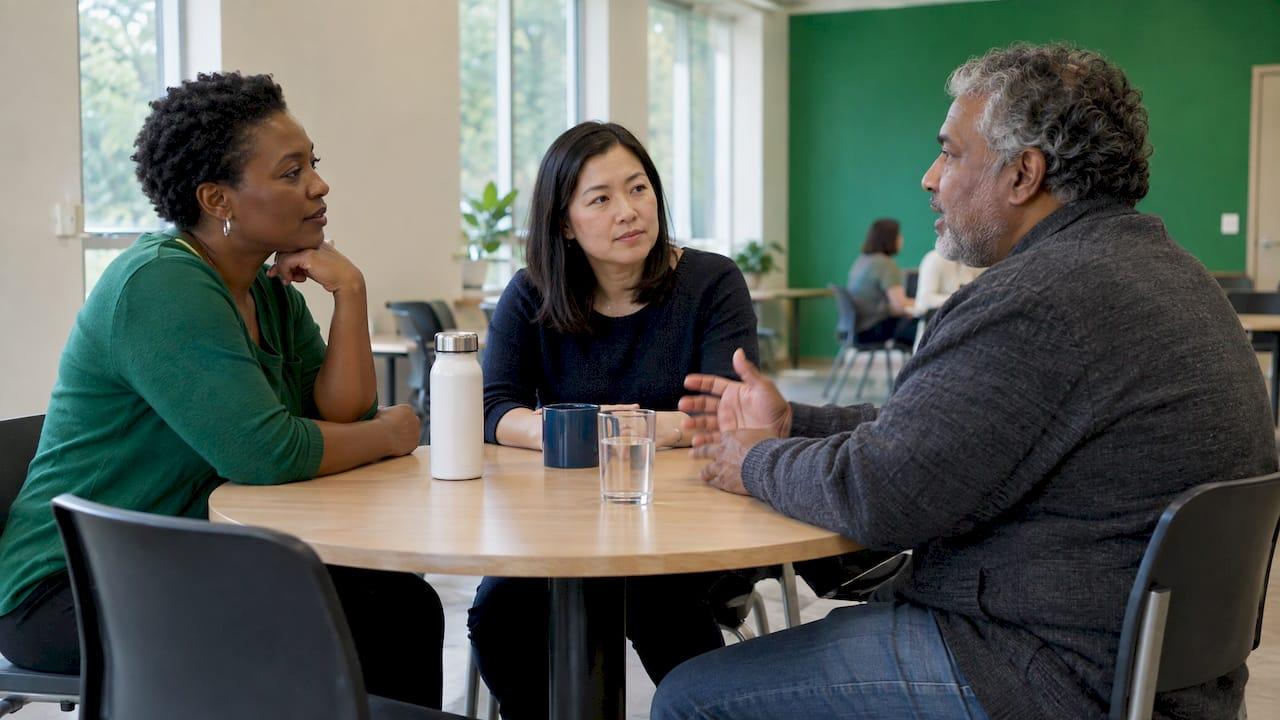
A good stakeholder engagement training outline has six modules: context and purpose, stakeholder mapping, engagement methods and sequence, facilitation and listening skills, linking engagement to ESG reporting and risk, and evaluation. It runs best as one to three days, with every module ending in a practice activity and a scored check. The outline below is built for sustainability officers, risk managers, finance and audit professionals and assurance practitioners who need engagement to produce evidence they can defend, not just meeting notes.
It is drawn from published training designs and workshop manuals, and it shows timings, activities and the points where sessions usually go wrong.
TL;DR
- Build the training around six modules, each ending in a practice activity: purpose, mapping, methods, facilitation skills, ESG and risk linkage, evaluation.
- Plan one to three days for the full course. A half-day dialogue workshop, a 2.5-hour internal session and a 1.5-day skills training are all proven formats.
- Keep groups small: 12 to 15 for skills training, 20 to 60 for a multi-stakeholder workshop.
- Assess learning with a scored task and an end-of-session evaluation, then judge engagement quality against what you said you would do.
- Match the depth to the role: board members need a short governance session, while reporting and assurance teams need the full outline.
Table of Contents
- What a stakeholder engagement training must achieve
- The six-module outline at a glance
- Module 1: Context and purpose
- Module 2: Stakeholder mapping
- Module 3: Methods and engagement sequence
- Module 4: Facilitation and listening skills
- Module 5: Linking engagement to ESG reporting and risk
- Module 6: Evaluation and follow-up
- Workshop agenda options
- Practice activities that work
- How to assess whether participants learned
- Where formal training fits
- Our perspective
- FAQ
- Sources
What a stakeholder engagement training must achieve
Start from outcomes, not topics. The UNESCAP and IAP2 three-day training on stakeholder engagement for the 2030 Agenda states that participants will be able to design an engagement process and plan, carry out stakeholder mapping and analysis, choose engagement methods for the right purpose, evaluate the quality of engagement, understand facilitation, and find ways to strengthen institutional support.
For an ESG audience that translates into four practical results:
- Participants can explain why they are engaging, and what decision the input will inform.
- They can show who was included, who was left out, and why.
- They can run a session that produces usable input rather than a list of opinions.
- They can record what was heard and what changed as a result, in a form a reviewer or assurance provider can follow.
Write these as learning objectives at the top of the outline. Every module and activity below should trace back to at least one of them. If an activity cannot, cut it.
The six-module outline at a glance
The table gives a full-course version of about two days. Shorten it by combining modules 3 and 4, or by turning module 5 into a role-specific breakout.
| Module | Focus | Suggested time | Practice activity |
|---|---|---|---|
| 1. Context and purpose | Why engage, scope, mandate, decision to be informed | 60 to 90 minutes | Write a one-sentence purpose and a list of decisions the input will affect |
| 2. Stakeholder mapping | Identify, prioritize, map relationships | 90 minutes | Brainstorm, rank and map stakeholders for a real company case |
| 3. Methods and sequence | Match methods to purpose and level of engagement | 90 minutes | Design a three-step engagement sequence |
| 4. Facilitation and listening | Run sessions, handle conflict, build agreement | 2 hours | Role-play of a contested dialogue |
| 5. ESG reporting and risk linkage | Turn input into material topics, risk registers and evidence | 2 hours | Trace one stakeholder concern to a disclosure or risk entry |
| 6. Evaluation and follow-up | Measure quality, close the loop | 60 to 90 minutes | Draft an evaluation plan and a feedback round |
Module 1: Context and purpose
The most common failure in engagement is starting with the method. The UNESCAP design platform begins with understanding context, scoping the project, understanding people, setting purpose and securing leadership commitment, in that order. Teach participants to settle purpose and scope before anyone is invited.
What to cover:
- The decision the engagement informs: a materiality assessment, a transition plan, a climate risk review, a disclosure.
- Who owns the process and who has the mandate to act on what is heard.
- The level of engagement promised, from informing and consulting up to collaborating. Promising collaboration when the company will only consult creates distrust that is hard to repair.
- A risk view of the engagement itself. The 2024 Stakeholder Engagement Toolkit from the King Abdulaziz Foundation advises aligning an engagement risk framework with the organization's risk management approach, researching stakeholder profiles and potential for conflict, defining desired outcomes first, and preparing contingency plans.
For the planning document that this module feeds, see our guide on how to build a stakeholder engagement plan.
Module 2: Stakeholder mapping
Mapping is the module participants remember, so make it hands-on. The Mental Health Europe co-creation toolkit, which recommends training groups of 12 to 15 people with no more than five per group-work table, describes a three-step mapping process:
- Brainstorm every stakeholder you can name.
- Prioritize them by readiness, influence and importance, using a six-level scale: Unaware, Awareness, Understanding, Support and Buy-in, Commitment and Action, Ownership and Lead.
- Map the relationships between stakeholders to reveal connections, missing synergies and difficult dynamics.
The third step is the one most teams skip. A map of who influences whom often shows that the quietest group is the one the loudest group listens to.
The University of California's facilitation workbook for collaborative adaptive management includes a module whose objectives are to identify the levels of stakeholders and their needs and to take part in a stakeholder analysis activity. Use the same pattern: define the levels, then analyze a real case.
Teach two ESG-specific additions. First, include groups affected by the company's impacts, not only those who affect the company: workers in the supply chain, local communities, and investors and lenders alike. Second, record the reason each group is in or out, because that record is what a reviewer will ask for. Our step-by-step stakeholder mapping guide can serve as the participant handout.
Module 3: Methods and engagement sequence
Participants need a menu of methods and a rule for choosing among them. Biodiversa's Stakeholder Engagement Handbook groups facilitation techniques into three families, and the grouping is useful as a teaching frame as it follows the natural order of a session:
- Opening up dialogue: brainstorming, metaplan, carousel listing.
- Exploring issues in depth: mind-mapping, SWOT analysis, timelines.
- Closing down options: ranking and prioritization.
The same handbook also describes participatory mapping, which explores how different stakeholder groups see connections between people and places. That is a strong fit for site-based topics such as a facility closure, a land-use question or a nature-related disclosure.
Then teach sequencing. The UNESCAP platform places "define the engagement sequence" before "select methods", because a single workshop rarely does everything. A typical sequence for a materiality refresh might be a survey to widen reach, interviews with key groups, and a workshop to test and rank findings.
In the practice activity, give each small group a purpose, a stakeholder group and a constraint (limited time, a sensitive topic, low trust) and ask them to design three steps and justify each method.
Module 4: Facilitation and listening skills
Skills are where training earns its fee. Colorado's collaborative facilitation framework names five competencies: planning and guiding the process, brokering communication, building agreement, managing conflict and transferring capability. The same framework lists the micro-skills to practice, including validating listening, uncovering the reasoning beneath an assertion, reading body language, highlighting areas of agreement, separating issues from interests and positions, and negotiating small agreements.
The distinction between issues, interests and positions deserves its own ten minutes. A supplier who "refuses" a data request (position) may be worried about commercial confidentiality (interest). A facilitator who hears the interest can offer aggregation or a confidentiality agreement, and the request becomes possible.
Suggested structure for the two hours:
- 20 minutes: short input on the five competencies.
- 30 minutes: paired listening drills, where one person states a position and the other uncovers the interest beneath it.
- 60 minutes: a role-play of a contested dialogue with an observer using a feedback sheet.
- 10 minutes: debrief on what moved the group toward agreement.
Role-play works best with a fictional case. The Dutch Social and Economic Council's half-day workshop manual uses fictional cases for both the preparation and the implementation segments, which keeps participants from defending a real company's position and lets them focus on technique.
Group preparation also matters before any face-to-face outreach. The principle that people should be briefed on purpose, norms and roles before they meet the public is covered well in material on preparing a group for outreach training, and it applies equally to a corporate team heading into a community consultation.

Module 5: Linking engagement to ESG reporting and risk
This module is what separates an ESG engagement course from a generic stakeholder management course. Participants should leave able to show how what they heard shaped something that is reported, managed or assured.
Cover these links:
- Materiality: how stakeholder input feeds the identification of topics, and how the reporting framework in use (ISSB, ESRS or GRI) treats stakeholder views. Participants should check the current text of their framework rather than rely on summaries.
- Risk: how a concern from a community or customer group becomes an entry in the enterprise risk register, with an owner and a response. Climate-related concerns can be tested further through climate scenario analysis.
- Transition and closure: how affected workers and communities are brought into plans early. Our article on just transition planning shows the approach.
- Investor dialogue: how asset owners and managers fold engagement outcomes into stewardship and risk, covered in our piece on embedding investor ESG in ERM.
- Evidence: what an assurance practitioner needs to see: the attendee list, the method, the record of input, and the response. Participants preparing for assurance work can read our comparison of ISAE 3000 and ISAE 3410.
The practice activity is a trace exercise. Give each group one stakeholder concern and ask them to follow it to a specific destination: a material topic, a risk entry, a target or a disclosure. If the trace breaks, the group writes down where the process failed.
Module 6: Evaluation and follow-up
Teach evaluation as part of design, not an afterthought. The Mental Health Europe guidance says the evaluation plan should be co-created, use methods suited to the informants (feedback forms, group discussions, surveys, interviews), collect feedback before, during and after, and report against three questions: are we doing what we said we would do, have we made a difference, and were these the right things to do?
Those three questions make a clean closing framework for the course. They map to process integrity, outcomes and relevance, and they give an assurance provider something concrete to test.
For follow-up, the Gold Standard stakeholder consultation guideline is specific about the end of a meeting: stakeholders are invited to complete an evaluation form, the follow-up action plan is explained, attendees are told how comments are recorded and where to find minutes and actions, and a feedback round is announced before closing. Teach participants to build those four steps into every session.
Workshop agenda options
Many readers searching for an outline want the agenda for a single stakeholder workshop, not a whole course. Three published formats cover the common cases.
Half-day dialogue workshop (about 3.5 hours)
The SER manual structures a half-day workshop as follows:
| Segment | Minutes |
|---|---|
| Welcome | 30 |
| Run-up to dialogue: motivation, internal preparation, identifying stakeholders | 50 |
| Preparation, using a fictional case | 50 |
| Implementation, through role-play of a fictional case | 50 |
| Follow-up and evaluation of the dialogue | 15 |
| Wrap-up | 15 |
This is the best fit for a training day, because it teaches the process by doing it.
Internal stakeholder session (2.5 hours)
The Pathways Resources internal engagement toolkit offers a sample agenda: a 10-minute welcome from a senior leader, two hours of dialogue in breakout groups of 10 to 12 with ground rules and a discussion framework, and 20 minutes on next steps and follow-up. It also advises choosing between single-group sessions, for depth on one group, and multi-stakeholder sessions, and using key connectors to reach beyond the usual voices. A visible senior opening is useful for employee and board-level sessions.
Multi-stakeholder consultation workshop
The Health COMpass guide sets out a 13-step process that runs from setting the goal and objectives through identifying stakeholders and gatekeepers, inviting participants, opening with purpose and norms, validating findings, and gathering input through varied techniques and pre-selected small groups. It recommends 20 to 60 participants to support meaningful participation and diversity.
Preparation rules that apply to all three
Biodiversa's handbook says successful workshops depend on good preparation and effective facilitation. Its practical advice is to write an event plan with timings for each agenda item, name a timekeeper, tailor techniques to participants' interests, move from opening out to exploring to deciding, include buffer time that can be cut, and list the equipment each activity needs. Teach these as a one-page checklist.
Practice activities that work
The FHI 360 toolkit session plan gives a good model of how to mix activities. Its objectives include identifying the factors that affect engagement (political, cultural, religious, economic and transport), and its tools include an Agree/Disagree activity to surface perceptions, group norm setting, role plays to build capacity, stakeholder identification sheets, and a wrap-up evaluation where participants vote with green and red dots on the most and least useful activities.
Use these formats in the ESG context:
- Agree/Disagree line: statements such as "Our suppliers see sustainability data requests as a burden." Participants move to a side and explain. It surfaces assumptions before mapping starts.
- Mapping on a wall: sticky notes on a readiness scale, with string showing relationships.
- Silent ranking: each person ranks topics individually, then the group compares. This shows how quickly consensus forms and whether quiet voices were heard.
- Concern trace: the module 5 exercise, tied to a disclosure or risk entry.
- Dot-vote debrief: a fast way to collect evaluation data and a model for participants to reuse.
Before finalizing the content, check what your audience already knows. Our ESG training needs analysis guide shows how to set module depth by role, and the ESG training budget guide helps you size and defend the spend.
How to assess whether participants learned
Two levels of assessment are needed: did participants learn, and does their engagement work?
Learning. Score each module's practice activity against a short rubric: purpose stated with a decision attached, map includes affected groups, method matches purpose, facilitation shows interest-finding, trace reaches a documented destination, evaluation plan answers the three questions. Set a pass threshold in advance. Participation alone does not show competence.
Practice. Three to six months after the course, ask participants to bring a real engagement file. Check it against the same rubric. Use the three evaluation questions to test whether it did what it promised, made a difference and was the right thing to do.
Session feedback. Use the evaluation form and dot-vote methods above to improve the course itself.
Where formal training fits
An outline gets a team started, but ESG engagement rests on standards that change, and the evidence it produces will be tested against them. Our programs are mapped to the international standards including ISSB, ESRS, GRI and ISSA 5000, with server-validated assessments and verifiable CPD, and credentials are designed to meet real pass thresholds, not just participation.
For teams building this capacity, the Certificate in ESG Governance is $199 one-off, the Executive Program in ESG Leadership suits senior leaders, and the short ESG Governance for Boards module is $49 one-off. Reporting teams can add Mastering IFRS S1 & S2 Sustainability Reporting at $129 one-off, and teams that want everything under one subscription can take the All-Access CPD Pass at $599 per year. See the full list on the CPD page.
For certification pathways in reporting, assurance, climate risk, carbon accounting and sustainable finance, browse the full ESG Training Institute catalog.
Our perspective
Stakeholder engagement is where ESG reporting is won or lost. A disclosure can follow the standard to the letter and still fail if no one can show who was heard and what changed because of it.
That is why we teach engagement as a chain of evidence: purpose, mapping, method, record, response. Each link must be something an assurance practitioner or a board member can inspect. Our certifications are mapped to ISSB, ESRS, GRI and ISSA 5000 for this reason, and our credentials are built on real pass thresholds so that a certificate means a competence was demonstrated.
Sustainability officers, risk managers, finance and audit professionals and assurance practitioners all touch this chain at different points. Training them together, against the same standards, gives an organization one shared language for engagement. That is the foundation of credible, decision-useful disclosure.
Ransford
FAQ
How long should a stakeholder engagement training be?
It depends on the audience. A skills training with 12 to 15 participants is ideally 1.5 days according to Mental Health Europe's toolkit, while the UNESCAP and IAP2 course runs three days. A focused dialogue workshop can fit in half a day, and a senior-leader session in about 2.5 hours.
What is the difference between a stakeholder engagement training and a stakeholder engagement workshop?
Training builds the skills of the people who will run engagement: mapping, method choice, facilitation and evaluation. A workshop is one engagement event with stakeholders to gather input or build agreement. A good training course includes a simulated workshop so participants practice both.
How many people should attend?
For skills training, 12 to 15 participants with no more than five per work group keeps practice meaningful. For a multi-stakeholder consultation workshop, the Health COMpass guide recommends 20 to 60 participants.
How do you measure whether stakeholder engagement worked?
Track three questions: did you do what you said you would do, did it make a difference, and were they the right things to do? Collect feedback before, during and after, and keep a record of what was heard and how the organization responded.
Sources
- UNESCAP and IAP2: Effective Stakeholder Engagement for the 2030 Agenda
- King Abdulaziz Foundation: Stakeholder Engagement Toolkit 2024
- Mental Health Europe: Co-Creation Toolkit
- University of California ANR: Facilitation Skills for Collaborative Adaptive Management
- Biodiversa: Stakeholder Engagement Handbook
- Colorado SMP: Effective Facilitation Skills
- SER: Workshop manual on engaging in dialogue with stakeholders
- Gold Standard: Stakeholder consultation and engagement guideline
- Pathways Resources: Internal Stakeholder Engagement Workshop Toolkit
- The Health COMpass: How to Conduct a Stakeholder Workshop
- FHI 360: Stakeholder engagement toolkit session plan
- Homeless Outreach Training: How to Prepare Your Group